



You Probably Have $78,000 Sitting in Your House. Touching It Is Either Smart or a Trap.


 FACT-CHECKEDFACT-CHECKED
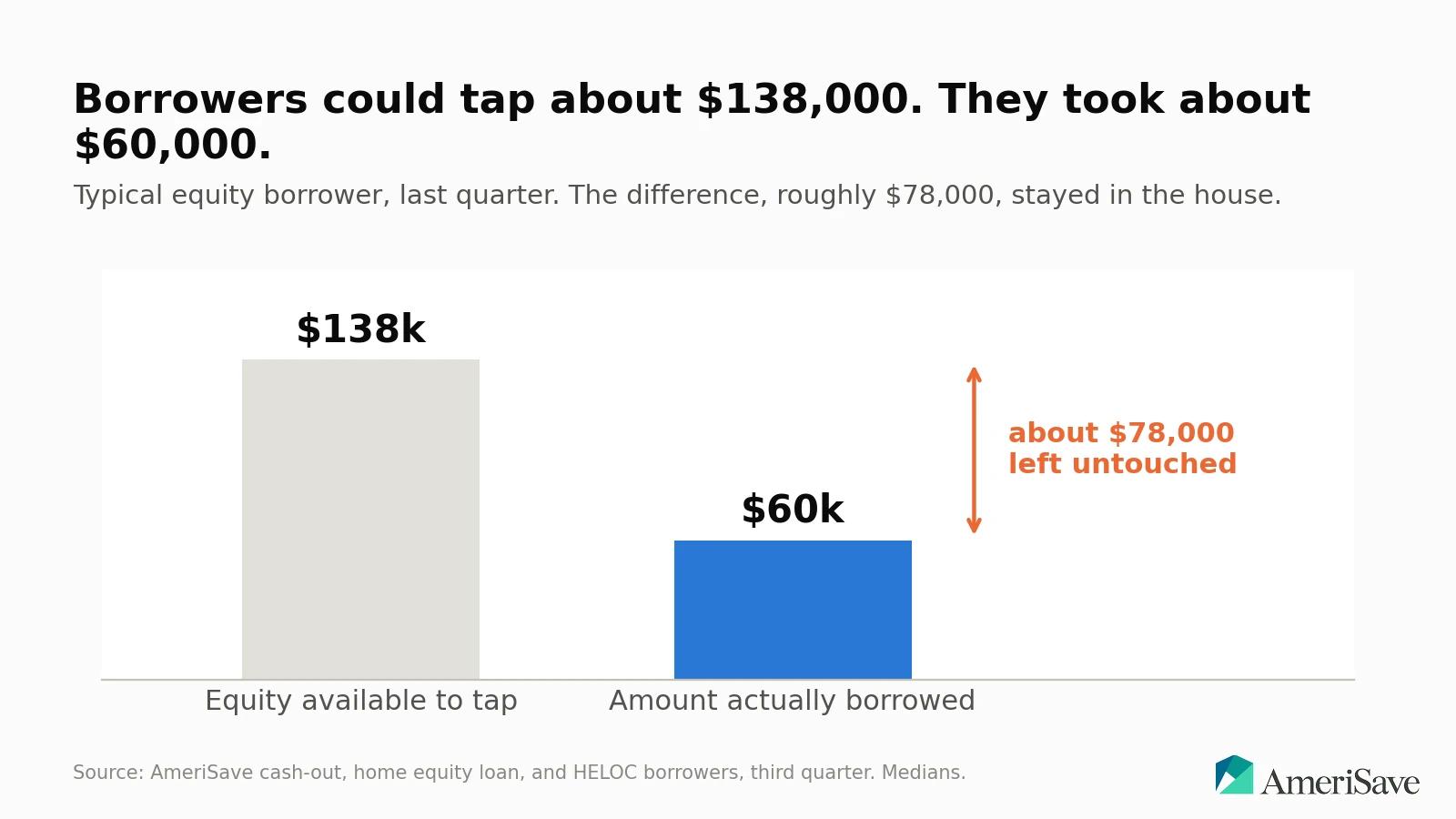
Most homeowners think the question is whether to borrow against the house at all. AmeriSave's funded loans say the real question is how much and how: last quarter the typical equity borrower could have tapped about $138,000 and took about $60,000, leaving roughly $78,000 untouched. That restraint is good; the only trap is borrowing on the wrong product.
Key Takeaways
- The typical equity borrower could have tapped about $138,000 last quarter and withdrew about $60,000, less than half.
- Borrowers ended the loan near 60% of their home's value, keeping a cushion of more than a third.
- HELOCs went from under a tenth of equity borrowing to nearly a quarter in a year, so product choice matters more.
- Match the product to the question: a known number, an idea without a number, or the whole balance sheet.
- Compare money borrowed with money repaid over the time you'll hold the debt, not the headline rate.


How Much Equity Can I Take Out of My House?
Usually more than you'd guess, and the data says most people don't take all of it. Tappable equity is what you could borrow while keeping 20% of the home's value untouched. Last quarter, the typical borrower who tapped equity in the data had about $138,000 of it available and withdrew about $60,000, counting cash in hand plus debts paid at closing. That's 44% of what was available. The gap, roughly $78,000, stayed in the house. Figure 1 shows the two numbers.
The typical home in the data was worth about $382,000, and borrowers ended with total debt on the home near 60% of its value. That's a cushion of more than a third, which is the discipline I'd want to see from the processing side of any file.
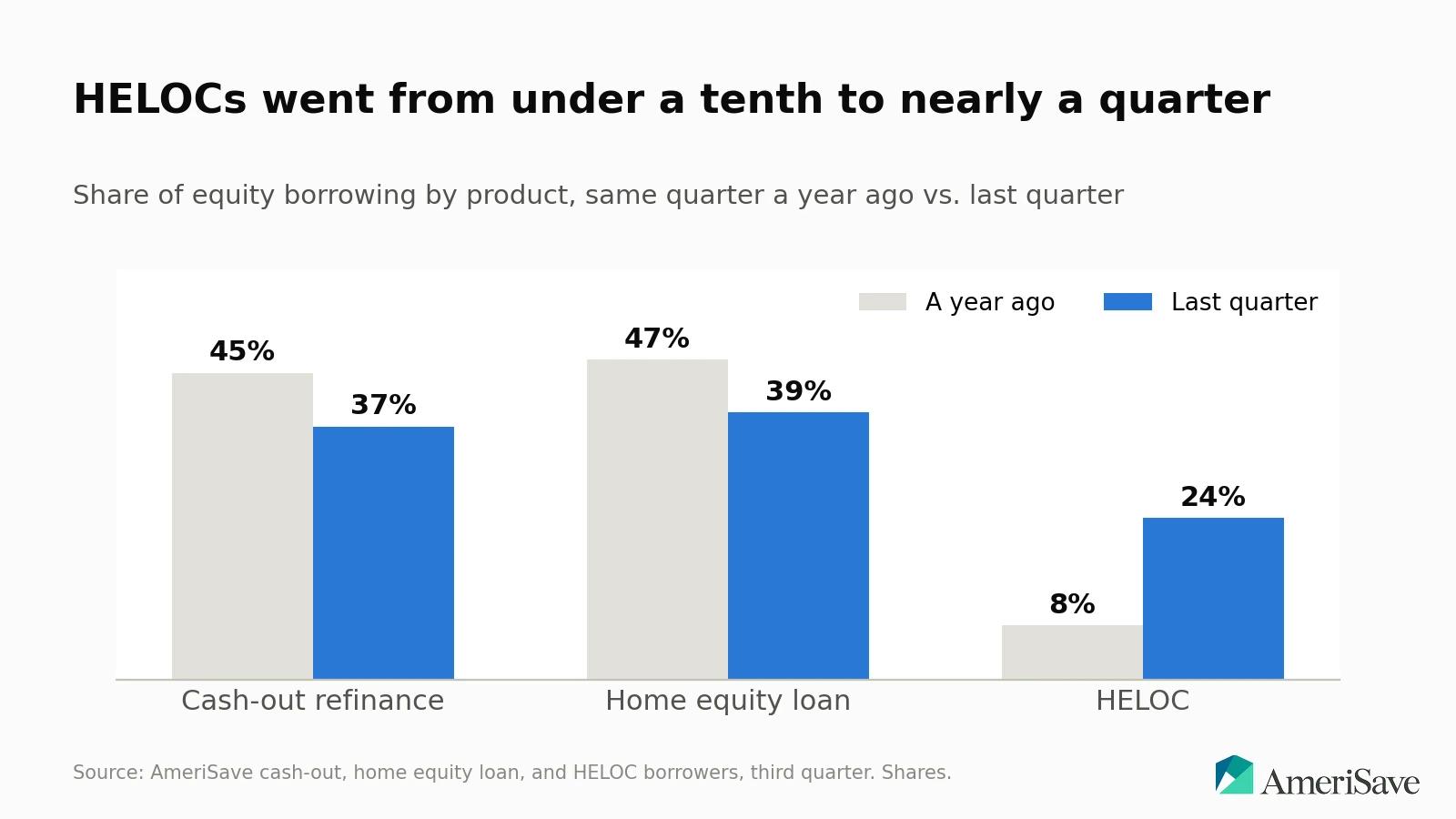
Here is where it gets interesting. A year ago, home equity lines of credit were under a tenth of equity borrowing. Last quarter they were nearly a quarter. Part of that shift is which products lenders, including AmeriSave, offered and priced over the year, so treat it as a market signal with that limit. But the HELOC borrowers themselves changed too. The average debt on the home after a HELOC rose from about 42% of value a year ago to about 58% now, and the equity left after a HELOC fell from about $145,000 to about $107,000. More homeowners are using the line, and they are using more of it, which makes matching the product to the job matter more than it did a year ago. Figure 2 shows the product mix a year ago against last quarter, and Table 1 shows how HELOC borrowers changed.
| HELOC measure | A year ago | Last quarter |
|---|---|---|
| HELOC share of equity borrowing | 8.0% | 23.7% |
| Average debt on the home after a HELOC, as a share of value | 42.4% | 58.4% |
| Average equity left after a HELOC | about $145,000 | about $107,000 |

The Homeowner With a Low Rate and a Big Idea
Picture a homeowner with a home worth about $380,000, a first mortgage at a low rate, and a kitchen and roof that both need doing. They have two bids in hand, so they have a number. A fixed home equity loan sized to that number gives them one payment that never changes, and the first mortgage stays exactly where it is. That's the smart version, and it's the most common one in the data.
Now picture the same homeowner without bids, drawing on a HELOC in stages for a project that keeps growing. The line works as designed, but a line with no number attached invites more borrowing than the plan called for, and a variable payment has to be planned at a higher rate than today's. Measured the way I insist on measuring, money borrowed against money repaid over the life of the debt, the first homeowner usually comes out ahead, and the difference is the product choice, not the decision to borrow.
That's the whole point. Borrowing against the house is a normal, sound move for a homeowner with a purpose and a cushion, and the data shows most borrowers keep a large one. The product has to match the question.
So ask one question first: do I have a number? A roof bid and a kitchen bid add up to a known cost, and a known cost is a home equity loan, fixed payment, done. An idea without a number yet, a renovation in stages or a reserve for a business, is a HELOC, drawn as needed, with a plan that survives a higher payment. Several debts plus a first mortgage that's no longer favorable is a restructuring of the whole balance sheet, which is a cash-out refinance. In Texas, state law pushes most borrowers to that third door regardless.
Table 2 compares the three products last quarter. Cash-out borrowers have the lowest-value homes and pull the most; the other two have higher-value homes and smaller withdrawals.
| Product | Typical withdrawal | Typical cash to borrower | Typical home value | Average debt on home after the loan | Paid off debt at closing |
|---|---|---|---|---|---|
| Cash-out refinance | $67,922 | $31,285 | $315,000 | 58.8% | 81.1% |
| Home equity loan | $56,692 | $25,822 | $435,711 | 63.1% | 73.8% |
| HELOC | $55,466 | $29,634 | $402,202 | 58.4% | 71.6% |

Run the Numbers on the Typical House
Here is the arithmetic behind the $78,000, using the house in the middle of the data. The typical equity borrower's home was worth $382,430. 80% of that is $305,944, the ceiling most lenders use for total debt on the home. The typical tappable equity was $137,793, which means the loans already on the house came to about $168,150. Table 3 walks it through.
| Step | Typical borrower |
|---|---|
| Home value | $382,430 |
| Lender ceiling at 80% of value | $305,944 |
| Loans already on the home | about $168,150 |
| Room to borrow (tappable equity) | $137,793 |
| Amount actually borrowed | $60,014 |
| Total debt on the home after the loan | about $228,165, or 59.7% of value |
| Room left untouched | about $77,800 |
Do the same four lines for your own house: a realistic value, times 0.8, minus every loan on it. That's your room. The data says the typical borrower uses less than half of it and ends near 60% of value, which leaves a cushion if prices soften and keeps the next decision open.
Then match the number to the product, using the typical amounts borrowers chose last quarter. A roof and a kitchen with bids in hand came to about $56,700 for the typical home equity loan borrower: one fixed payment, closed in about 17 days. A project in stages ran about $55,500 on the typical HELOC, drawn as needed, closed in about 18 days, with the payment planned at a higher rate than today's. A full restructuring ran about $67,900 on the typical cash-out refinance, about $31,300 of it as cash and the rest paying off other debts, in one payment that replaced the first mortgage. Same house, three different questions, three different right answers.
What to Check Tonight
Check your tappable equity. Take a realistic value for the home, multiply by 0.8, and subtract every loan on it. That's roughly what a lender could let you borrow. The data says the typical borrower uses less than half of it, and that's a reasonable place to start.
Check whether you have a number. If you do, price a fixed home equity loan for that number and nothing more. If you don't, be honest that a HELOC is a line you'll draw on, and run the payment at a higher rate than today's before you sign.
Check the first mortgage with real arithmetic. Add up what you'd repay over the years you expect to hold each option, including closing costs, and compare the totals. The low rate you're protecting sits on a balance that shrinks every month. Sometimes it's worth protecting. Sometimes it isn't, and the data says a meaningful number of HELOC borrowers never ran that comparison.
The full report, Equity Borrowers Took Out a Median $60,000 Last Quarter, Less Than Half of What They Could Have Tapped, has the product and metro detail.
Methodology
The figures come from AmeriSave cash-out refinances, home equity loans, and HELOCs funded in the third quarter. Tappable equity is the amount a homeowner could borrow while keeping 20% equity, using the valuation on the loan and the liens on the credit report; withdrawal is cash to the borrower plus debt paid at closing. The $78,000 figure is the difference between the median tappable equity and the median withdrawal, not a median of individual gaps. Combined loan-to-value counts a HELOC's full line. Days to close are median calendar days from application to closing, by product, for the same quarter. Data through October 29.
The Bottom Line
You probably have more borrowing room in your house than you think, and the typical borrower leaves most of it alone, which is sound. Touching the equity is not the trap; choosing a product that doesn’t match the job is, and that's easy to avoid. Decide whether you have a number before you decide on a loan, run money borrowed against money repaid, and compare all three options on your own equity. AmeriSave's HELOC, home equity loan, and cash-out refinance are the three doors; the one you walk through should match the question you're actually asking.
AmeriSave internal funded-loan data, Quarterly Home Equity Report and Home Equity Use Index, cash-out refinances, home equity loans, and HELOCs funded in the third quarter, data through October 29, 2026. Internal, not publicly available.
AmeriSave, "Equity Borrowers Took Out a Median $60,000 Last Quarter, Less Than Half of What They Could Have Tapped," the full report behind this article.
Consumer Financial Protection Bureau, "What you should know about home equity lines of credit"; supports HELOC mechanics:
Consumer Financial Protection Bureau, "What is a home equity loan?"; supports product definitions:


Jon brings extensive experience in loan origination, sales leadership, and operations to AmeriSave, based in Waikiki, HI. Starting as a Loan Originator, he was promoted to Manager after 13 months and to VP eight months later, eventually managing 330 direct reports and establishing AmeriSave's Spanish lending channel. Married with three children, he specializes in transparent, technology-enabled lending that prioritizes client relationships and consumer empowerment.
Frequently Asked Questions
Usually up to the point where total debt on the home reaches about 80% of its value, which is what tappable equity measures. Take a realistic value for the house, multiply by 0.8, and subtract every loan secured by it. In AmeriSave's data last quarter, the typical equity borrower had about $138,000 available on that basis and withdrew about $60,000, ending with total debt near 60% of the home's value. Lenders also look at income, credit, and the product; a HELOC's full line counts against the limit even before you draw on it.
It depends on the arithmetic, not the rate alone. A HELOC leaves the first mortgage untouched, which protects a low rate on a balance that shrinks every month, but the line carries a variable rate and the data shows HELOC borrowers now ending with total debt near 58% of value, up from 42% a year ago. A cash-out refinance replaces the whole balance at one fixed rate and one payment. Add up what you'd repay under each option over the years you expect to hold the debt, including closing costs, and pick the smaller total. For several debts plus an unfavorable first mortgage, the refinance often wins.
Tappable equity is the amount you could borrow against your home while keeping 20% of its value as a cushion, the level most lenders use as a ceiling for total debt on the property. It's calculated from the home's current value and every lien on it, so it changes as the home appreciates and as you pay the mortgage down. It's not the same as your total equity, which is the full gap between value and debt. In AmeriSave's data, the typical equity borrower last quarter had about $138,000 tappable and used 44% of it.
When the product matches the purpose. A known cost, like a roof bid or a single card balance, fits a fixed home equity loan sized to the number. A plan in stages fits a HELOC, with the payment planned at a higher rate than today's. Several debts plus a first mortgage that's no longer favorable fit a cash-out refinance. In the data, equity borrowers ended last quarter with total debt near 60% of their home's value, a healthy cushion, and three in four used the money to restructure debt. Run money borrowed against money repaid over the time you'll hold the debt, including closing costs, on all three options and pick the smallest total.