



Equity Borrowers Took Out a Median $60,000 Last Quarter, Less Than Half of What They Could Have Tapped


 FACT-CHECKEDFACT-CHECKED
Homeowners who tapped equity through AmeriSave's funded loans last quarter took out a median $60,014 against a median $137,793 they could have borrowed, and most of them left the first mortgage alone. That restraint is healthy. The product they used to protect that first mortgage is the part worth a second look.
Key Takeaways
- Equity borrowers withdrew a median $60,014 last quarter, about 44% of the median $137,793 they could've tapped.
- Combined loan-to-value after the new loan ended near 60%, so the typical borrower left more than half of the equity in place.
- HELOCs went from under a tenth of equity borrowing to nearly a quarter in a year, and HELOC borrowers are borrowing deeper.
- Borrowers in Texas metros chose cash-out refinancing two to one over HELOCs, and the state constitution shapes that choice.


The Low-Rate Reflex Shows Up in the Numbers
A lot of homeowners think the smartest thing you can do with a low rate on your first mortgage is never touch it. I heard that belief on the phone when I was a loan originator, and I still see it in the files that cross my desk now that I run processing. Borrowers who tapped equity took out a median $60,014, less than half of the median $137,793 they could've borrowed while keeping 20% of the home's value in reserve, and the product gaining the most ground among them was the one that leaves the first mortgage untouched: the HELOC.
Keeping more than half your equity in reserve is good discipline. The product choice is where I'd push back. A growing share of borrowers took a HELOC, usually at a variable rate and usually a higher one than a fixed first mortgage carries, to protect a low rate on a balance that shrinks every month. Measured the way I insist on measuring, money borrowed against money repaid over the life of the debt, my read is that a meaningful share of them would've paid less in total with a cash-out refinance.

How Much Equity Borrowers Took Out, and How Much They Left
The median withdrawal, counting cash to the borrower plus debt paid off at the closing table, was $60,014. Median tappable equity before the loan, meaning what the homeowner could've borrowed while keeping 20% of the value in the home, was $137,793. That withdrawal works out to 44% of the tappable amount. Figure 1 shows withdrawal against tappable equity, overall and by product.
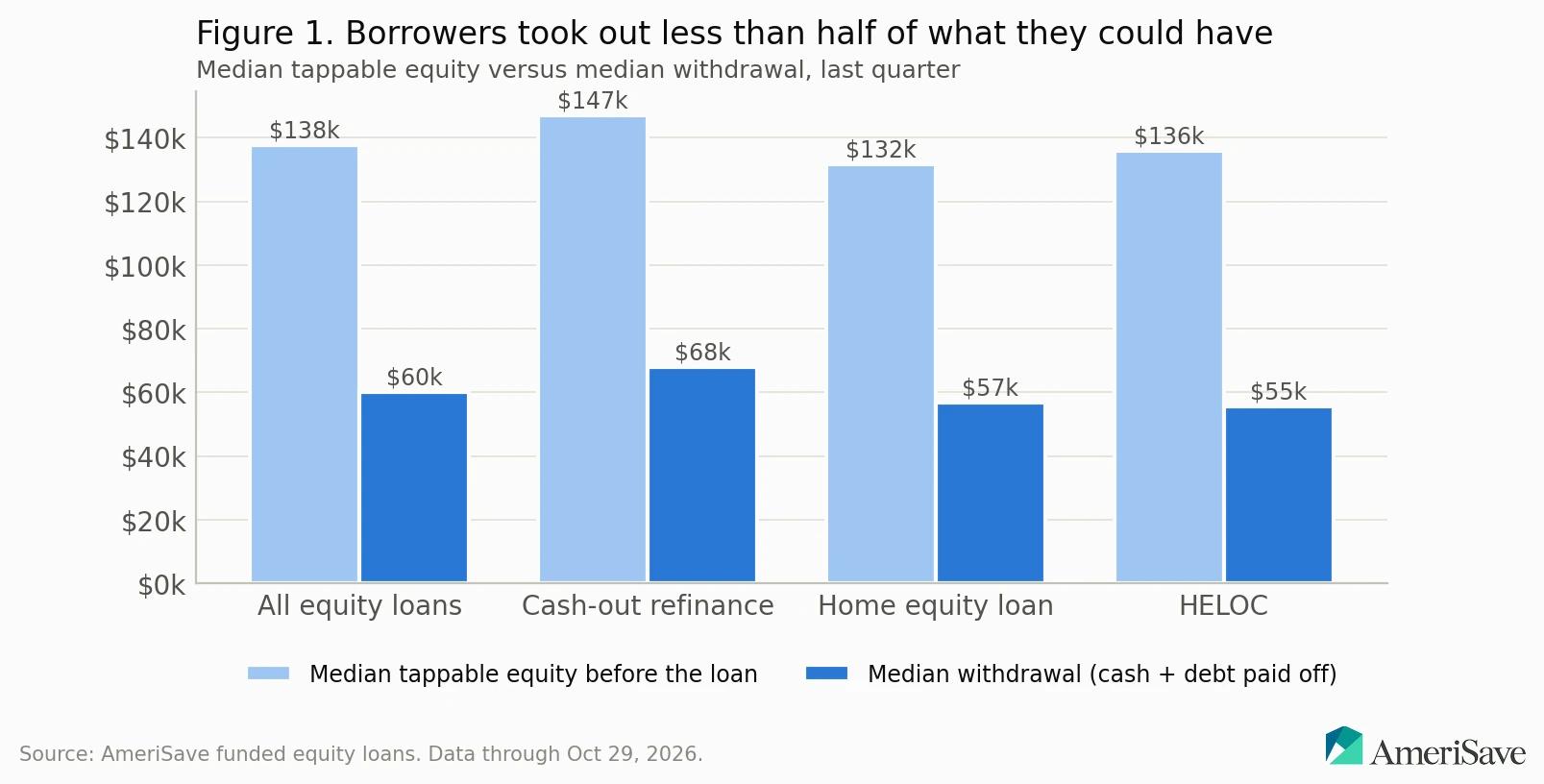
The median cash that actually reached the borrower was $28,412, so a large piece of the typical withdrawal went to paying off other debt at closing. After the new loan funded, the average borrower still had $98,400 of tappable equity left, more than half of the $180,757 average they started with. Average combined loan-to-value after the new loan ended near 60%, against a median home value of $382,430. In my years taking applications, the homeowner who worried me wanted every dollar the appraisal would support. Last quarter, that borrower was the exception.
Paying off debt at closing showed up on 81.1% of cash-out refinances, 73.8% of home equity loans, and 71.6% of HELOCs, and credit cards were the most common debt retired, on 66.8% of cash-out refinances. Cash taken with little or no debt paid off, the report's proxy for home improvement, ran 18.4%, 25.4%, and 28.1% in the same order. Most of the people in this data were cleaning up a balance sheet.
Home Equity Loan vs. HELOC vs. Cash-Out Refinance: What the Mix Says
Figure 2 tracks the product mix across five quarters, and the HELOC line is the one that moves. Last quarter, home equity loans were 39.2% of equity borrowing, cash-out refinances 37.1%, and HELOCs 23.7%. A year earlier the split was 46.9%, 45.0%, and 8.0%. HELOCs went from under a tenth of equity borrowing to nearly a quarter in a year. Part of that shift is which products lenders, including AmeriSave, offered and priced over the year, so treat it as a market signal with that limit attached.
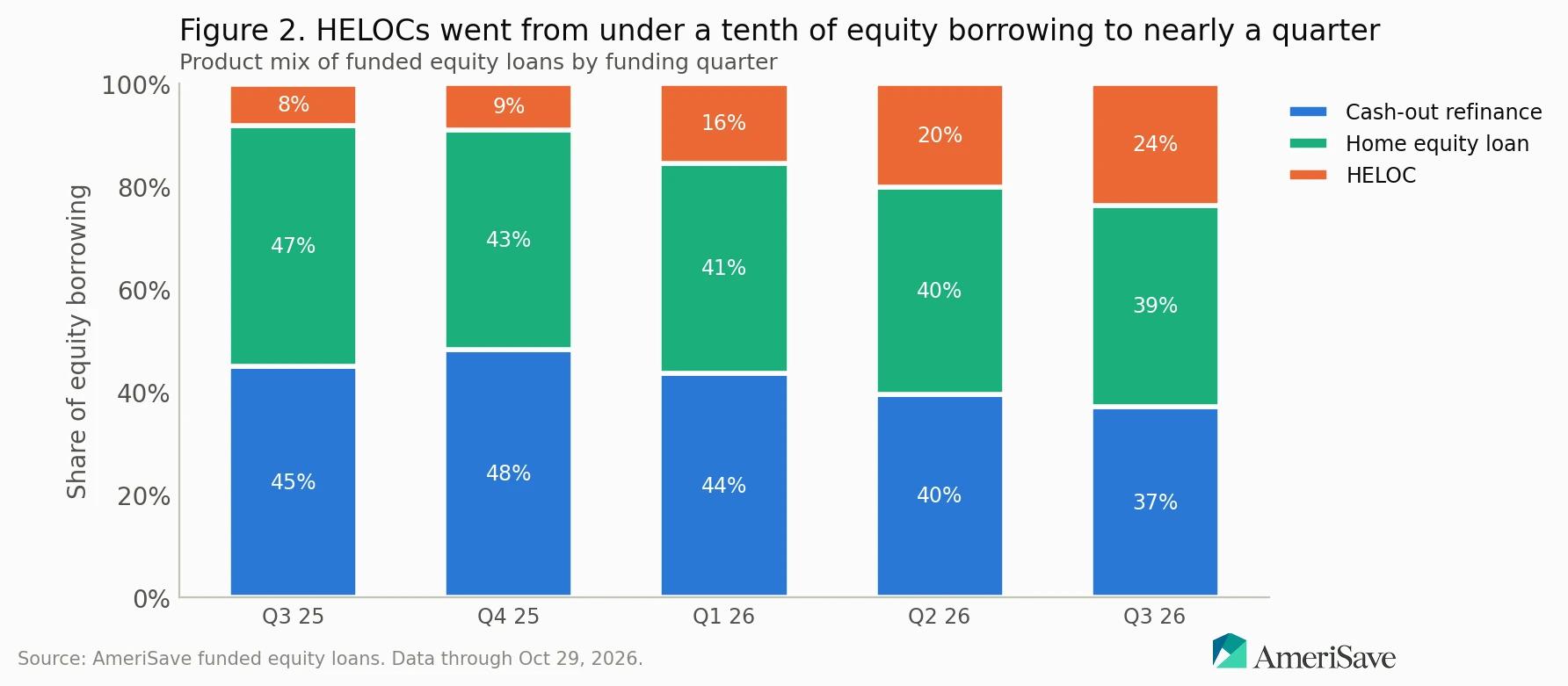
The HELOC borrowers changed too. A year ago, the average combined loan-to-value on a HELOC was 42.4%. Last quarter it was 58.4%. Average tappable equity left after a HELOC funded fell from about $145,000 to about $107,000 over the same period. People are choosing HELOCs more often and borrowing deeper on them, at a rate that can move. The by-product table below puts the three side by side.
| Product | Median withdrawal | Median cash to borrower | Median home value | Average CLTV after loan |
|---|---|---|---|---|
| Cash-out refinance | $67,922 | $31,285 | $315,000 | 58.8% |
| Home equity loan | $56,692 | $25,822 | $435,711 | 63.1% |
| HELOC | $55,466 | $29,634 | $402,202 | 58.4% |
One pattern in that table has held in every quarter I've watched. Cash-out borrowers have the lowest-value homes and pull the most money. HELOC and home equity loan borrowers own higher-value homes and take smaller withdrawals.
Is a HELOC or a Cash-Out Refinance Better When You Have a Low Mortgage Rate?
The simple version of the framework I've used with borrowers for years goes like this. A known cost with a known number, a roof bid, a tuition bill, a single card balance you're done carrying, calls for a home equity loan: fixed rate, fixed payment. An idea without a number yet, a renovation you'll do in stages or a reserve for a business, calls for a HELOC: you draw as you go and pay interest on what you've drawn. A restructuring of the whole balance sheet, several debts, a first mortgage that's no longer favorable, or a Texas borrower working inside the rules below, calls for a cash-out refinance: one payment on the whole balance.
The fuller picture turns on one question: has the money already been spent? If the contractors are hired and the cards are maxed, you're committing to amortize that balance no matter which product you pick, and a variable-rate line that runs higher than a fixed first mortgage is an expensive place to park a balance you've already decided to pay down over years. If the money hasn't been spent and the plan is still an idea, the HELOC earns its place, because you only pay interest on what you actually draw.

There's an exception I teach with a specific illustration. If you owe $600,000 on your first mortgage and you need $30,000, a HELOC makes sense even if the money's already spent, because reworking a $600,000 loan to reach $30,000 of equity is rarely worth resetting the rate on the big balance. The larger the draw relative to the first mortgage, the more that math flips toward the cash-out.
The misconception I opened with comes from treating each debt as its own bucket: this is my mortgage, this is my car, these are my cards. Looked at together, the number that changes your life is the total cash leaving the house every month and the total interest you'll pay before the last payment. That's money borrowed versus money repaid. Add up every dollar you'd pay out over the time you expect to hold each option, closing costs included, and pick the smaller total that also keeps your monthly obligation from jumping.
How Much Equity Can You Borrow? Tappable Equity by Metro
Figure 3 ranks the top 15 metros by median tappable equity over the trailing four quarters, with the national median marked. Borrowers in San Jose had a median $551,266 available before their loan, and the average there was $712,879. Borrowers in San Francisco had a median $363,504, in Los Angeles $358,939, and in San Diego $334,414. Outside California, borrowers in Barnstable had a median $323,860, in Honolulu $273,910, and in Seattle $235,739. At the other end, measured by average rather than median, homeowners who tapped equity in Peoria had $80,732 available and in Fayetteville, North Carolina $90,680. Every one of those figures describes borrowers in that metro who took an equity loan, never every homeowner there.
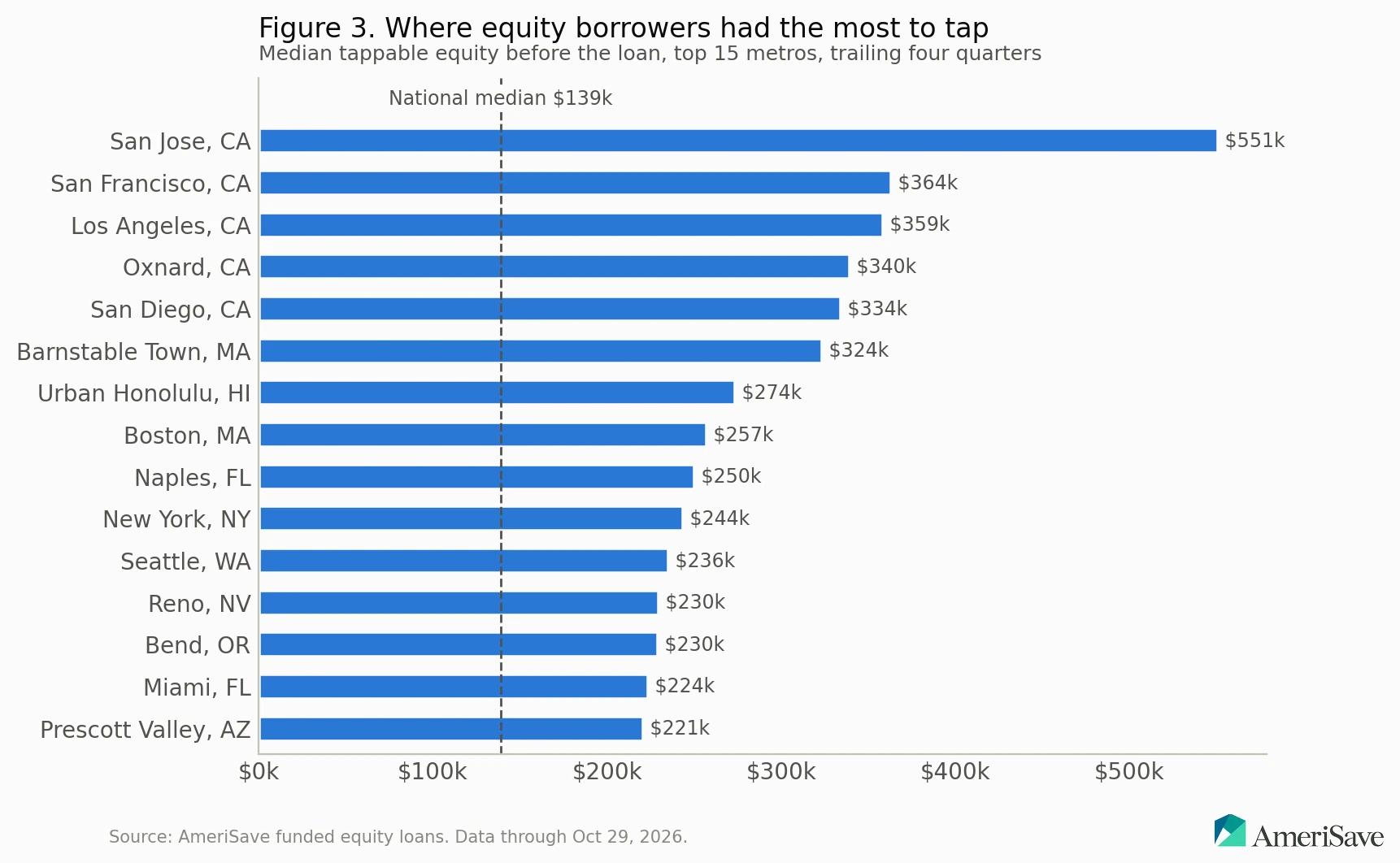
The metro table below lists the 25 metros with the highest median tappable equity, followed by the large metros that fall outside that group. Metros beyond the table are available on request.
| Metro | Median tappable equity | Average CLTV after the loan | Cash-out share | Home equity loan share | HELOC share |
|---|---|---|---|---|---|
| San Jose, CA | $551,266 | 45.5% | 27.3% | 41.8% | 30.9% |
| San Francisco, CA | $363,504 | 53.5% | 19.3% | 55.1% | 25.7% |
| Los Angeles, CA | $358,939 | 51.2% | 22.9% | 56.9% | 20.2% |
| Oxnard, CA | $339,550 | 52.9% | 13.1% | 62.3% | 24.6% |
| San Diego, CA | $334,414 | 53.8% | 18.7% | 59.6% | 21.8% |
| Barnstable Town, MA | $323,860 | 48.0% | 39.5% | 36.8% | 23.7% |
| Urban Honolulu, HI | $273,910 | 55.8% | 30.8% | 55.8% | 13.5% |
| Boston, MA | $257,462 | 55.6% | 35.9% | 47.0% | 17.1% |
| Naples, FL | $250,358 | 47.4% | 52.6% | 23.7% | 23.7% |
| New York, NY | $244,003 | 54.6% | 27.1% | 57.0% | 15.8% |
| Seattle, WA | $235,739 | 58.8% | 28.9% | 52.6% | 18.6% |
| Reno, NV | $230,012 | 55.0% | 35.6% | 49.5% | 14.9% |
| Bend, OR | $229,641 | 60.4% | 38.7% | 54.8% | 6.5% |
| Miami, FL | $223,985 | 54.5% | 38.0% | 41.9% | 20.1% |
| Prescott Valley, AZ | $221,213 | 50.1% | 46.5% | 46.5% | 7.0% |
| Hilton Head Island, SC | $219,794 | 53.8% | 45.5% | 45.5% | 9.1% |
| Portland, OR | $209,114 | 59.4% | 24.6% | 50.3% | 25.1% |
| Coeur d'Alene, ID | $208,748 | 56.8% | 28.1% | 53.1% | 18.8% |
| Portland, ME | $202,473 | 56.0% | 34.1% | 43.9% | 22.0% |
| Modesto, CA | $201,891 | 57.4% | 29.1% | 52.7% | 18.2% |
| Salt Lake City, UT | $201,051 | 57.5% | 21.4% | 59.5% | 19.0% |
| Denver, CO | $197,989 | 58.4% | 28.4% | 48.8% | 22.7% |
| Riverside, CA | $197,854 | 59.2% | 24.0% | 57.7% | 18.2% |
| Bridgeport, CT | $194,919 | 58.5% | 28.7% | 57.4% | 13.8% |
| Providence, RI | $193,276 | 57.9% | 38.5% | 45.9% | 15.6% |
| Dallas, TX | $189,378 | 60.5% | 66.4% | 22.9% | 10.7% |
| Washington, DC | $176,176 | 62.6% | 31.2% | 47.4% | 21.4% |
| Houston, TX | $160,441 | 62.0% | 67.6% | 21.9% | 10.6% |
| Tampa, FL | $155,491 | 58.1% | 34.5% | 45.6% | 19.9% |
| Phoenix, AZ | $152,332 | 60.3% | 27.3% | 48.9% | 23.8% |
| Atlanta, GA | $149,748 | 60.9% | 32.7% | 44.7% | 22.6% |
| Chicago, IL | $126,599 | 61.5% | 31.7% | 46.9% | 21.4% |
| Detroit, MI | $101,888 | 61.2% | 39.9% | 38.9% | 21.2% |
Read down the CLTV column and the pattern is clear. Borrowers in Los Angeles ended at an average combined loan-to-value of 51.2%, with an average $326,090 of tappable equity still left after the loan; borrowers in Detroit ended at 61.2% with an average $62,748 left. The share of equity borrowed doesn't vary much from metro to metro. The dollars do, because the home values do. The two Texas rows stand apart on a different axis: borrowers in Dallas and Houston chose cash-out refinancing on 66.4% and 67.6% of their equity loans, against HELOC shares near a tenth.
Why Texas Borrowers Choose Cash-Out Two to One
Figure 4 sets the cash-out and HELOC shares in Texas metros against the national split. Borrowers in Waco chose cash-out refinancing on 78.4% of their equity loans, in El Paso 70.4%, in Houston and Austin 67.6%, in Killeen 67.4%, and in Dallas 66.4%; the only non-Texas metro in that group was Fayetteville, North Carolina, at 68.1%. Across the Texas metros, cash-out runs two-thirds to three-quarters of equity borrowing, with HELOCs around a tenth.
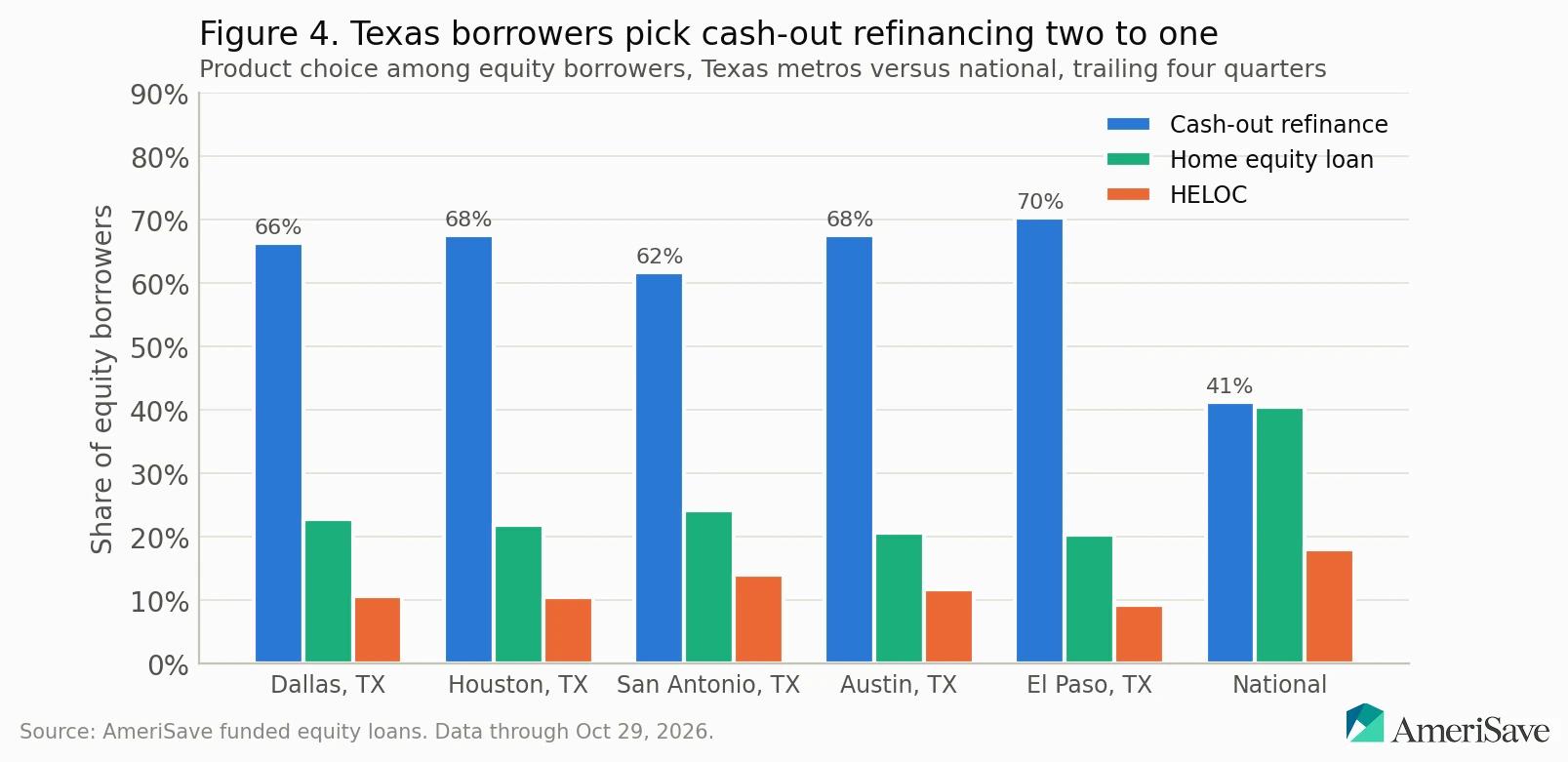
The state constitution does a lot of that choosing. I spent years working out of AmeriSave's Plano office before the move to Hawaii. Article XVI, Section 50 of the Texas Constitution sets the rules for any loan secured by a homestead's equity. Total debt secured by the home, including the new loan, can't exceed 80% of the home's fair market value on the day the loan is made. A new home equity loan can't be made until a year after any other home equity loan on the same homestead, with narrow exceptions. HELOCs carry their own restrictions in the same section: each advance has to be at least $4,000, you can't draw with a credit card or debit card, and the full credit line counts toward that 80% ceiling the day the line is opened.
Put those rules together and a Texas HELOC loses much of what makes a HELOC useful elsewhere. You can't tap a small amount for a rainy day, and the whole line sits against your borrowing cap whether you draw it or not. So borrowers who want to restructure debt do it in one move, through a cash-out refinance, roughly two to one.
Texas also showed the highest median homeowners insurance premium of any state in the data, about $2,978. If you're planning a Texas cash-out refinance, run the money borrowed versus money repaid comparison with that premium in it, because the insurance line on a Texas escrow account is part of the monthly obligation you're trying to keep from jumping.
Choosing Among the Three on Your Own Equity
I'd work the decision with your numbers instead of the medians in two steps. Start with the withdrawal size. If you need an amount that's small relative to your first mortgage, think $30,000 against $600,000, a second lien wins on cost, and the choice is a home equity loan if the number is fixed and a HELOC if the number is still open. If the amount is large relative to the first mortgage, or you're consolidating several debts into it, a cash-out refinance belongs in the running even if your current rate is low.
Next, the existing first-mortgage rate. A low rate argues for a second lien only if the second lien is small and the money isn't spent yet; the lower the rate and the larger the draw, the more carefully you should run the total-repayment math. A fixed payment on a home equity loan or a cash-out refinance protects you from payment shock in a way a variable line doesn't, and the more of the balance you expect to carry, the more that protection is worth.
If you're in Texas, add the branch above: the 80% cap, the one-year rule, and the $4,000 minimum HELOC advance apply to you. Wherever you are, the useful next step is to put your actual balance, rate, and equity into a side-by-side comparison of all three products, which is what an AmeriSave loan officer will do with you before you choose.
Methodology
Sources. The equity figures come from AmeriSave's funded-loan records: every cash-out refinance, home equity loan, and HELOC funded in the third quarter, by funding date, with purchases and rate-and-term refinances left out. Metro figures use the trailing four quarters ending with the report quarter so that more metros clear the floor. The Texas homeowners insurance figure comes from the same funded-loan records across all products this year to date. The equity data runs through October 29.
Definitions. Tappable equity before the loan is 80% of the home's value minus every mortgage and HELOC balance already on the home, never below zero, using the appraisal or valuation on the loan and the liabilities on the loan file, which come mostly from the credit report. Tappable equity left after the loan subtracts the new loan and any liens that stay in place, with a HELOC counted at its full line. Combined loan-to-value is the new loan, again counting a HELOC's full line, plus any remaining liens, divided by home value. Withdrawal is cash to the borrower plus debt paid off at closing, and cash to borrower is shown alongside it. Use cases come from what happened at closing rather than what the borrower said: debt paid off at the table, or cash taken with little or no debt paid off, which serves as the home improvement proxy.
Period. National figures describe the third quarter and are compared with the same quarter a year earlier. Metro figures cover the trailing four quarters.
Publication floor. A metro is named only with at least 30 loans in both periods, and smaller metros stay in the national totals. ZIP-level figures aren't published. Only aggregates appear here: medians, averages, and shares, never loan counts or dollar totals.
Limitations. Every metro figure describes borrowers who tapped equity in that metro, never homeowners there generally, and the national figures describe AmeriSave borrowers rather than all homeowners. Product mix reflects which products lenders offered and priced during the period as well as what borrowers chose. Averages can move on a few high-value homes, which is why medians lead and averages are labeled. The home improvement proxy is a proxy; cash taken with no debt payoff isn't confirmed renovation spending.
The Bottom Line
A lot of homeowners think a low first-mortgage rate should never be touched, and last quarter's data shows them acting on it: a median $60,014 withdrawn against $137,793 available, more than half the equity left in reserve, and HELOCs climbing to nearly a quarter of equity borrowing. The restraint is right. The reflex toward the variable-rate line to protect the fixed-rate balance is where I'd slow down. Measured as money borrowed against money repaid, a meaningful share of those HELOC borrowers would've done better with a cash-out refinance.
A known cost with a known number is a home equity loan. An idea without a number is a HELOC. A balance sheet that needs rebuilding is a cash-out refinance, and in Texas the constitution usually makes that decision for you. The option that lowers the total you repay and keeps the payment from jumping is the one that checks both of those boxes. That's usually the one that fits.
AmeriSave internal funded-loan data, Quarterly Home Equity Report and Home Equity Use Index, cash-out refinances, home equity loans, and HELOCs funded in the third quarter and the trailing four quarters, data through October 29, 2026. Internal, not publicly available.
Consumer Financial Protection Bureau, "What is a home equity line of credit (HELOC)?" supports HELOC mechanics, variable rates, and draw and repayment periods:
Consumer Financial Protection Bureau, "What is a home equity loan?" supports the fixed-rate, lump-sum home equity loan definition:
Texas Constitution, Article XVI, Section 50, supports the 80% cap, the one-year rule, and the HELOC advance rules:
Texas Legislative Council, "The Texas Constitution," full text including Article XVI, Section 50(a)(6) and 50(t):


Jon brings extensive experience in loan origination, sales leadership, and operations to AmeriSave, based in Waikiki, HI. Starting as a Loan Originator, he was promoted to Manager after 13 months and to VP eight months later, eventually managing 330 direct reports and establishing AmeriSave's Spanish lending channel. Married with three children, he specializes in transparent, technology-enabled lending that prioritizes client relationships and consumer empowerment.
Frequently Asked Questions
Tappable equity is the amount you could borrow against your home while still keeping 20% of its value as equity. In this report it's calculated from the appraisal or valuation on the loan minus every mortgage and HELOC balance already on the home, measured before the new loan. The median tappable equity among borrowers last quarter was $137,793, and the average was $180,757. The gap between those two numbers comes from high-value homes pulling the average up, which is why the report leads with the median. After their new loan funded, the average borrower still had $98,400 of tappable equity left, so most people borrowed well inside their limit.
The practical ceiling for most equity products is the 80% combined loan-to-value line, the same line this report uses to define tappable equity. If your home is worth $400,000 and you owe $200,000, that leaves roughly $120,000 you could borrow before you hit 80%. Last quarter's borrowers didn't go near it: the average combined loan-to-value after the new loan ended near 60%, and the median withdrawal was 44% of the median tappable amount. Your own figure depends on the appraisal, your credit, your income, and the product; a HELOC counts its full line against the cap even before you draw on it. In Texas, the 80% limit is constitutional.
Combined loan-to-value, or CLTV, is every loan secured by your home, including the new one, divided by the home's value. If your home is worth $400,000 and your first mortgage plus a new second lien add up to $240,000, your CLTV is 60%. It matters because it's the number lenders use to decide how much equity you can borrow and on what terms, and because it measures how much cushion you keep if values fall. Last quarter's equity borrowers ended at an average CLTV near 60%, and a HELOC counts at its full credit line, so an undrawn line still raises your CLTV.
It depends on how much you need and whether the money is already spent. If the draw is small relative to your first mortgage, say $30,000 against $600,000, a HELOC or home equity loan wins because reworking the big balance to reach a little equity rarely pays. If you're consolidating several debts or the draw is large, run the total you'd repay over the years you'll hold the debt, closing costs included, for both options. A variable-rate line carrying a balance you've already committed to pay down for years can cost more in total than a cash-out refinance, even one that replaces a low rate. The low rate is one input, never the whole answer.
No. A HELOC and a home equity loan are second liens: they sit behind your first mortgage, which keeps its balance, rate, and payment exactly as they were. You end up with two payments, the original mortgage and the new second lien. A cash-out refinance is the opposite: it pays off the existing mortgage and replaces it with a larger new loan at today's terms, leaving you with one payment. That's why borrowers with a low first-mortgage rate lean toward second liens, and why last quarter's home equity loan and HELOC borrowers owned higher-value homes and took smaller withdrawals than cash-out borrowers did.
Mostly because of the Texas Constitution. Article XVI, Section 50 caps total debt on a homestead at 80% of its value and allows only one home equity loan per year on the same home, with narrow exceptions. For HELOCs it adds a $4,000 minimum per advance, bans card-based draws, and counts the full line against the 80% cap from day one. Those rules strip out the flexibility that makes a HELOC attractive elsewhere, so borrowers in Texas metros chose cash-out refinancing on two-thirds to three-quarters of their equity loans, with HELOCs around a tenth. Texas also showed the highest median homeowners insurance premium in the data, so size the loan with that monthly cost in mind.