



2 in 3 Who Borrowed Against Their House Paid Off $16,700 in Credit Cards. One Mistake Makes It a Trap.


 FACT-CHECKEDFACT-CHECKED
Forget the kitchen remodel: AmeriSave's funded loans show that 2 in 3 people who borrowed against their home last quarter used it to pay off at least one credit card, about $16,700 each. For most of them it was the right move. The loan works; the only thing to get right is what happens to the cards afterward.
Key Takeaways
- 65.2% of equity borrowers paid off at least one credit card at closing, with a typical payoff of about $16,700.
- 76% paid off some non-mortgage debt; among them, the typical total cleared was about $34,000.
- The share paying off cards held between 62% and 67% every month this year, so this is a pattern, not a blip.
- The one way it goes wrong is refilling the cards afterward, and that's decided before closing, not after.
- Judge the move on monthly cash flow before and after, not on the rate alone.


Should I Use a Cash-Out Refinance to Pay Off Credit Card Debt?
Most people who did it last quarter were right to, and the data is unambiguous about how common it is. Of everyone who borrowed against their home through AmeriSave in the third quarter, whether by cash-out refinance, home equity loan, or HELOC, 76% paid off at least some non-mortgage debt at closing. 65.2% paid off at least one credit card, and the typical card payoff was about $16,700. Among those who paid off any debt, the typical total cleared was about $34,000. Figure 1 shows the shares.
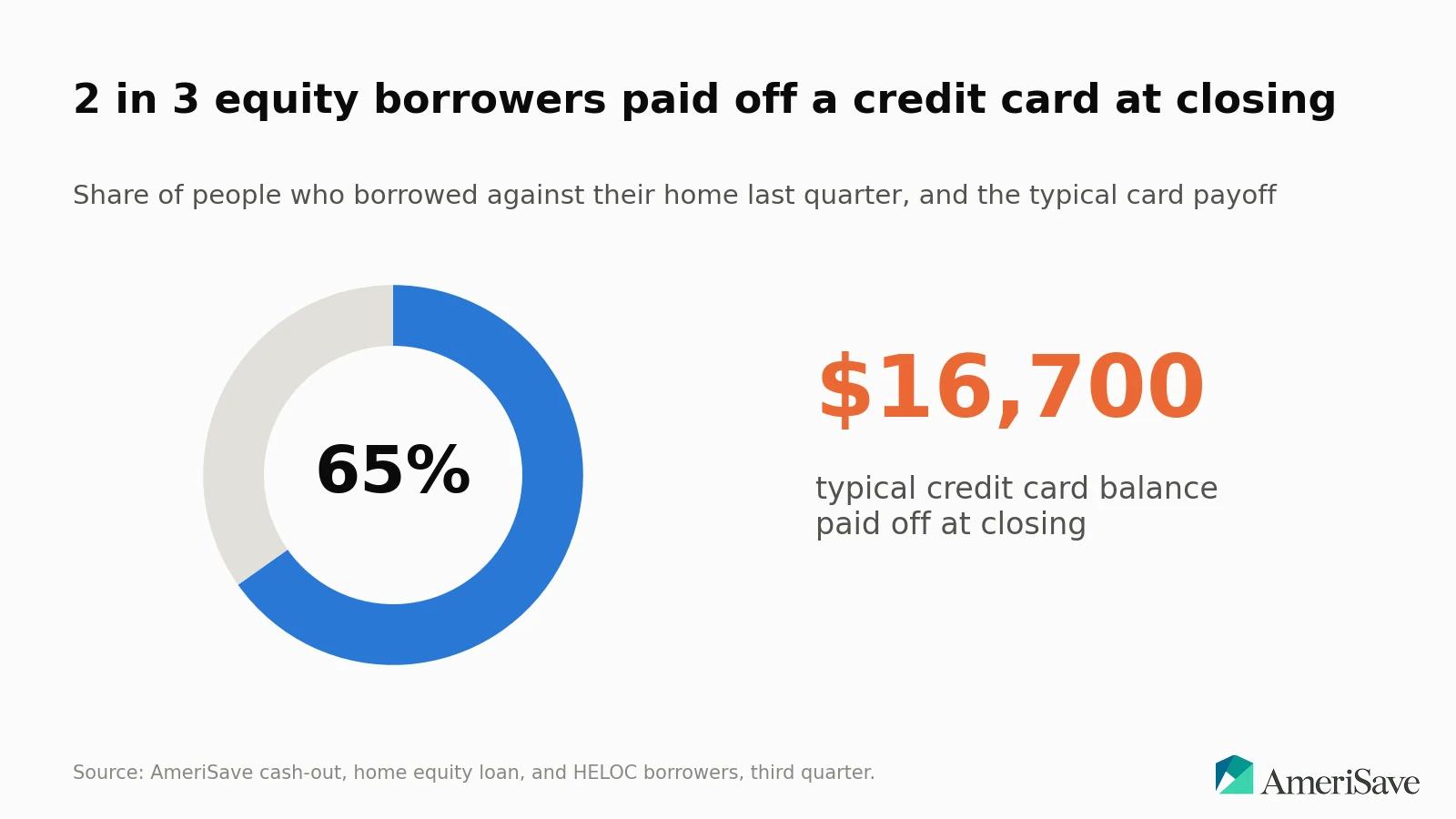
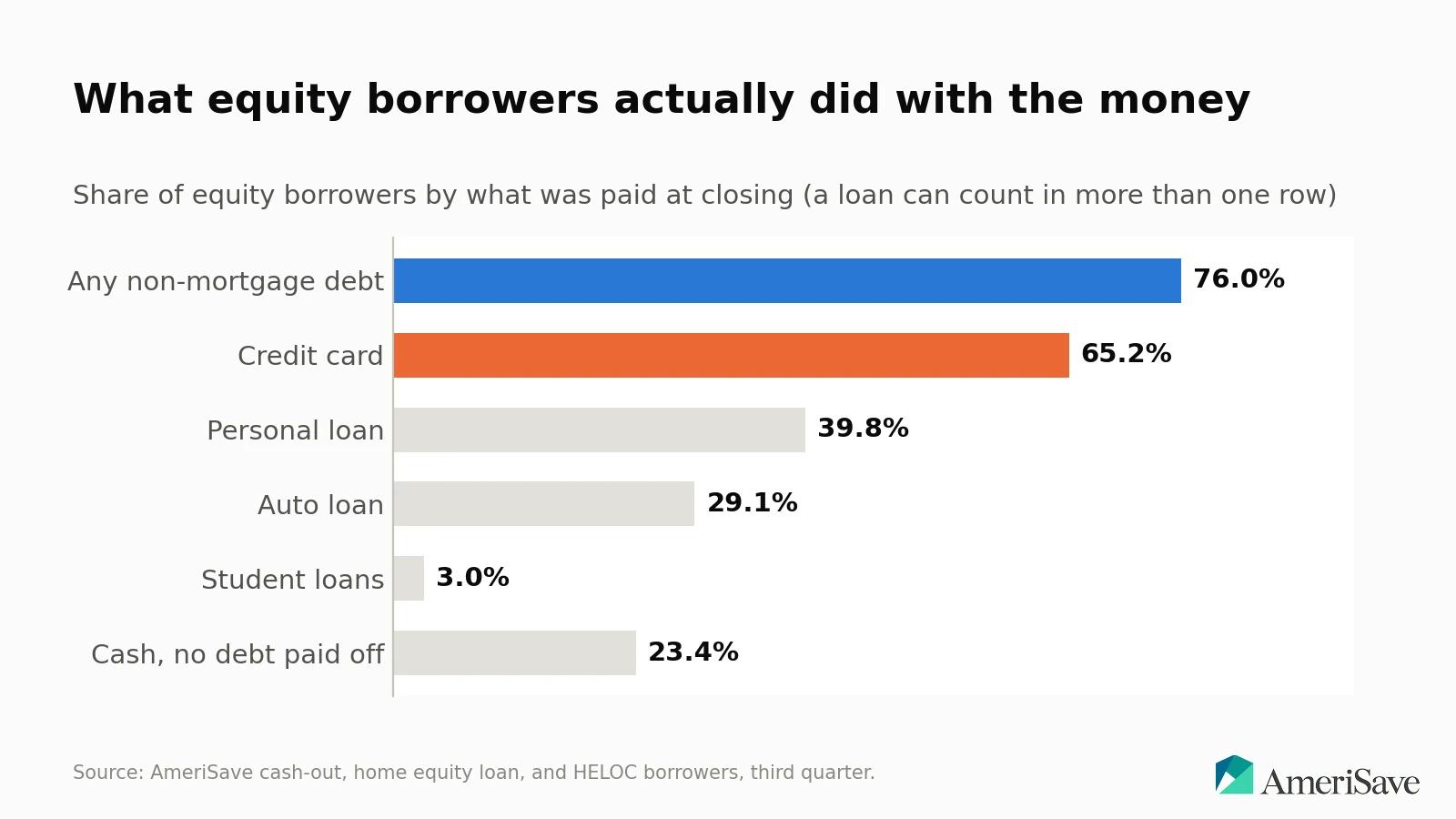
The pattern held all year. The share paying off a card stayed between 62% and 67% every single month. Cash-out refinance borrowers did it most often at 66.8%, home equity loan borrowers at 65.4%, and HELOC borrowers at 62.2%. The home improvement story is a marketing fiction. Three in four equity borrowers are restructuring debt. Figure 2 shows every use at closing, and Table 1 adds the typical amount for each.
| What was paid at closing | Share of equity borrowers | Typical amount |
|---|---|---|
| Any non-mortgage debt | 76.0% | $34,056 in total debt cleared |
| Credit card | 65.2% | $16,696 |
| Personal loan | 39.8% | $15,544 |
| Auto loan | 29.1% | $18,326 |
| Student loans | 3.0% | $8,459 |
| Medical debt | 0.8% | $1,151 |
| Cash with no debt paid off | 23.4% | $54,965 in cash |
When a borrower calls me asking about the rate, they’re asking the wrong question. What they mean is "I want more money left at the end of the month." So the real question is cash flow: what goes out the door today across the mortgage, the cards, the car, and the personal loan, and what goes out after. A card balance in the mid five figures at a typical card rate, carried for years, costs several times what the same balance costs inside a mortgage product. On that measure, consolidating $16,700 of cards is often the strongest financial move a homeowner makes all year.

The Homeowner Who Did It Right
Picture a homeowner carrying about $17,000 across three cards, paying the minimums and watching the balance barely move. They consolidate it into a cash-out refinance. The card payments disappear. Monthly cash flow improves by hundreds of dollars. This is the move working exactly as designed.
The only way this goes wrong is if the cards fill back up. The loan did its job; what remains is a habit, and it's entirely manageable with a decision made before closing: cut the limits, close the accounts you don't need, or automate a full payoff each month. The borrowers who consolidate and keep the cards clear are the ones who turn a one-time move into a permanent improvement in monthly cash flow.
One more pattern worth knowing. 23.4% of equity borrowers took cash with no meaningful debt payoff, and their typical cash was about $55,000, nearly double the typical cash for everyone else. Many had no card debt to pay. If you do carry card balances, the strongest version of the loan pays them off at the closing table, because that's where the monthly savings come from. Consolidation is a one-time fix for a cash-flow problem, and it works best when the cards stay clear afterward.
Run the Numbers Before and After
The test is two columns, and the data gives a realistic set of figures to show how it works. The typical borrower who paid off debt cleared about $34,000 at closing. A common shape for that $34,000 in the data is a credit card balance of about $16,700 plus a personal loan of about $15,500, which is close to the typical amounts for each. Table 3 is the worksheet, with the typical figures filled in on the left and blanks for yours on the right.

| Monthly outflow | Typical shape in the data | Yours |
|---|---|---|
| Credit card minimums (about $16,700 across three cards) | enter from statements | |
| Personal loan payment (about $15,500 balance) | enter from statement | |
| Current mortgage payment | enter from statement | |
| Total today | add the three lines | |
| New loan payment after consolidation (one line) | from the side-by-side quote | |
| Change per month | total today minus new payment |
The rule is simple. If the bottom line is smaller by enough to justify the closing costs over the time you expect to hold the loan, the move works. If it's not, the loan is not solving the problem, no matter how the rate compares.
Two more figures from the data belong on the worksheet. The typical equity borrower's total withdrawal was $60,014, and the typical cash in hand was $28,412. If your plan includes cash on top of the payoff, write down what the cash is for before you close, because every dollar of it is a dollar of room in the house you’re spending. And decide the fate of the cards on the same page: which limits come down, which accounts close, which one stays open with a full automatic payoff. That decision is what turns a one-time payoff into a permanent improvement in the bottom line.
What to Check Tonight
Pull every statement and write two columns: what goes out each month today, and what would go out after the cards are gone and the new loan payment is in. If the second column is smaller by a meaningful amount, the math works. If it isn't, the loan isn't solving the problem.
Decide what happens to the cards before you close, not after. Cut the limits, close the accounts you don't need, or set an automatic full payoff each month. The consolidation only works once.
Then decide which door. If your current first-mortgage rate is worth keeping, a HELOC or home equity loan leaves it alone. If it isn't, a cash-out refinance replaces everything with one payment. Either way, ask for a side-by-side quote on your own balances, not a rate in the abstract. Table 2 shows how borrowers used each product last quarter.
| Product | Paid off any debt | Paid off a credit card | Cash with no debt paid off |
|---|---|---|---|
| Cash-out refinance | 81.1% | 66.8% | 18.4% |
| Home equity loan | 73.8% | 65.4% | 25.4% |
| HELOC | 71.6% | 62.2% | 28.1% |
The full report, Homeowners Are Rolling a Median $16,700 in Credit Card Debt Into Their Mortgages, has the breakdown by debt type and product.
Methodology
The figures come from AmeriSave cash-out refinances, home equity loans, and HELOCs funded in the third quarter. Use is inferred from what happened at closing, not from a stated purpose: a loan counts as debt consolidation when at least $1,000 of non-mortgage debt on the application was paid at closing, and "cash with no debt payoff" means at least $2,500 to the borrower with under $1,000 of debt paid. Dollar figures are medians across borrowers. Data through October 28.
The Bottom Line
Two in three equity borrowers used their house to clear credit cards, about $16,700 each, and most of them improved their monthly cash flow by doing it. The one thing that can undo it is refilling the cards afterward, and that's a choice you can make before you close. Run the before-and-after on your own statements, decide the fate of the cards before closing, and get a side-by-side quote. If your first-mortgage rate isn't worth protecting, AmeriSave's cash-out refinance is where the whole balance sheet gets reset in one payment.
AmeriSave internal funded-loan data, Home Equity Use Index, cash-out refinances, home equity loans, and HELOCs funded in the third quarter, data through October 28, 2026. Internal, not publicly available.
AmeriSave, "Homeowners Are Rolling a Median $16,700 in Credit Card Debt Into Their Mortgages. 2 in 3 Equity Borrowers Did It Last Quarter," the full report behind this article. Link to be added when live.
Consumer Financial Protection Bureau, "What is a home equity loan?"; supports product definitions:
Consumer Financial Protection Bureau, "What you should know about home equity lines of credit"; supports HELOC mechanics:
Federal Reserve, Consumer Credit G.19 release; supports the statement that revolving credit carries materially higher rates than secured mortgage debt:


Al brings two decades of experience in lending, sales strategy, and mortgage operations to AmeriSave. He holds a Business Administration degree from Belmont University and transitioned to mortgages after working as a music industry professional traveling the world with artists. A husband and father of five children, Al specializes in straightforward, borrower-focused mortgage education that cuts through industry jargon.
Frequently Asked Questions
Yes, for most borrowers who do it, and AmeriSave's data shows 2 in 3 equity borrowers did exactly that last quarter, with a typical payoff of about $16,700. Card balances carry rates several times higher than mortgage products, so moving the balance usually lowers the monthly outflow by a meaningful amount. The test is cash flow before and after, including the new loan payment and closing costs. It stops being a good idea if the cards get refilled afterward, because then you carry the original debt inside the mortgage plus new card balances on top.
Refilling the cards. Consolidation clears the balances but leaves the credit lines open, so the gain depends on keeping them clear. Decide before closing whether to cut limits, close accounts, or automate full payoffs, and treat the consolidation as a one-time reset. The data is encouraging on this point: the share of equity borrowers paying off cards held between 62% and 67% every month this year, and among those who paid off any debt, 85.8% cleared at least one card. Done with that discipline, the move lowers the monthly outflow for years, which is the whole reason to do it.
It depends on your current first-mortgage rate. If that rate is worth keeping, a HELOC or a home equity loan pays off the cards while leaving the first mortgage alone, and in the data those borrowers paid off cards 62.2% and 65.4% of the time. If the first-mortgage rate is no longer favorable, a cash-out refinance replaces everything with one payment, and cash-out borrowers cleared cards most often at 66.8%. Compare what you would repay under each option over the years you expect to hold the debt, including closing costs, and ask for a side-by-side quote on your actual balances.
Enough that total debt on the home stays at or below about 80% of its value after the new loan, which is the ceiling most lenders use. For a typical card payoff of about $16,700 that's a modest amount of room, and in AmeriSave's data equity borrowers ended last quarter with total debt near 60% of value, well inside the limit. Lenders also look at income and credit. The more useful question is whether the monthly outflow after the loan, including the new payment, is lower than today's by enough to justify the closing costs.