



Homeowners Are Rolling a Median $16,700 in Credit Card Debt Into Their Mortgages. 2 in 3 Equity Borrowers Did It Last Quarter.


 FACT-CHECKEDFACT-CHECKED
Two in three homeowners who borrowed against their equity with AmeriSave last quarter paid off at least one credit card at closing, and the median card balance they cleared was about $16,700. That share held steady all year. The numbers say the home improvement story is mostly marketing, and that the right test for these loans is monthly cash flow before and after.
Key Takeaways
- 76.0% of equity borrowers paid off at least $1,000 of non-mortgage debt at closing, and 65.2% paid off a credit card.
- The median credit card payoff was about $16,700, and the median total debt cleared at closing was about $34,000.
- Credit cards were 71.6% of the accounts paid off at closing but only 47.7% of the dollars paid off.
- 23.4% took cash with no debt payoff, and their median draw of about $55,000 was nearly double the overall median cash.
- Judge a consolidation by total monthly outflow before and after, closing costs included, rather than by the new loan's rate.


The question underneath "what's your rate?"
Three in four homeowners who borrowed against their equity last quarter paid off at least $1,000 of non-mortgage debt at the closing table. Two in three paid off at least one credit card. The median card balance they cleared was about $16,700, and the median total debt they retired was about $34,000. Those figures come from AmeriSave's funded cash-out refinances, home equity loans, and HELOCs for the third quarter, and they've held within a few points every month this year.
Those four numbers describe a product the industry still markets as a kitchen remodel. The home improvement story is a marketing fiction. The borrowers in this data are restructuring debt, and on the measure that counts, most of them are right to.
That measure is monthly cash flow, and it's the reason the question most homeowners ask first is the wrong one. The call opens with "what's your rate?" The stated want is a lower number. Ask why, and the answer underneath is "I want more money left at the end of the month." Those are different questions. The first compares one rate to another. The second compares everything that goes out the door today, across the mortgage, the cards, the car, and the personal loan, against everything that goes out after. A homeowner who consolidates a mid five-figure card balance can watch the mortgage rate move the wrong direction and the monthly total move the right direction in the same transaction. The sections below show what the data says borrowers did, how to run that comparison on your own balances, and which borrowers in the data should give you pause.

What equity borrowers actually did at closing
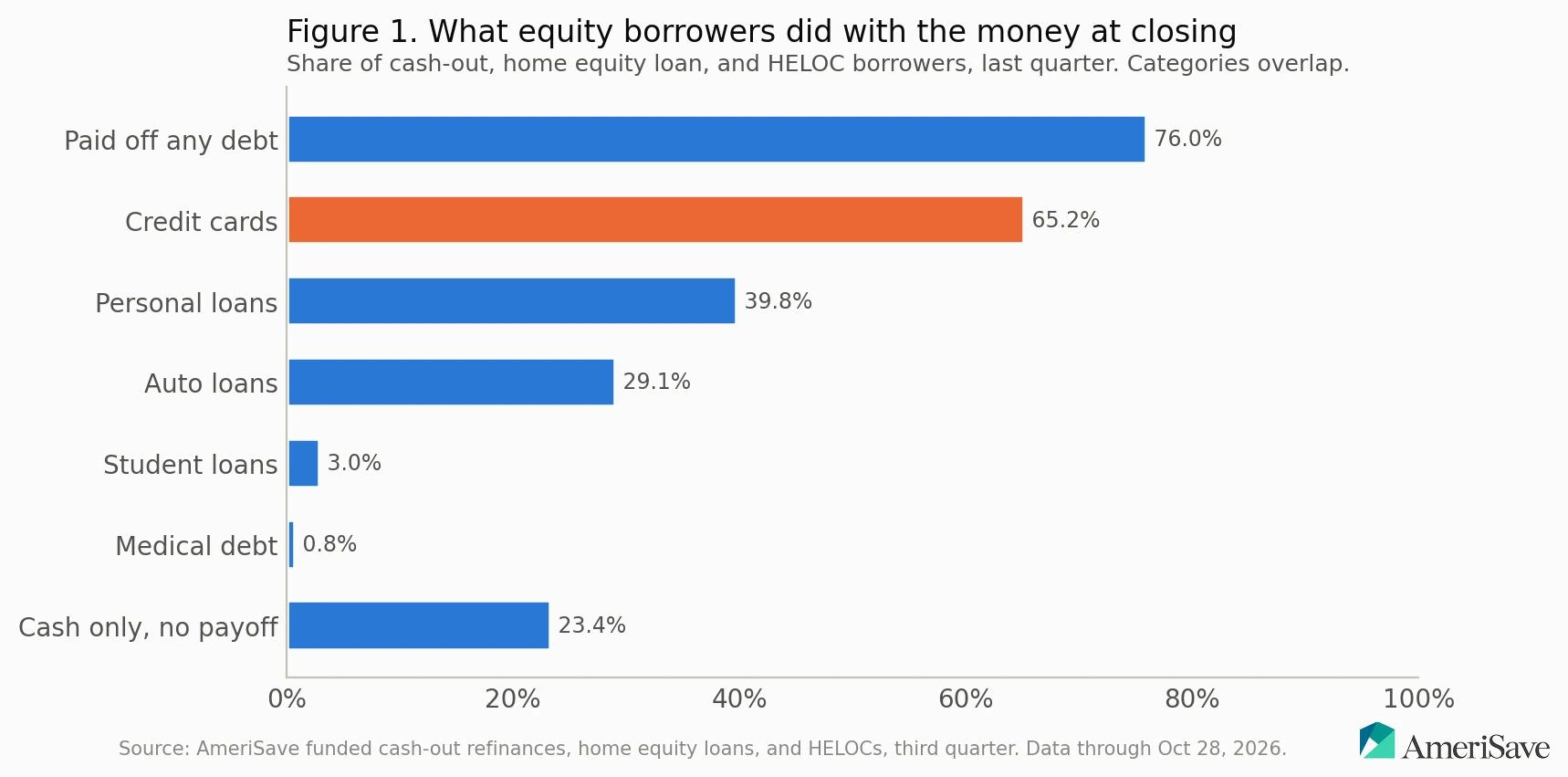
76.0% of equity borrowers in the third quarter paid off at least $1,000 of non-mortgage debt at closing. 65.2% paid off at least one credit card. 39.8% paid off a personal loan, 29.1% paid off an auto loan, 3.0% paid off student loans, 0.8% paid off medical debt, and 0.3% cleared a lien on another property. Figure 1 shows the share of borrowers by each use. The categories overlap because a single closing often retires several accounts, and the overlap shows up in the dollars: the median total paid off, about $34,000, is roughly double the median card payoff of about $16,700, so the typical consolidation reached well past the cards. The table below carries the full use-at-closing breakdown, including the share who took cash with no payoff, which the next sections return to.
| Use at closing | Share of equity borrowers | Median amount for this use |
|---|---|---|
| Paid off any debt | 76.0% | $34,056 |
| Credit cards | 65.2% | $16,696 |
| Personal loans | 39.8% | $15,544 |
| Auto loans | 29.1% | $18,326 |
| Student loans | 3.0% | $8,459 |
| Medical debt | 0.8% | $1,151 |
| Cash only, no payoff | 23.4% | $54,965 |
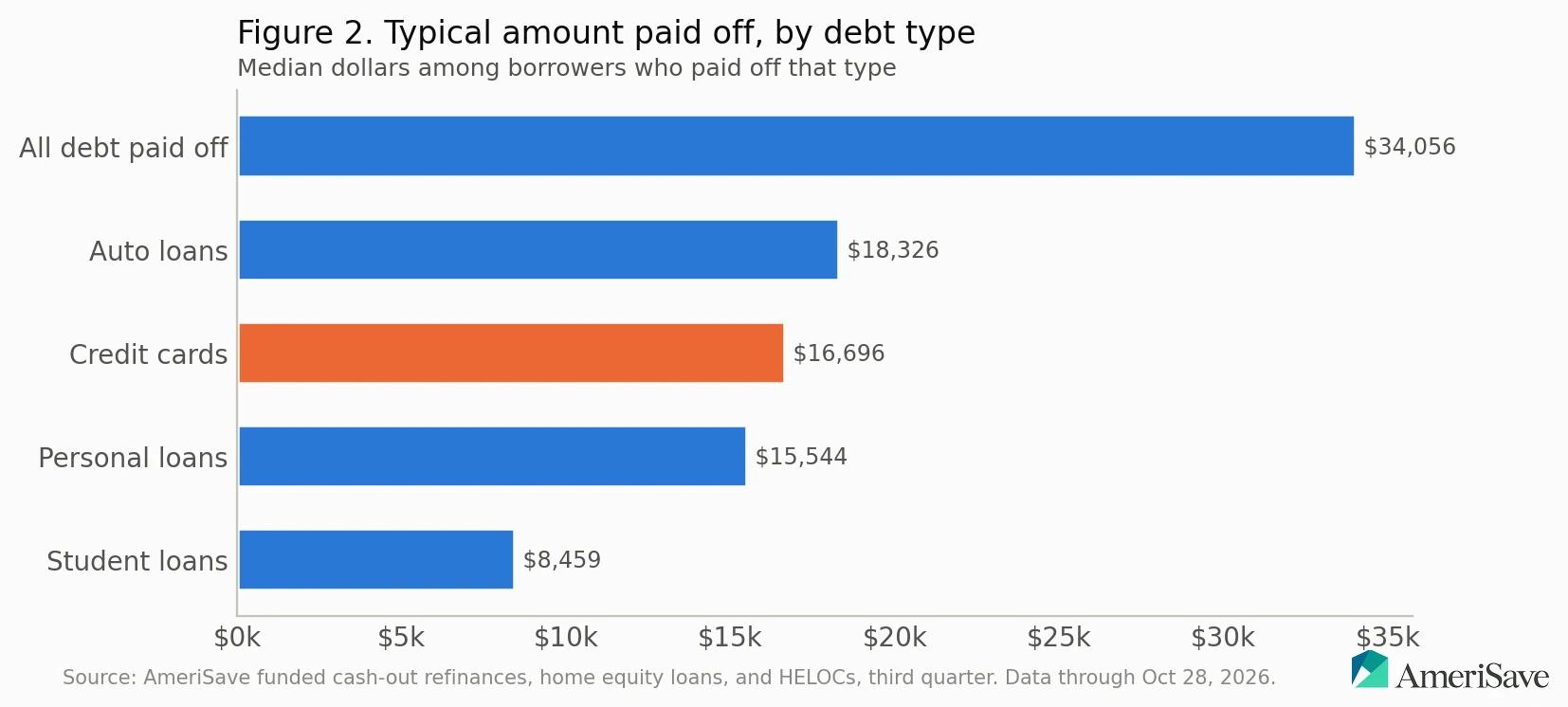
Among borrowers who paid off any debt at all, 85.8% cleared at least one credit card. Figure 2 shows the median dollars paid off by debt type. Auto loans carried the largest median at $18,326, credit cards came next at $16,696, and personal loans followed at $15,544. Those three medians sit within a few thousand dollars of one another, so the card balance is typically one piece of a stack that also includes a car payment and a personal loan, and it's the piece carrying the highest rate.
The median withdrawal across all equity borrowers, counting cash to the borrower plus debt paid off, was $60,014. The median cash to the borrower alone was $28,412. The difference between those two figures is the debt leaving the household balance sheet at closing, and it's the larger half.
The pattern held steady all year. The credit card share stayed between 62% and 67% every month, the debt payoff share between 73% and 76%, and the median withdrawal between about $58,000 and $63,000. That stability changes how to read the headline numbers. The third quarter wasn't unusual, and the shares above describe a standing use of home equity rather than a reaction to one quarter's conditions.
Credit cards are most of the accounts and under half the dollars
Credit cards were 71.6% of the accounts paid off at closing and 47.7% of the dollars. Personal loans took 26.5% of the dollars, auto loans 20.3%, student loans 1.2%, and other debts 4.3%. Figure 3 shows the split. The gap between the account share and the dollar share comes from balance size: a borrower might clear four cards and one auto loan, and the auto loan alone can outweigh the four cards in dollars.
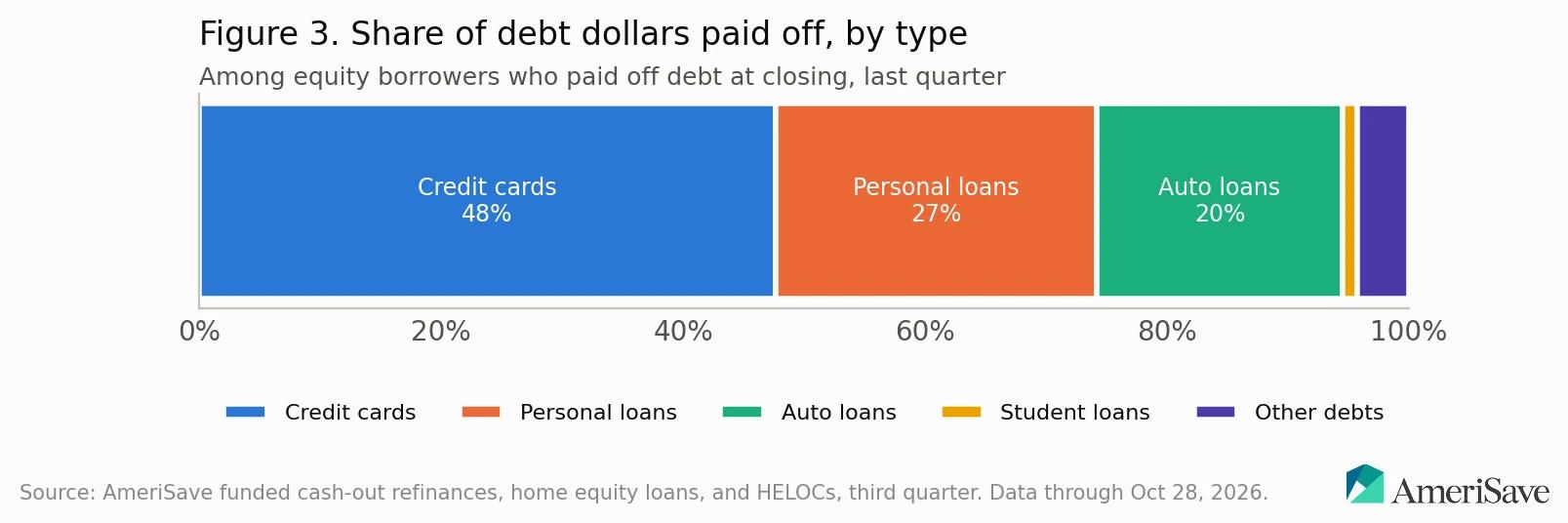
That means the supported statement is that most equity borrowers who consolidated paid off credit cards. The unsupported statement, and the one you'll hear in marketing, is that most of the money went to credit cards. It didn't. Adding the personal loan, auto, student, and other shares together puts 52.3% of the dollars somewhere other than a card.
This explains why the cash-flow comparison has to include every account and not only the cards. A card balance at a card rate is the most expensive debt in the stack, and clearing it produces the largest change in monthly outflow per dollar borrowed. A personal loan or an auto loan comes with a set payment on a short schedule, and rolling it into a mortgage product lowers the monthly outflow while stretching the payoff over far more years. That tradeoff is real in both directions. It helps the homeowner whose problem is this month's cash flow, and it costs the homeowner who would've paid the car off in a couple of years and kept the house loan small.

Should you use home equity to pay off debt? Run the cash-flow math
The rate on the new loan is the number every borrower asks about and the least useful number for this decision. The comparison that decides it has four lines, and you can build it from your own statements.
First, total what goes out the door today: the principal and interest on your current mortgage, the minimum payment on every card, the auto loan payment, and the personal loan payment. Second, total what would go out after. That's the payment on the new mortgage or the new equity product, plus whatever payments remain on any debt you didn't consolidate. Third, subtract the second total from the first to get the monthly change. Fourth, divide the closing costs by that monthly change to get the number of months before the transaction has paid for itself.
Take the median consolidation in the data as the illustration: about $34,000 in debt retired, with about $16,700 of it on cards. Card rates run several times the rate on a mortgage product, so the card portion drives most of the monthly change even though it's under half the dollars. Your own statements show the exact rate on each account, and that's where the comparison should run, not from a national average and not from the headline rate on the new loan. A loan officer at AmeriSave can build the four lines with you, but every input comes from your statements, and you should see each one before you see a recommended structure.
The case against belongs on the same page, and a lender who leaves it off is doing you a disservice. You're converting unsecured debt into debt secured by your house, so a missed payment that used to cost you a late fee and a credit score hit now puts the home at risk. You're also extending the payoff. A card balance you might have cleared within a few years becomes part of a loan with a far longer schedule, and total interest over the life of the debt can rise even as the monthly outflow falls, unless you keep sending the freed-up cash toward principal. On top of that, a closing has costs, and those costs are the reason the fourth line exists. A consolidation that improves monthly cash flow but takes longer to pay for itself than you'll keep the loan is a worse transaction than it looks on the first three lines. The math works or it doesn't, and only your own four lines will tell you which.
The borrowers to worry about
23.4% of equity borrowers last quarter took at least $2,500 in cash and paid off under $1,000 of debt. Their median cash was about $55,000, nearly double the $28,412 median cash to borrower across all equity loans. By product, that group was 18.4% of cash-out refinances, 25.4% of home equity loans, and 28.1% of HELOCs. That's the home improvement population, or the closest the closing data can get to it, and it's under a quarter of the total.
The data can't show what those borrowers did with the cash, and it can't show whether they were carrying card balances they chose to leave in place. It appears from the size of the draws that many were funding a project or a purchase, and that's a legitimate use of equity. If you're in that group and you also have a card balance, though, the question is why you went through a closing to borrow against the house while leaving the most expensive debt untouched. Adding the card payoff to the same transaction would've raised the loan amount and, at a card rate several times the mortgage rate, would usually have lowered the total monthly outflow in one step. Leaving it out means two sets of interest running at once, with the more expensive one still open.
The second group to watch is the 65.2% themselves, a year from now. Consolidation is a one-time fix for a cash-flow problem. It clears the balances, and it does nothing about the spending that built them. A homeowner who pays off about $16,700 in cards at closing and refills them over the following two years ends up with the larger mortgage balance and the card balances both, and a second consolidation is harder to justify than the first because the equity it would need went into the first one. The data can't measure refills, which is why the 65.2% measures what happened at closing and nothing after it. If you're consolidating, decide before closing what happens to the cards afterward, and decide it in writing.
Home equity loan, HELOC, or cash-out refinance for debt consolidation
81.1% of cash-out refinance borrowers paid off debt at closing and 66.8% paid off a credit card. Home equity loan borrowers paid off debt 73.8% of the time and a card 65.4%. HELOC borrowers came in at 71.6% and 62.2%. Debt consolidation leads across all three products, and the card share sits within five points from one product to the next. The product choice, then, comes down to what happens to your first mortgage.
A cash-out refinance replaces the first mortgage with a larger one, so the entire balance moves to a current rate. A home equity loan or a HELOC leaves the first mortgage in place and adds a second lien for the consolidation amount. If the rate on your current first mortgage is worth keeping, the second-lien route protects it and prices only the new money at today's cost. If it isn't worth keeping, a cash-out refinance reprices everything at once and leaves you with a single payment. All three structures are available for consolidation, and the honest way to choose between them is the four-line comparison run twice, once for each structure, on your actual balances. The structure that produces the lower total monthly outflow and the shorter payback on closing costs is the right one, and that answer changes from one homeowner to the next because the first-mortgage rate does.
Methodology
The figures in this article come from AmeriSave's funded-loan records for cash-out refinances, home equity loans, and HELOCs: the liabilities listed on the final loan application, the payoffs made at closing, and the cash disbursed to the borrower on the closing disclosure. No third-party data is used. The population is those equity loans funded in the third quarter, by funding date, with data through October 28. Purchases and rate-and-term refinances are out, and liens on the home being financed aren't treated as debt paid off.
Withdrawal means cash to the borrower plus debt paid off at closing. Cash to borrower is the amount disbursed to the homeowner, with negative amounts counted as zero. A loan counts as debt consolidation when at least $1,000 of non-mortgage debt listed on the application was paid at closing, and the debt types tracked are credit cards, personal loans, auto loans, student loans, medical debt, other debt, and liens on another property. A loan can count in several types at once, so the type shares overlap and don't add to 100%. The home improvement proxy, labeled cash only in the table, is at least $2,500 of cash to the borrower with under $1,000 of debt paid off. Shares divide loans with a given use by all equity loans in the same period and product. Median amounts are the median of each use's own dollars among the loans with that use, and medians are reported instead of averages so that a few large loans don't move the figures.
A product, state, or month cell is published only when it holds at least 30 loans in each compared period. The national figures in this article clear that floor, and state detail is left out. Use is inferred from what happened at closing rather than from a stated purpose, so a borrower who took cash and then paid a contractor can't be told apart from one who put the cash in savings, and the cash-only share is a ceiling on home improvement spending. Categories overlap, so a borrower who paid off a card and also renovated counts as debt consolidation. And the figures describe AmeriSave borrowers who tapped equity in the quarter, not all homeowners and not all equity borrowers.
The Bottom Line
Three in four equity borrowers used the loan to restructure debt, two in three cleared a credit card, and the median card balance they cleared was about $16,700. The home improvement story is a marketing fiction, and the rate question is the wrong first question. The question that decides whether one of these loans is a good transaction is total monthly outflow before and after, across every account, with closing costs divided by the monthly change to show how long the payback takes. Run that comparison and the median consolidation in this data is usually the strongest cash-flow move the homeowner makes all year. The exceptions are the borrowers who draw cash and leave card balances in place, and the borrowers who clear the cards and refill them.
I started in this industry as a loan officer and have spent the seventeen years since on the executive side of mortgage lending, where the hardest cases end up on my desk. The transactions that still look right two years later share one trait: the borrower saw the full math before choosing a structure. If your first-mortgage rate is worth keeping, price a HELOC or a home equity loan against your balances. If it isn't, price a cash-out refinance. Then put the two side by side on your own statements and request a quote from AmeriSave on each, because a clear and defensible comparison is the only version of this decision that holds up.
AmeriSave internal funded-loan data, Home Equity Use Index, cash-out refinances, home equity loans, and HELOCs funded in the third quarter, data through October 28, 2026. Internal, not publicly available.
Consumer Financial Protection Bureau, "What is a home equity loan?" supports the home equity loan definition and second-lien mechanics:
Consumer Financial Protection Bureau, "What is a home equity line of credit (HELOC)?" supports the HELOC mechanics and the risk of losing the home on nonpayment described in the article:
Federal Reserve, Consumer Credit G.19 statistical release, supports the statement that revolving credit card balances carry materially higher rates than mortgage debt:


Al brings two decades of experience in lending, sales strategy, and mortgage operations to AmeriSave. He holds a Business Administration degree from Belmont University and transitioned to mortgages after working as a music industry professional traveling the world with artists. A husband and father of five children, Al specializes in straightforward, borrower-focused mortgage education that cuts through industry jargon.
Frequently Asked Questions
Yes, when two conditions hold. The first is that the total monthly outflow across every account falls by enough to repay the closing costs well before you expect to sell or refinance again. The second is that the cards stay paid off. In the data, two in three equity borrowers cleared at least one card at closing, with a median payoff of about $16,700, and the median total debt retired was about $34,000. The case against is that you're securing unsecured debt with your house and stretching the payoff over a far longer schedule, so run all four lines of the comparison on your own statements before deciding.
It depends on the rate on your current first mortgage. A cash-out refinance replaces that mortgage with a larger one at a current rate, which makes sense when the existing rate isn't worth protecting and you want a single payment. A HELOC or a home equity loan leaves the first mortgage untouched and adds a second lien for the consolidation amount, which makes sense when the existing rate is worth keeping. In the data, cash-out borrowers paid off debt 81.1% of the time and HELOC borrowers 71.6%, so both are used for consolidation. Run the cash-flow comparison once for each structure and take the one with the lower total outflow and the shorter payback.
Enough that the new loan, or the combined first and second liens, stays within the lender's loan-to-value limit after the debt payoff and the closing costs are added to the balance. The limit varies by product and by lender, so the practical step is to total the balances you want to retire and ask for a quote that shows the resulting loan-to-value. For scale, the median withdrawal in the data, counting cash to the borrower plus debt paid off, was $60,014, and the median total debt retired among those who consolidated was about $34,000. If your balances are smaller, the equity requirement is smaller as well.
The house becomes the collateral for debt that used to be unsecured. A missed card payment costs you a late fee and a credit score hit, while a missed payment on a mortgage or a home equity product can lead to foreclosure. The second risk is behavioral: consolidation clears the balances and changes nothing about the spending behind them, so a homeowner who refills the cards ends up with the larger mortgage and the card debt both. The third is cost over time, since a balance spread across a long schedule can accrue more total interest even when the monthly payment falls. Each of those is manageable, and none of them should be a surprise at closing.
Yes. A home equity loan or a HELOC is a second lien, so your first mortgage, its rate, and its remaining schedule stay exactly as they are, and only the new money is priced at today's cost. That's the structure to price first if your existing rate is one you'd rather not give up. In the data, home equity loan borrowers paid off debt 73.8% of the time and HELOC borrowers 71.6%, which puts consolidation as the leading use for both second-lien products. The tradeoff is a second payment alongside the first, so compare the combined outflow against a single cash-out refinance payment before choosing.