


Your Rate Is Fixed. Your Payment Isn't. The Part of Your Mortgage That's Up 22% in Two Years.


 FACT-CHECKEDFACT-CHECKED
The letter says your mortgage payment is going up, and your rate hasn't moved an inch. AmeriSave's funded loans show why: the homeowners insurance collected inside the payment rose 22.3% in two years while property tax barely moved. The increase lands once a year, after the money is already owed, and it will come again.
Key Takeaways
- Homeowners insurance inside the escrow payment rose 22.3% in two years; property tax rose 0.8% over the same stretch.
- The typical escrow line rose $21.57 a month over the past year, about $259 a year, on loans with a fixed rate.
- Insurance is now about 45% of the typical escrow payment, up from about 39% ten quarters ago.
- Each half-point reduction in rate on the typical loan offsets roughly three times the past year's escrow increase.
- Shop the policy before the annual escrow review, not after; a lower premium filed late waits a full year to help.


Why Did My Mortgage Payment Go Up?
Because the part of your payment that was never fixed went up. A fixed-rate mortgage locks the principal and interest. It doesn’t lock the property tax and homeowners insurance that your servicer collects alongside them each month and holds in an escrow account. Those two bills change every year, and the servicer only adjusts your payment once a year, after it compares what it collected with what it paid.
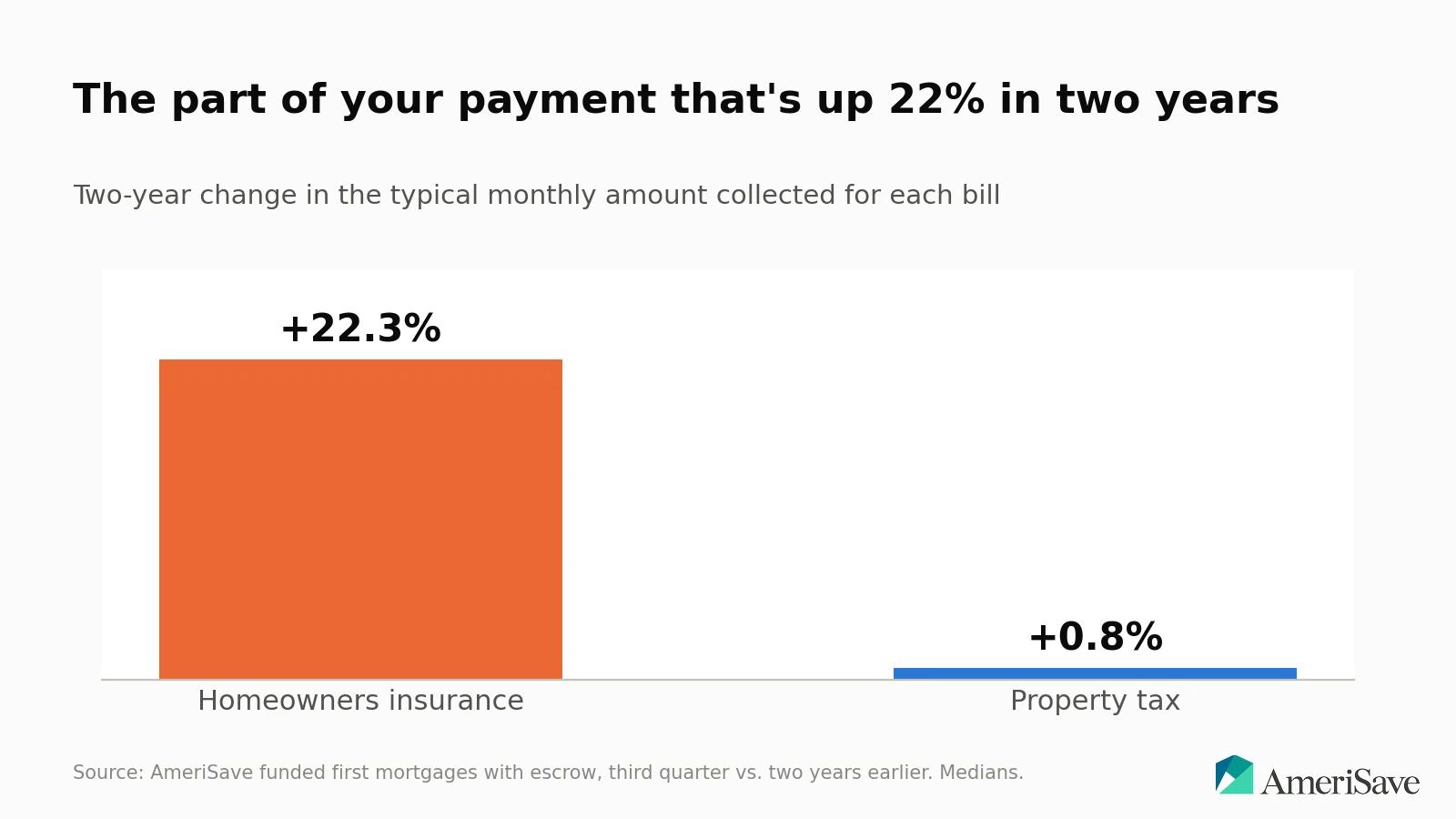
The loans AmeriSave closed over the past two years show which bill did the moving. Homeowners insurance inside the escrow payment rose 22.3% over two years. Property tax rose 0.8% over the same two years. The whole escrow line rose 11.9%. Insurance did almost all of it.
Figure 1 puts the two numbers side by side.
The past year softened a little. Insurance rose 3.8% over the past year, and property tax rose 6.3%, so the tax line is now the faster mover. Together they pushed the typical monthly escrow payment from $349.82 to $371.39, up $21.57 a month, about $259 a year. Ten quarters ago, insurance was about 39% of the typical escrow payment. Today it’s about 45%.
Figure 2 shows the year-over-year change for both lines by quarter. Insurance peaked at +17.8% a year ago and has slowed to +3.8%, while property tax went from falling to rising 6.3%.
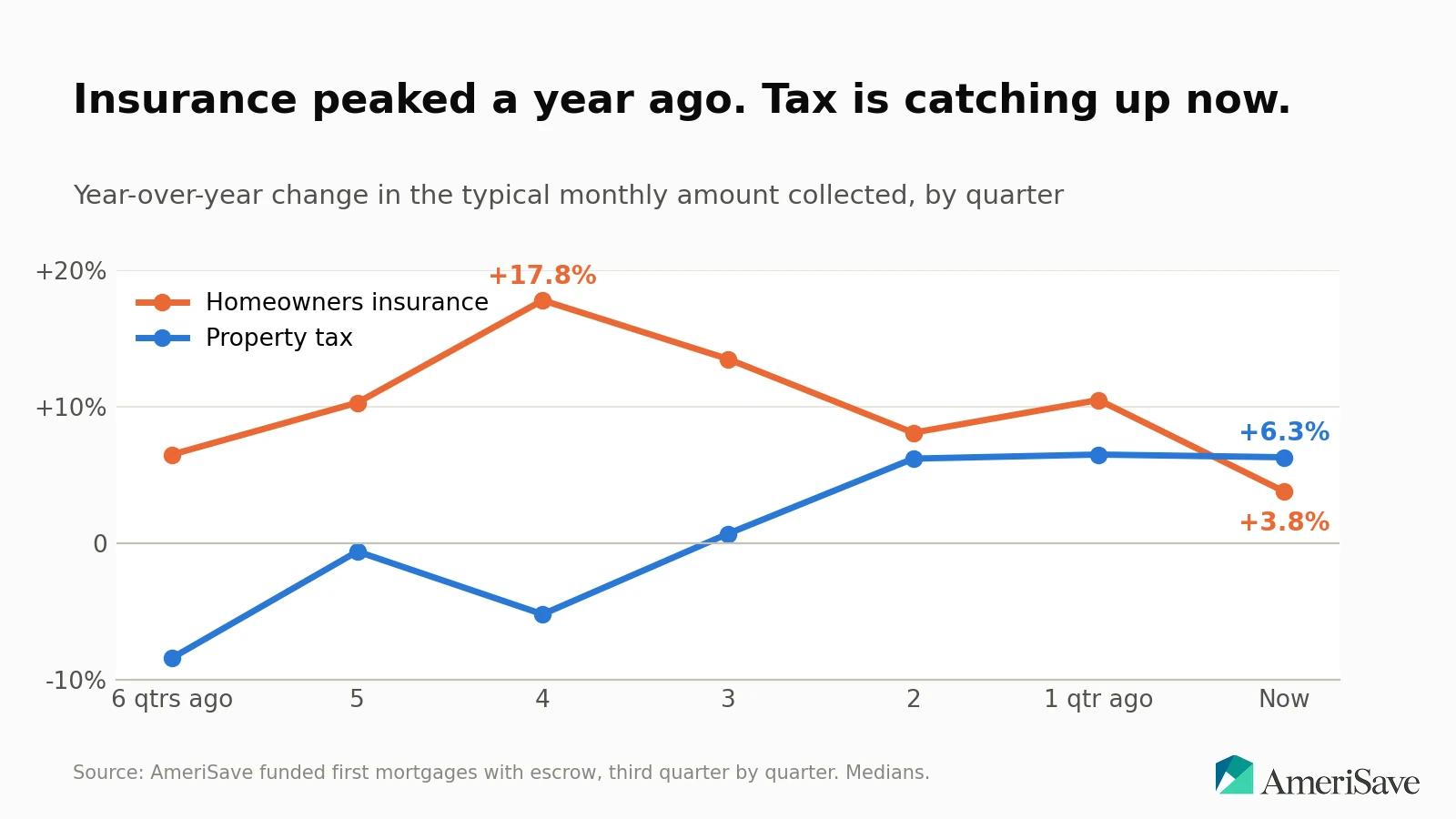
Table 1 shows the national medians behind those lines.
| Line in the payment | A year ago | Now | Change |
|---|---|---|---|
| Monthly escrow (tax plus insurance) | $349.82 | $371.39 | +6.2% |
| Monthly property tax | $172.84 | $183.81 | +6.3% |
| Monthly homeowners insurance | $162.95 | $169.12 | +3.8% |
| Appraised home value | $301,680 | $318,850 | +5.7% |
After three decades in mortgage finance, my read is that the insurance shock is over as a rate of change and the property tax catch-up is next. Assessments trail home prices by one to three years in most places, which is my professional observation rather than a cited statistic. Home values in the data rose 5.7% over the past year, and the tax bills that follow those values haven’t fully arrived.

The Homeowner Who Opened the Letter
Picture a homeowner in the middle of the data. The house appraised at about $319,000. The loan is about $195,000 on a fixed rate. The payment has three parts: principal and interest, which never change, and tax and insurance, which the servicer collects at about $371 a month.
In the spring the insurer renews the policy at a higher premium. The servicer keeps collecting the old amount, so the escrow account runs short. Months later the annual escrow analysis arrives in an envelope that looks like every other statement. It says two things. The account came up short, and the collection going forward has to be higher. The new payment carries both: the catch-up and the higher go-forward amount, in a single step.
Federal escrow rules give the homeowner a choice on the shortage. A small one can be paid within 30 days or spread over twelve months. A larger one must be offered over at least twelve months. Either way, the higher collection stays, because next year's bills are higher.
Then the homeowner does what almost everyone does. They look at the rate, which they cannot change, and they ignore the two lines that keep moving, which they never shop.
Run the Numbers on the Typical House
Take the house in the middle of the data: appraised at $318,850, with a loan of $195,360 and a fixed rate. Last year the servicer collected $349.82 a month for taxes and insurance. This year's bills work out to $371.39 a month. The account came up $21.57 short every month, so the shortage at the annual review is about $259.
Here is what the review letter does with that. The go-forward collection rises to the new $371.39. The $259 shortage is spread over the next twelve months, about $21.57 a month. For one year the escrow line rises by roughly $43 a month, then drops back to the $21.57 increase once the catch-up is paid. Table 3 lays it out.
| Line | Last year | This year, months 1 to 12 | This year, month 13 on |
|---|---|---|---|
| Monthly escrow collection | $349.82 | $371.39 | $371.39 |
| Shortage catch-up | none | about $21.57 | none |
| Change in the total payment | none | about +$43 | about +$22 |
Two rules of thumb fall out of the data. First, escrow runs about $116 a month for every $100,000 of home value nationally, so a $400,000 house carries roughly $464 a month before principal and interest. Second, taxes and insurance together run about 1.44% of home value a year nationally, which is where the "budget 1.5%" advice comes from. On the typical $318,850 house that’s about $4,600 a year. In Illinois, the heaviest published state at 2.51%, the same house would carry about $8,000 a year, or $667 a month.
Now the lever. On the typical $195,360 loan, each half-point reduction in rate lowers principal and interest by roughly $60 to $65 a month in the rate range borrowers have seen over the past two years. That single move covers the $43 catch-up year with room to spare and keeps paying after the catch-up ends. This is an illustration of payment arithmetic, not an offer, and the result depends on the rate you hold today.
What to Check Tonight
Pull the escrow analysis letter and read the two numbers separately: the shortage and the new monthly collection. One is a one-time catch-up. The other is permanent until the next review.
Pull the insurance declarations page and find the renewal date. The premium is the one escrow line you can change with a phone call. Get competing quotes four to six weeks before renewal, match the coverage and the deductible so the comparison is fair, and get the lower policy on file before the servicer runs its analysis. A premium that drops after the analysis won’t lower your payment until the next cycle.
Then do the arithmetic on the biggest line. On a loan the size of the typical one in the data, about $195,000, each half-point reduction in rate lowers principal and interest by roughly $60 to $65 a month in the rate range borrowers have seen over the past two years. That’s about three times the past year's escrow increase. This is an illustration, not an offer, and whether the number works depends on the rate you hold today.
Table 2 shows the states where the escrow payment rose most over the past year. If you live in one of them, the letter has probably already arrived.
| State | Monthly escrow | Change | Property tax change | Insurance change |
|---|---|---|---|---|
| Washington | $531 | +33.4% | +16.7% | +22.9% |
| Maryland | $492 | +32.1% | +45.9% | +12.7% |
| Virginia | $344 | +26.7% | +16.4% | +10.5% |
| South Carolina | $293 | +24.7% | +36.5% | +16.9% |
| Michigan | $361 | +15.8% | +13.1% | +26.7% |
| Texas | $583 | +15.0% | +20.2% | +6.9% |
- The full report behind these numbers, “Homeowners Insurance Now Costs More Than Property Tax in 12 States, and It Is,” has the state-by-state table.
Methodology
The figures come from AmeriSave first mortgages that funded with an escrow account: cash-out refinances, rate-and-term refinances, and purchases. The comparison is the third quarter of this year against the same quarter one and two years earlier. Each figure is a median across the loans that closed in that quarter, not the same homeowners' bills tracked over time, so part of any change is who refinanced rather than what insurers and assessors did. Mortgage insurance and HOA dues are excluded. Data through October 27.
The Bottom Line
Your rate is fixed. Your payment is not. The insurance inside it rose 22.3% in two years, the tax line is catching up now, and the servicer will tell you once a year, after the fact. Budget about 1.5% of home value a year for taxes and insurance, shop the policy before every escrow review, and run a rate check against your current loan before the next letter arrives. If the number works, AmeriSave's rate-and-term refinance is the lever large enough to absorb what the other two lines keep adding.
AmeriSave internal funded-loan data, Escrow Shock Index, first liens funded with escrow, data through October 27, 2026. Internal, not publicly available.
AmeriSave, "Homeowners Insurance Now Costs More Than Property Tax in 12 States, and It Is Up 22% in Two Years," the full report behind this article.
Consumer Financial Protection Bureau, Regulation X, 12 CFR 1024.17, Escrow accounts; supports the annual escrow analysis and shortage repayment mechanics:
Consumer Financial Protection Bureau, "What is an escrow or impound account?"; supports the escrow account definition:


Cam brings 30 years of expertise in capital markets, residential mortgage lending, and risk management to AmeriSave. A Certified Mortgage Banker (CMB) with dual degrees in Business with a Finance & Economics specialization, he previously led capital markets at GoodLeap and managed derivative books at Discover Financial. Originally from Australia, he is now a single father of two based in Newport Beach, CA, focused on translating complex market dynamics into actionable insights for homeowners and industry professionals.
Frequently Asked Questions
Because the escrow portion changed. Principal and interest on a fixed-rate loan stay the same for the life of the loan, but the property tax and homeowners insurance your servicer collects alongside them are re-estimated once a year. If the bills paid from the account ran higher than projected, the servicer raises the monthly collection to match and adds a catch-up for the shortage. In AmeriSave's data, the typical escrow line rose $21.57 a month over the past year, with insurance up 22.3% over two years. The shortage notice itemizes both pieces, so read it line by line.
You have options under federal escrow rules. If the shortage is less than one month's escrow payment, the servicer can ask for it within 30 days or spread it over twelve months. If it’s one month's payment or more, the servicer must offer to spread it over at least twelve months. You can also pay it in a lump sum at any time, which removes the catch-up from your payment but leaves the higher go-forward collection in place. Paying the lump sum doesn’t lower next year's bills, so the permanent part of the increase stays either way.
Probably, yes. The servicer reviews the account every year, and both bills tend to move. Insurance in AmeriSave's data rose 22.3% over two years, and property tax, which rose only 0.8% over that stretch, posted a 6.3% increase in the past year as assessments caught up with home prices. The size of next year's change depends on your insurer's renewal and your county's assessment, and neither is announced in advance. The only parts of the process you control are the policy you carry and the loan you hold.
No. A refinance replaces the loan. The tax bill belongs to the property and the premium belongs to the policy, and both continue regardless of who holds the mortgage. What a refinance can do is change principal and interest, the largest line in the payment and the only one with the size to offset an escrow increase. In the illustration above, each half-point reduction on a loan the size of the typical one in the data lowers the payment by roughly $60 to $65 a month, about three times the past year's escrow increase. Whether that works depends on the rate you hold today.