



Homeowners Insurance Now Costs More Than Property Tax in 12 States, and It Is Up 22% in Two Years


 FACT-CHECKEDFACT-CHECKED
AmeriSave's funded loans show the median escrow payment rose 6.2% over the past year, and homeowners insurance is up 22.3% in two years. The insurance surge has slowed, though, and property tax is now the line moving fastest. In 12 of the 26 states with enough data, insurance already costs more each month than property tax.
Key Takeaways
- Median monthly escrow rose from $349.82 to $371.39 over the past year, about $259 more a year.
- Insurance is up 22.3% in two years but only 3.8% over the past year; property tax rose 6.3% in that same year.
- Insurance now exceeds property tax in 12 of 26 published states, led by Alabama at 84% of the escrow payment.
- Budget about 1.5% of home value a year for taxes and insurance, and 2% or more in the heaviest states.
- A half-point rate reduction on the median loan offsets roughly three times the past year's escrow increase.


The Two Lines in Your Payment That Keep Moving
If your mortgage payment went up this year and your rate didn't move, you already know where this is headed. The rate is the one line in the payment you can't change after closing, and it's the line homeowners watch. The two lines that keep moving, property tax and homeowners insurance, get almost no attention, and nobody shops them the way they shop a rate.
The loans AmeriSave closed over the past two years tell the story of those two lines. Homeowners insurance rose 22.3% over two years and then slowed to 3.8% over the past year. Property tax barely moved for most of that stretch and then rose 6.3% in the past year. My read, after approximately three decades in mortgage finance, is that the insurance shock is over as a rate of change and the property tax catch-up is next. Assessments lag home values by one to three years in most places, which is my professional observation rather than a cited statistic, and that lag is where the next increase comes from. Very few household budgets have a line for it.
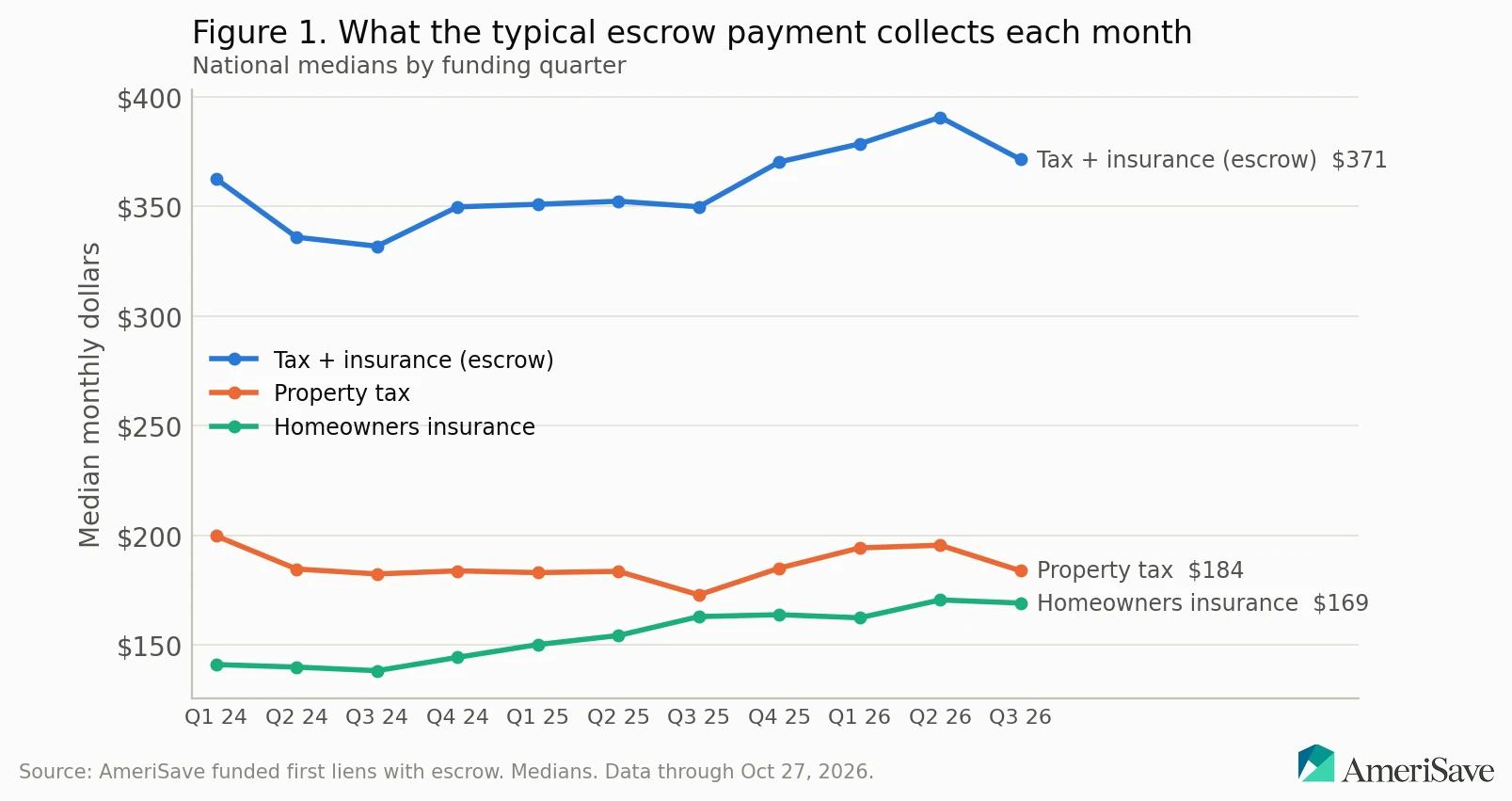
The median escrow payment in the data rose from $349.82 to $371.39 a month over the past year, up 6.2%. Figure 1 shows the tax, insurance, and combined escrow lines by quarter.

How an Escrow Shortage Turns Into a Higher Payment
Coming from Australia, I still think the American habit of folding taxes and insurance into the mortgage payment is a tidy piece of financial engineering. Your servicer collects a twelfth of the annual bills each month, holds the money in an escrow account, and pays them when they come due. The CFPB's definition is plain: an account your lender sets up to pay certain property-related expenses on your behalf.
The trouble is that the bills change and the collection doesn't, at least not until the servicer looks. Regulation X requires an annual escrow analysis: the servicer compares what it collected with what it paid, projects the coming year, and adjusts your payment. If the account came up short, you get a shortage notice. If the shortage is less than one month's escrow payment, the servicer can ask for it within 30 days or spread it over 12 months; if it's larger, the servicer must spread it over at least 12 months. The new monthly amount carries both the catch-up and the higher go-forward collection, so the increase lands in a single step.
On a fixed-rate loan, principal and interest never change, so everything that moves in your payment moves through escrow, and both escrow components rose over the past year: property tax from $172.84 to $183.81 a month, up 6.3%, and homeowners insurance from $162.95 to $169.12, up 3.8%.
The Insurance Shock Is Fading as a Rate of Change
Look at the year-over-year insurance growth by quarter and the shape is unmistakable. It ran +6.5%, then +10.3%, then peaked at +17.8% a year ago, then +13.5%, +8.1%, +10.5%, and +3.8% in the latest quarter. Over two full years insurance is up 22.3%, the number in the title. Over the past year alone, the increase is under 4%.
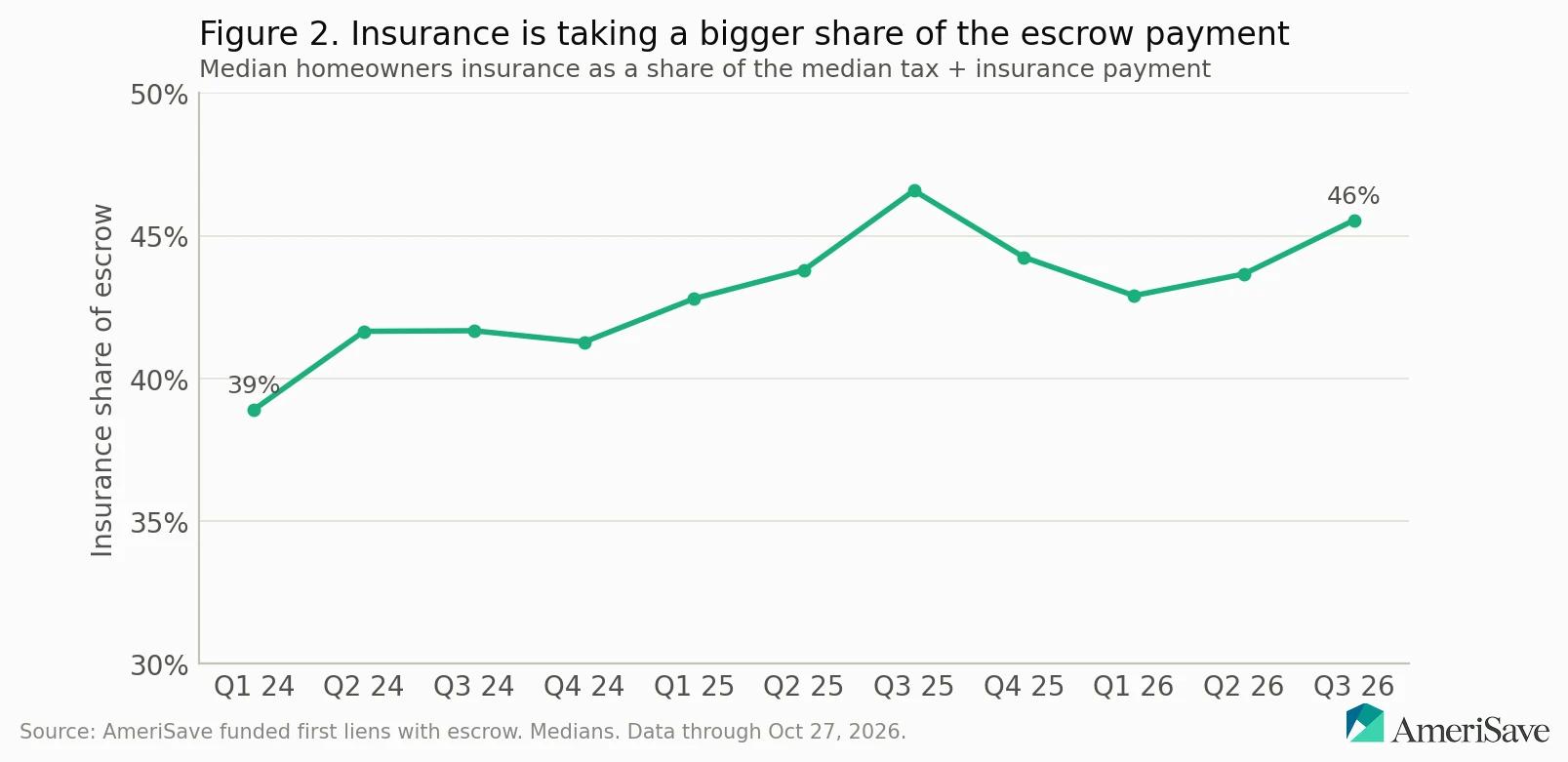
Insurance's share of the escrow payment tells the same story from a different angle. Ten quarters ago, homeowners insurance was about 39% of the median escrow payment. It climbed to a peak of 46.6% a year ago, eased, and now sits at 45.5%. Figure 2 shows that share by quarter, from about 39% to about 45%.
I want to be careful with the word "over." Premiums didn't fall. The median insurance payment still rose $6.17 a month over the past year, and Michigan, Washington, and South Carolina each saw insurance rise more than 16% in a single year. What ended is the national acceleration. In capital markets we'd call it a second-derivative turn, and those turns rarely get noticed in real time because the level still hurts.
Property Tax Is the Line That Catches Up Next
Now look at property tax over the same seven quarters: -8.4%, -0.6%, -5.2%, +0.7%, +6.2%, +6.5%, and +6.3% now. For three quarters the tax line fell while insurance surged. Then it turned, and it has posted three straight quarters above 6%. Over two years property tax is up only 0.8%, which is why nobody is writing headlines about it. Over the past year it rose faster than insurance, 6.3% against 3.8%.
The first reason is timing. Property tax is billed on a value an assessor set in the past, and reassessment cycles vary by jurisdiction from annual to several years apart. Home values in the data were falling or flat for four of the last seven quarters and then rose 5.8%, 8.7%, and 5.7% year over year in the last three. The tax bills that reflect those higher values haven't all arrived yet. That lag is the pipeline the next escrow increase will come out of.
The second reason is more important for how you should read this whole report. The tax-and-insurance rate on value, meaning annual taxes plus insurance divided by appraised value, was 1.4403% a year ago and 1.4417% now. Up 0.1%. Flat. The median appraised value in the data rose 5.7% to $318,850, and the median escrow payment rose 6.2%. Most of the national escrow shock, in other words, is the cost of owning a more valuable house; the asset got bigger. That's a very different problem from a state where the burden rate itself climbed, and those states are the ones I'd worry about.
Homeowners Insurance vs Property Tax: 12 States Where the Order Flipped
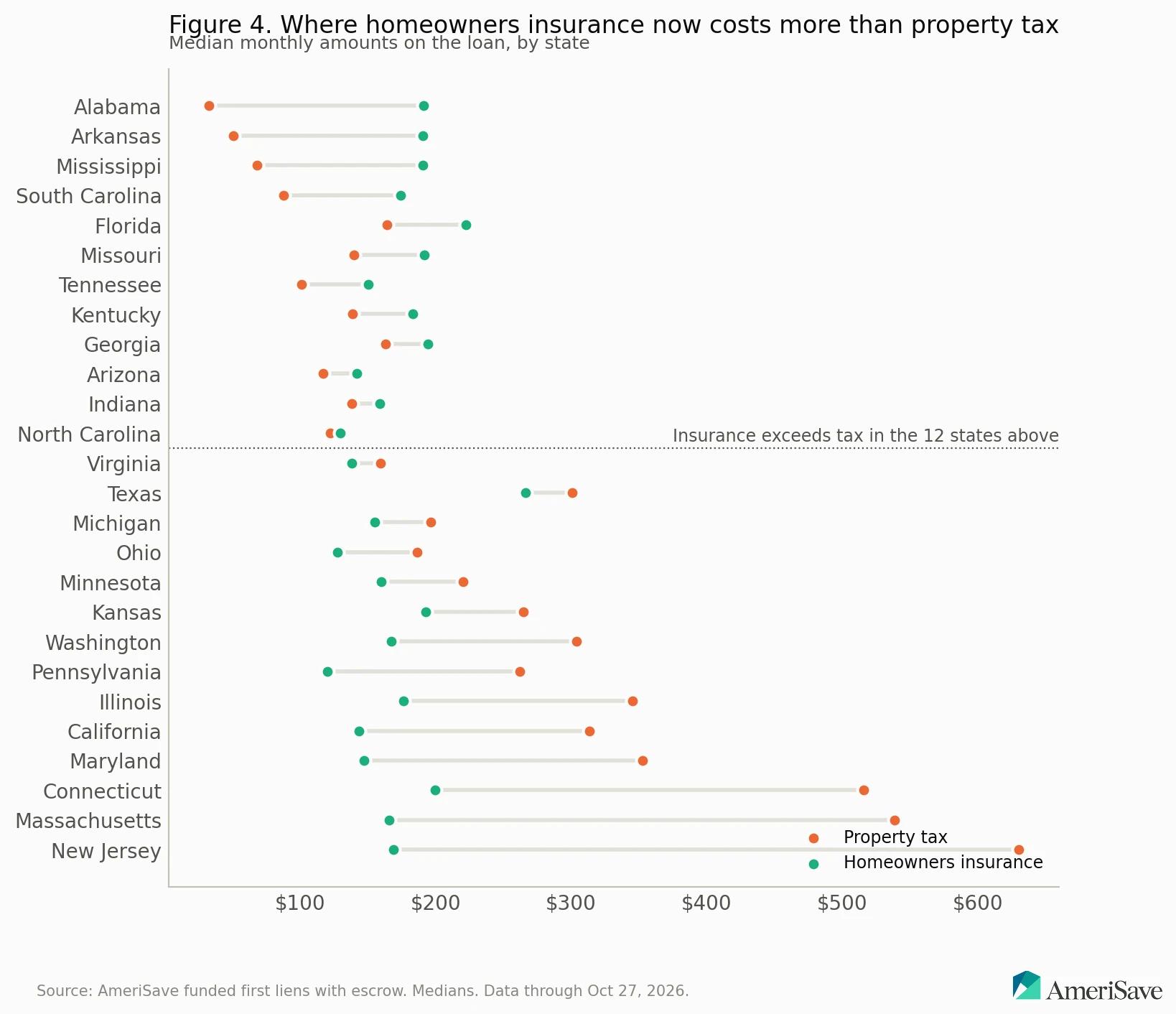
Nationally, property tax is still the larger line, $183.81 against $169.12 a month. In 12 of the 26 published states, that order has flipped. Figure 4 plots insurance against tax by state with those 12 highlighted, and the table below lists them.
| State | Median monthly insurance | Median monthly property tax |
|---|---|---|
| Alabama | $191 | $33 |
| Arkansas | $190 | $51 |
| Mississippi | $191 | $68 |
| South Carolina | $174 | $88 |
| Missouri | $192 | $140 |
| Kentucky | $183 | $139 |
| Tennessee | $150 | $101 |
| Georgia | $194 | $163 |
| Indiana | $159 | $138 |
| Arizona | $142 | $117 |
| Florida | $222 | $164 |
| North Carolina | $130 | $122 |
Alabama is the extreme case. Insurance at $191 a month against $33 of property tax means insurance is 84% of the escrow payment, and a borrower there who wants a lower payment should start with the insurer. The same shape runs across the Gulf and the Southeast, which I read as low effective property tax meeting storm exposure that insurers price for. Florida belongs on the list at $222 against $164, the highest insurance dollars of the 12, though Florida borrowers in this data saw smaller escrow growth than most states over the past year, up 5.4%.
At the other end, the tax-heavy states look nothing like this. New Jersey borrowers pay a median $630 a month in property tax against $169 in insurance, Massachusetts $539 against $166, and Connecticut $516 against $200. In those states the insurance renewal is a footnote and the assessment notice is the whole story. The split matters because the two lines respond to different levers: you can shop insurance every year; you can't shop your county.
The States That Should Worry
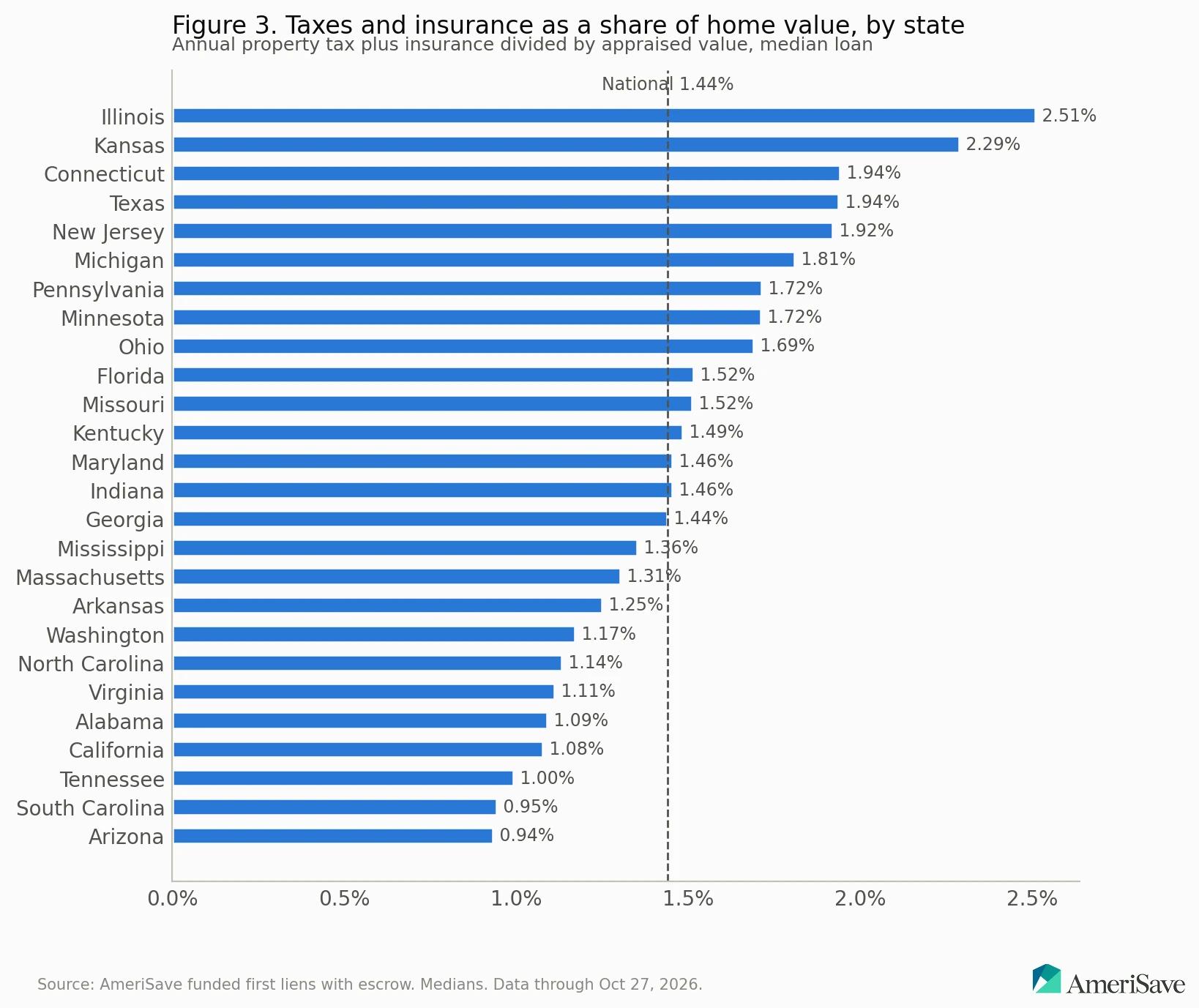
Figure 3 ranks the published states by burden rate, annual tax plus insurance as a share of home value, with the national 1.44% drawn as a line. Illinois leads at 2.51%, then Kansas at 2.29%, Connecticut and Texas at 1.94%, and New Jersey at 1.92%. At the light end sit Arizona at 0.94%, South Carolina at 0.95%, and Tennessee at 1.00%. The full 26-state table below carries the escrow, tax, insurance, and home value changes alongside the burden rate.
| State | Median monthly escrow | Escrow change | Tax change | Insurance change | Home value change | Tax + insurance as % of value |
|---|---|---|---|---|---|---|
| Washington | $531 | 33.4% | 16.7% | 22.9% | 17.1% | 1.17% |
| Maryland | $492 | 32.1% | 45.9% | 12.7% | 13.6% | 1.46% |
| Virginia | $344 | 26.7% | 16.4% | 10.5% | 11.6% | 1.11% |
| South Carolina | $293 | 24.7% | 36.5% | 16.9% | 12.2% | 0.95% |
| Michigan | $361 | 15.8% | 13.1% | 26.7% | 10.8% | 1.81% |
| Texas | $583 | 15.0% | 20.2% | 6.9% | 22.2% | 1.94% |
| Connecticut | $716 | 14.8% | 22.7% | 2.8% | 16.4% | 1.94% |
| Indiana | $304 | 14.0% | 22.8% | 16.8% | 7.5% | 1.46% |
| Pennsylvania | $380 | 11.1% | 17.6% | 2.2% | 8.5% | 1.72% |
| Arkansas | $258 | 10.2% | -18.9% | 9.2% | 13.8% | 1.25% |
| Kentucky | $316 | 9.8% | -3.9% | 12.2% | -1.2% | 1.49% |
| Florida | $441 | 5.4% | 2.6% | 2.9% | 8.2% | 1.52% |
| Illinois | $505 | 5.0% | -2.0% | 13.2% | 3.3% | 2.51% |
| Tennessee | $266 | 3.7% | 10.0% | 0.2% | 1.7% | 1.00% |
| Georgia | $359 | 2.6% | -3.5% | 4.9% | 2.7% | 1.44% |
| Kansas | $467 | 1.2% | 5.1% | -15.8% | 2.2% | 2.29% |
| Arizona | $280 | 1.2% | -11.1% | 10.4% | -14.8% | 0.94% |
| New Jersey | $802 | -1.2% | 2.8% | 0.8% | -0.2% | 1.92% |
| Minnesota | $406 | -1.2% | -12.6% | -19.3% | -13.0% | 1.72% |
| Ohio | $313 | -3.1% | -0.7% | 2.0% | 6.8% | 1.69% |
| Mississippi | $284 | -4.1% | 22.7% | -19.4% | 10.8% | 1.36% |
| Massachusetts | $684 | -4.3% | 6.5% | -4.9% | 4.0% | 1.31% |
| California | $482 | -4.6% | -1.9% | 16.5% | 12.1% | 1.08% |
| Missouri | $326 | -4.7% | -9.5% | 6.1% | -0.7% | 1.52% |
| North Carolina | $281 | -4.9% | -12.0% | -7.8% | -7.0% | 1.14% |
| Alabama | $227 | -12.1% | -38.9% | -1.6% | -13.0% | 1.09% |
A high burden rate is a cost of living in a state. A rising burden rate is a trend, and the trend is what should change your behavior. Six states saw the tax-and-insurance rate on value rise at least 5% over the past year: Arizona +14.4%, Virginia +14.1%, Michigan +12.8%, Tennessee +7.0%, Kentucky +6.6%, and Maryland +5.7%. The payment got heavier relative to the house, and that's the pattern I'd expect to continue as assessments catch up.
The biggest escrow jumps were in Washington (+33.4%), Maryland (+32.1%), Virginia (+26.7%), and South Carolina (+24.7%). Maryland's increase was tax-led, up 45.9%, and so was South Carolina's, up 36.5%. Washington's was both, with tax up 16.7% and insurance up 22.9%. Texas, at $583 a month, saw values rise 22.2% while its burden rate fell 1.4%; Texas borrowers in the data are paying more because they're financing pricier homes.
Nine states posted lower median escrow than a year earlier. California's two-year picture is the one to study: insurance there rose 25.6% over two years and escrow still fell 7.4%, because the tax line fell. Each quarter's state figure is a median of different loans, so some of that is who refinanced rather than what assessors did, and I'd hold the state-level decreases more loosely than the national lines.
Budgeting for the Two Lines You Never Shop
Frequency and magnitude is the lens I use for almost everything. The escrow increase is high frequency and moderate magnitude: it lands every year, by design, and this year it was $21.57 a month at the median. The rate on your note is low frequency and high magnitude: set once, governing the biggest line for the life of the loan. Households budget for the second and get surprised by the first, even though the first is the predictable one.
The fix is a budget line. Nationally, the data says tax and insurance together run 1.44% of home value a year, and the median escrow payment works out to about $116 a month per $100,000 of home value. Round the rate to 1.5% and you have a rule you can carry around: on a $318,850 home, the median appraised value in the data, that's about $4,800 a year. If you live in Illinois, Kansas, Connecticut, Texas, or New Jersey, use 2% or more; the burden rate ranking says you're already there. Then assume the number grows with your home's value; the flat burden rate over the past year is exactly that relationship holding.
The other half of the fix is shopping the line you can shop. Another carrier may price your roof, your claims history, and your deductible differently. Taxes aren't negotiable, but assessments are appealable, and the appeal window usually opens when the notice arrives, before the bill shows up in your escrow analysis. Ask your servicer when the annual analysis runs, and get a lower premium or a successful appeal on file before that date; one that lands after waits for the next cycle.
The Lever Big Enough to Absorb It
If you've received a shortage notice, you have three choices, in rough order of size. Pay the shortage in a lump sum and accept the higher go-forward collection. Shop the insurance and appeal the assessment, which trims at the margin. Or restructure the loan, the only lever large enough to swallow the increase whole.
A worked example, illustrative only. The median loan amount in the data is $195,360. The median escrow payment rose $21.57 a month over the past year. On a 30-year fixed loan of that size, each half-point reduction in rate lowers principal and interest by roughly $60 to $65 a month, using the rate range borrowers have seen over the past two years. That's about three times the escrow increase. One half point covers this year's escrow step-up and the next two like it. Whether a half point is available to you depends on where you locked, where the market is, and your credit and equity, and that's a question for a quote.
The timeline question comes first, as it always does. If you plan to stay in the home for years, a rate-and-term refinance is the move with the magnitude to matter. If you're carrying a large shortage, a deficiency, or a tax bill you'd rather not fund from savings, a cash-out refinance can fold that into the loan, and AmeriSave's cash-out refinance is built for that use. If your horizon is short, don't refinance to solve an escrow problem; take the 12-month spread and shop the insurance.
Methodology
The Escrow Shock Index tracks the property tax and homeowners insurance built into the monthly payment on loans AmeriSave closed with an escrow account. The source is production loan data from AmeriSave's funded first mortgages; the monthly tax and insurance amounts are the figures on the borrower's final loan application at funding, and appraised value is the valuation used for the loan.
The population is funded first mortgages where the borrower escrows taxes and insurance: cash-out refinances, which are most of the volume, rate-and-term refinances, and purchases. HELOCs, home equity loans, and loans where the borrower waived escrow are excluded, and mortgage insurance and HOA dues aren't counted in any figure.
Median monthly escrow is the median across loans of monthly property tax plus homeowners insurance plus any supplemental property insurance; because these are medians, the tax median plus the insurance median won't equal the escrow median. Median monthly property tax and median monthly homeowners insurance are the medians of those two application amounts. The tax-and-insurance rate on value, which this article calls the burden rate, is each loan's yearly tax plus insurance divided by its appraised value, with the median of those rates published as a %. Insurance share of escrow is the insurance median divided by the escrow median for the same quarter. A published state is one with at least 30 escrowed loans in both compared quarters; states below that floor stay in the national row but aren't ranked or named, which leaves 26 published states.
The period is the third quarter of this year against the same quarter a year earlier, with a two-year view against the same quarter two years earlier where both endpoints clear the floor. Data through October 27.
Each quarter's figure is a median of a different set of new borrowers, not the same homeowners' bills a year apart, so a shift toward pricier homes, different states, or a different product mix moves the median even when no bill changed, and part of any state change is who refinanced rather than what assessors or insurers did. Tax amounts on new originations can reflect stale or land-only bills on recently built or recently sold homes, so tax changes describe what escrow accounts are collecting, not assessed values. The figures describe AmeriSave borrowers who closed an escrowed first mortgage in the quarter, not all homeowners in a state.
The Bottom Line
The insurance shock is over as a rate of change, and the property tax catch-up is next. Insurance rose 22.3% in two years and then slowed to under 4% over the past year, while property tax has now posted three quarters above 6% with one to three years of home price gains still to work through. Nationally the burden rate held at 1.44% of home value, so most of the escrow increase is the cost of owning a more valuable house. In Arizona, Virginia, Michigan, Tennessee, Kentucky, and Maryland, the burden rate itself rose, and those borrowers should be doing the arithmetic now.
From where I sit in Newport Beach, the pattern I've watched for three decades is consistent: homeowners obsess over the one line they can't change after closing and ignore the two that keep moving. Budget 1.5% of home value a year for taxes and insurance, 2% or more in the heavy states, shop the insurance every renewal, and appeal the assessment when the notice arrives. None of those moves has the magnitude of the loan itself. Wealth in housing comes from a handful of good decisions made for the right reasons, and resetting the largest line in your payment when the market allows is one of them. Run a rate check against your current loan before the next escrow analysis, and if the number works, AmeriSave's rate-and-term refinance is where that decision gets made.
AmeriSave internal funded-loan data, Escrow Shock Index, first liens funded with escrow, data through October 27, 2026. Internal, not publicly available.
Consumer Financial Protection Bureau, Regulation X, 12 CFR 1024.17, Escrow accounts; supports the annual escrow analysis and shortage repayment mechanics:
Consumer Financial Protection Bureau, "What is an escrow or impound account?"; supports the escrow account definition:


Cam brings 30 years of expertise in capital markets, residential mortgage lending, and risk management to AmeriSave. A Certified Mortgage Banker (CMB) with dual degrees in Business with a Finance & Economics specialization, he previously led capital markets at GoodLeap and managed derivative books at Discover Financial. Originally from Australia, he is now a single father of two based in Newport Beach, CA, focused on translating complex market dynamics into actionable insights for homeowners and industry professionals.
Frequently Asked Questions
Because the escrow portion changed. On a fixed-rate mortgage, principal and interest stay the same for the life of the loan, but the property tax and homeowners insurance your servicer collects alongside them are re-estimated once a year in an escrow analysis. If the bills paid out of the account were higher than projected, the servicer raises your monthly collection to match the new bills and adds a catch-up amount for the shortage. In the data, the median escrow payment rose $21.57 a month over the past year, with tax up 6.3% and insurance up 3.8%. Your shortage notice itemizes both pieces, and it's worth reading line by line.
An escrow shortage is the gap between what your account holds and what it needs to hold under the servicer's projection for the coming year. Federal escrow rules give you options. If the shortage is less than one month's escrow payment, the servicer can ask for it within 30 days or spread it over 12 months. If it's one month's payment or more, the servicer must offer to spread it over at least 12 months. You can also pay it in a lump sum at any time, which removes the catch-up portion from your payment but leaves the higher go-forward collection in place. Read the notice carefully; both numbers are shown separately.
Yes, in some cases, though it depends on your loan type, your equity, and your servicer's policy. Conventional loans often allow an escrow waiver once you've built enough equity and have a clean payment history, sometimes with a fee or a pricing adjustment. Government-backed loans generally require escrow for the life of the loan. Removing escrow doesn't lower the bills; it moves them from twelve monthly installments to a few large payments you fund yourself, and the shortage mechanism disappears because you're paying the actual bills directly. If budgeting discipline is the real issue, keeping escrow is usually the safer structure for you.
No. A refinance replaces the loan, and the tax bill and insurance premium belong to the property and the policy. What a refinance can do is change the principal and interest portion of the payment, which is the largest line and the only one with the magnitude to offset an escrow increase. In the illustrative example above, each half-point reduction on a loan the size of the data's median lowers principal and interest by roughly $60 to $65 a month, about three times the past year's escrow increase. A cash-out refinance can also fund a large shortage or a tax bill. Whether either option works depends on the rate you hold today and the quote you can get.
Measured as a share of home value, Illinois leads the published states at 2.51% a year, followed by Kansas at 2.29%, Connecticut and Texas at 1.94%, and New Jersey at 1.92%, against a national 1.44%. Measured in monthly dollars, New Jersey's median escrow is highest at $802, then Connecticut at $716, Massachusetts at $684, Texas at $583, Washington at $531, and Illinois at $505. The lowest monthly escrow payments in the data are Alabama at $227, Arkansas at $258, Tennessee at $266, Arizona at $280, and North Carolina at $281. Those low-dollar states are also where insurance tends to be the larger of the two lines.
Every renewal, and at minimum once a year. The premium is the one escrow component you can change by making a phone call, and in 12 of the 26 published states it's already the larger of the two lines. Get competing quotes four to six weeks before the renewal date, match the coverage and deductible so the comparison is fair, and ask your current carrier to review the premium before you switch. Time it so a lower premium is on file before your servicer runs its annual escrow analysis; a premium that drops after the analysis won't lower your payment until the next cycle, and by then another renewal is due.