




 Fact Checked
The House Rich, Cash Poor Paradox
On paper, American homeowners have rarely looked wealthier. Households are sitting on roughly $35 trillion in home equity, near record levels. But equity doesn’t pay the electric bill, and for a growing share of owners, the monthly reality of keeping a home has drifted far from the wealth the home represents. To learn more about how homeowners are living in that gap, AmeriSave surveyed 1,000 U.S. homeowners about their finances, housing costs, and the choices those costs are forcing them to make. What emerged is a portrait of people who are asset-rich yet cash-strapped. They’re trimming savings and skipping vacations while sitting on real equity, and many are reaching for a credit card before tapping into their home equity. Yet others are comfortable where they are happy with their home and the equity it provides. We dove deep into both shares of people to find out how they feel about their biggest asset in today’s economy.
Key Takeaways
- Nearly 4 in 5 homeowners (79%) said utility costs have risen over the past three years, and 45% said their housing costs have now outpaced their income entirely.
- Property taxes have increased for nearly 3 in 4 homeowners (72%), ranking among the top budget strains alongside utilities (49%), homeowners insurance (41%), and major repairs (32%).
- Two-thirds (66%) said their home’s value has gone up, but they don’t feel financially better off because of it, and 43% describe themselves as “house rich and cash poor.”
- More than half (53%) have already cut discretionary spending because of housing costs, nearly 1 in 4 (24%) have taken on extra work just to keep up, and 37% have scaled back retirement savings contributions.
- Nearly half (49%) of homeowners worry that climate or weather-related risks will make their home harder or more expensive to insure, and 4 in 10 (41%) are questioning whether rising insurance costs will let them afford to stay long term.
- More than 1 in 3 homeowners (35%) say they would consider moving but feel constrained by affordability factors, including their current mortgage rate (14%) or the cost of buying elsewhere (21%).
- When asked where they’d turn in a financial emergency, homeowners are far more likely to reach for credit cards (64%) than home equity (43%), even as 4 in 5 report having at least some equity.
- A majority (55%) say they're happy where they are, and 46% feel financially comfortable staying long term. Only 10% have actually sold in the past year.
- Four in five homeowners report having at least some equity, with 42% describing it as substantial and 41% as moderate.
- Over half of homeowners (51%) said owning their home has been more financially stressful than expected, and just 1 in 5 (19%) view their home equity as a long-term wealth-building asset.


Being a Homeowner Is More Expensive Than Ever
For years, the down payment has been like the finish line. You save, you stretch, you sign, and the hard part is supposedly over. Then the bills start arriving. The utility costs creep up. So do the tax assessment and the insurance renewal. For most homeowners, their income has not kept up with these rising prices.
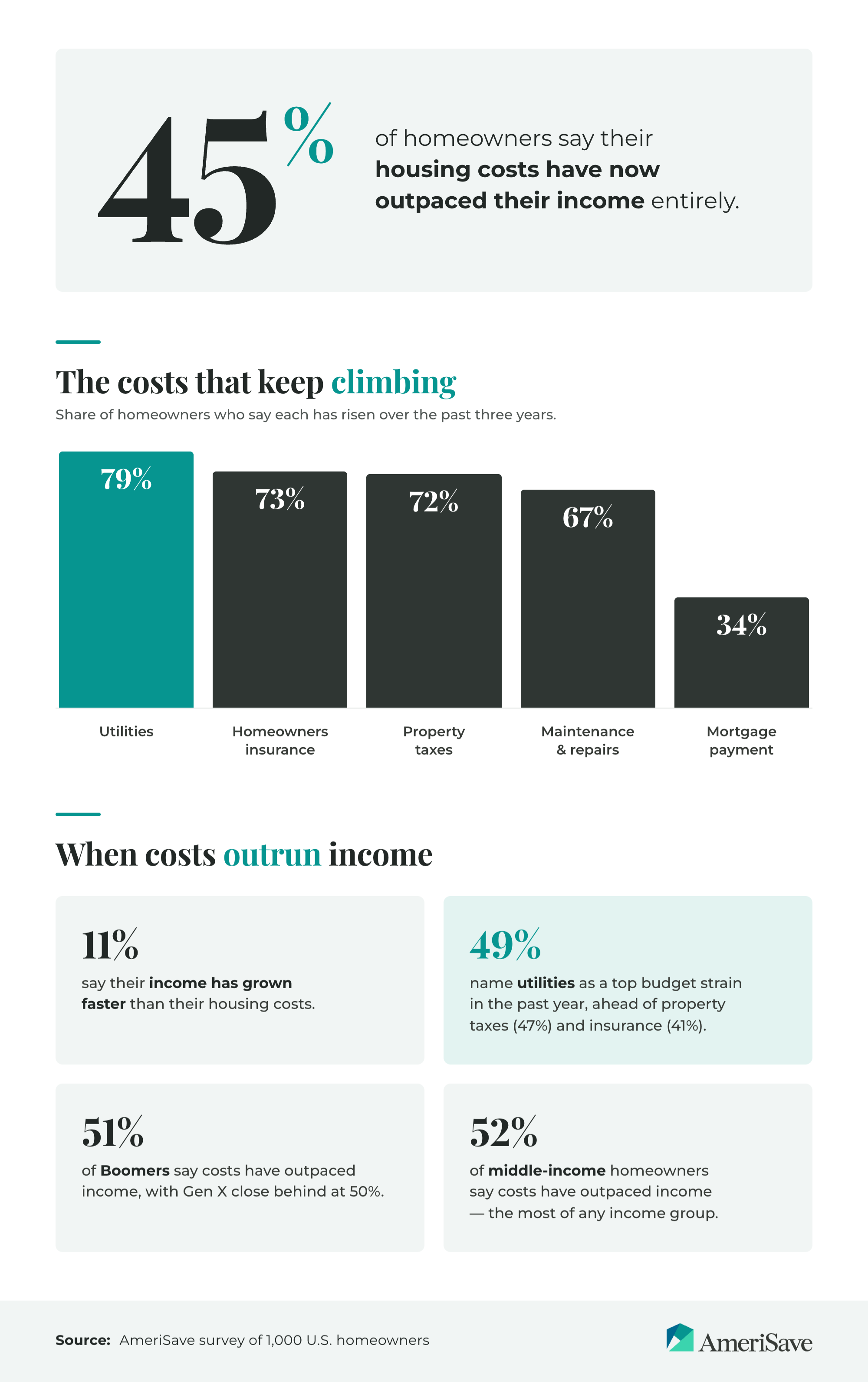
Nearly four in five homeowners (79%) said their utility costs have climbed over the past three years, while 73% said the same about homeowners insurance, and 72% about property taxes. Those tax increases track a national pattern. The average single-family property tax bill rose 3.7% in 2025, outpacing inflation.
What makes those bills difficult to bear is the fact that salaries have not risen alongside them. Nearly half of homeowners (45%) said their housing costs have now overtaken their income entirely, and only 11% said their income has grown faster than the cost of keeping their home. For another 22%, costs and income have risen at roughly the same rate, representing a share of homeowners who are treading water financially.
The pressure wasn’t limited to the predictable monthly bills, either. Maintenance and repair costs have risen for 67% of owners, with 26% calling the increase significant. Nearly a quarter (23%) said an emergency repair to plumbing, heating, or electrical systems strained their budget in the past year alone. When asked which expenses hit hardest over the past 12 months, homeowners pointed to utilities (49%), property taxes (47%), homeowners' insurance (41%), and major repairs (32%). The mortgage payment itself was rarely the villain: only 34% saw it rise, and every surrounding cost category outpaced it.
The squeeze also lands hardest on homeowners furthest along in their homeownership. Half of Gen X (50%) and 51% of baby boomers said housing costs have overtaken their income, compared with 45% of millennials and 32% of Gen Z. Older homeowners tend to have smaller mortgage balances, but they are also the most likely to be living on a fixed or retirement income, and a fixed income gets eaten up by rising costs even when the mortgage is small or gone entirely. By income, middle earners feel it most (52%), edging out lower earners (46%) and sitting well ahead of higher earners (37%). That middle-income result is telling; it’s the group with the least room to absorb a surprise and the least access to the cushions wealthier homeowners can lean on.

House Rich, Cash Poor
Rising home values are supposed to feel like good news. For millions of homeowners, the numbers on the listing estimate have never been higher. Ask them how their finances actually feel, though, and the distance between paper wealth and lived experience comes into focus.
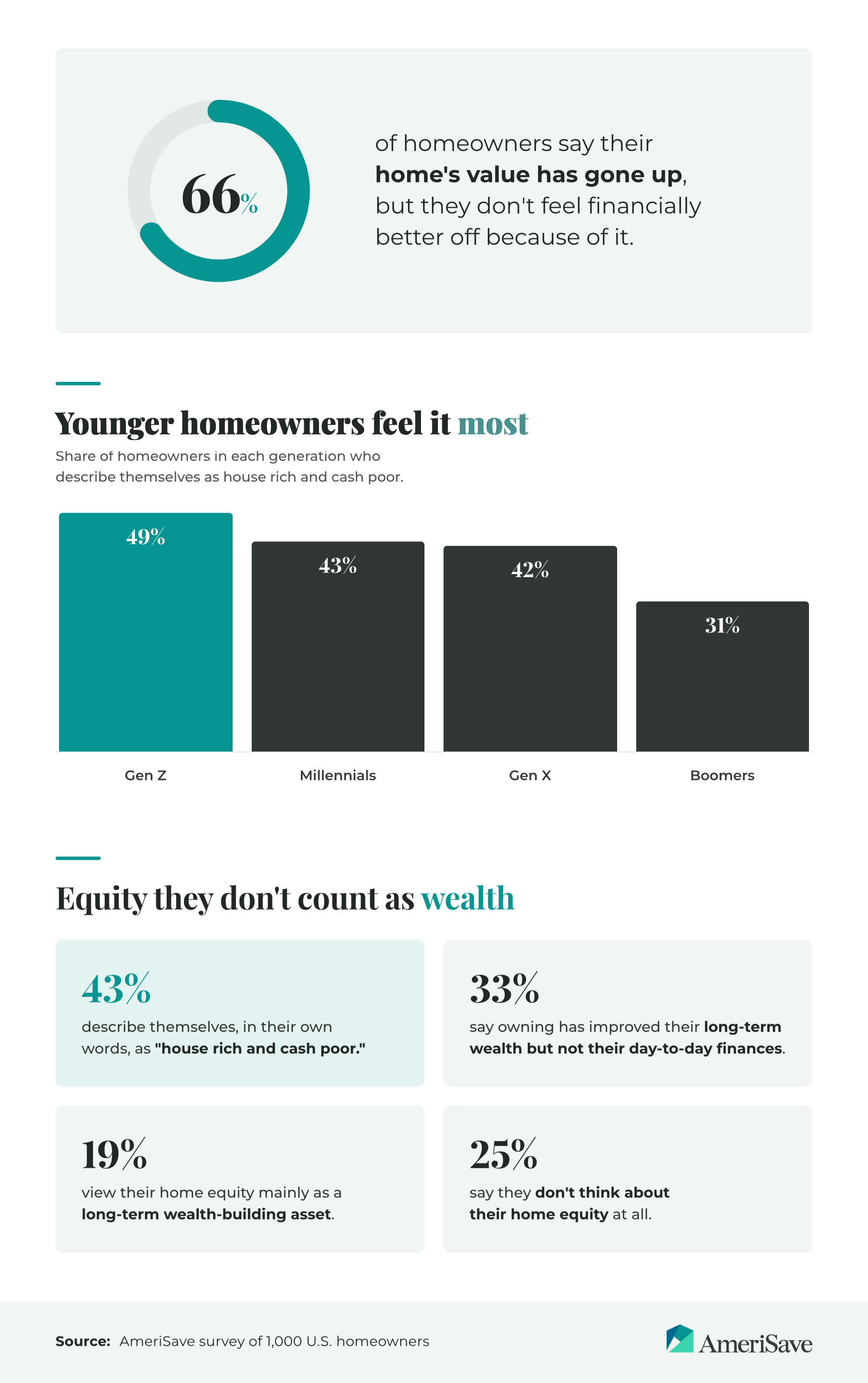
Two-thirds of homeowners (66%) said their home’s value has gone up without making them feel any better off financially, and 43% identified with the phrase “house rich and cash poor.” The label isn’t evenly distributed. Nearly half of Gen Z homeowners (49%) describe themselves that way, along with 43% of millennials and 42% of Gen X, but only 31% of Boomers. The split makes sense. The younger homeowners bought more recently, at higher prices and higher rates, with less equity built and thinner savings to fall back on, so the same costs eat a larger share of what they earn.
Part of what makes equity feel abstract is that many homeowners don’t think of it as money at all. Just 19% view their home equity primarily as a long-term wealth-building asset. Another 22% see it mainly as a financial safety net, and 12% as a tool they might one day have to lean on. A full quarter (25%) said they don’t think about their equity at all, which leaves one in four homeowners effectively disengaged from the single largest asset they own.
The result is a divide between long-term wealth and day-to-day comfort. A third of homeowners (33%) said homeownership has improved their long-term financial position but not their everyday finances, while 32% said it has improved both. For 12%, owning a home has actively strained or worsened their daily finances. Even among those who can comfortably cover the cost of the home, 30% said doing so requires significant financial trade-offs.
What separates those two groups is smaller than it looks. The cash-poor feeling sits on a genuine asset base rather than a thin sliver of one. Only 8% report having very little equity, and another 11% aren't sure how much they have. For most of these homeowners, the wealth is already there. The question is whether they know how much equity they've built and what it would take to reach it.
Americans Are Making Sacrifices To Keep Their Homes
The real cost of a home doesn’t always show up on the monthly statement. Sometimes it’s the trip that never got booked, the retirement contribution that got skipped, or the decision to start a family that slid another year down the road. Many homeowners aren’t just adjusting their budgets. They’re rewriting the entire plan.
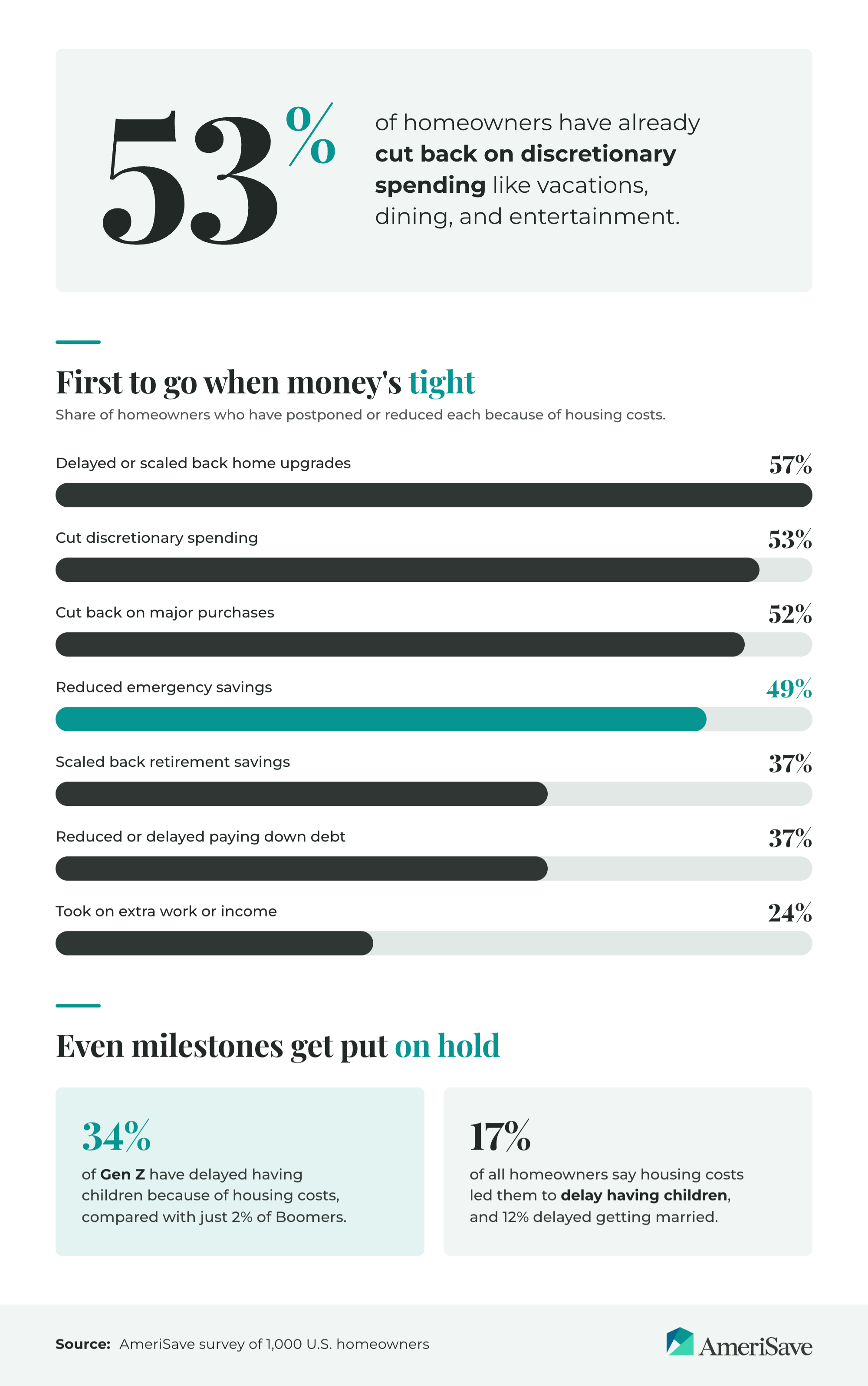
Most homeowners start with discretionary spending. The most common trade-off was delaying or scaling back home upgrades (57%), followed closely by cutting discretionary spending like vacations and dining out (53%) and pulling back on major purchases such as vehicles or appliances (52%).
From there, the cuts move closer to the bone. Nearly half of homeowners (49%) have reduced their emergency savings contributions, leaving themselves especially vulnerable to income interruption. More than a third have scaled back retirement contributions (37%) or delayed paying down non-mortgage debt (37%), and 32% have dipped into savings earmarked for other goals. To keep up, 24% have taken on extra work or additional income, and 23% have taken on credit card debt to cover housing costs. In other words, a meaningful number of homeowners are paying for a long-term asset by drawing down other forms of long-term security.

Across all homeowners, 17% said housing costs have led them to delay having children or growing their family, and 12% have put off getting married. Among Gen Z, those numbers jump sharply: 34% have delayed having children, and 24% have delayed marriage, compared with just 2% of Boomers who said the same. Zoomers are also cutting their emergency savings (54%) and retirement savings (48%) at far higher rates than Boomers (37% and 27%, respectively). The generational pattern is consistent. The homeowners with the longest road ahead are giving up the most to stay on it–but they also have the most to gain from their sacrifices.
Homeowners Are Protecting Their Equity, But Not Their Credit
Most homeowners have equity… a lot of it. But when the water heater gives out, or an unexpected bill arrives, they reach for a credit card. The gap isn’t really about access; most of these homeowners could borrow against the house if they chose to. The missing piece is awareness of equity as a tool, rather than just a hypothetical number.
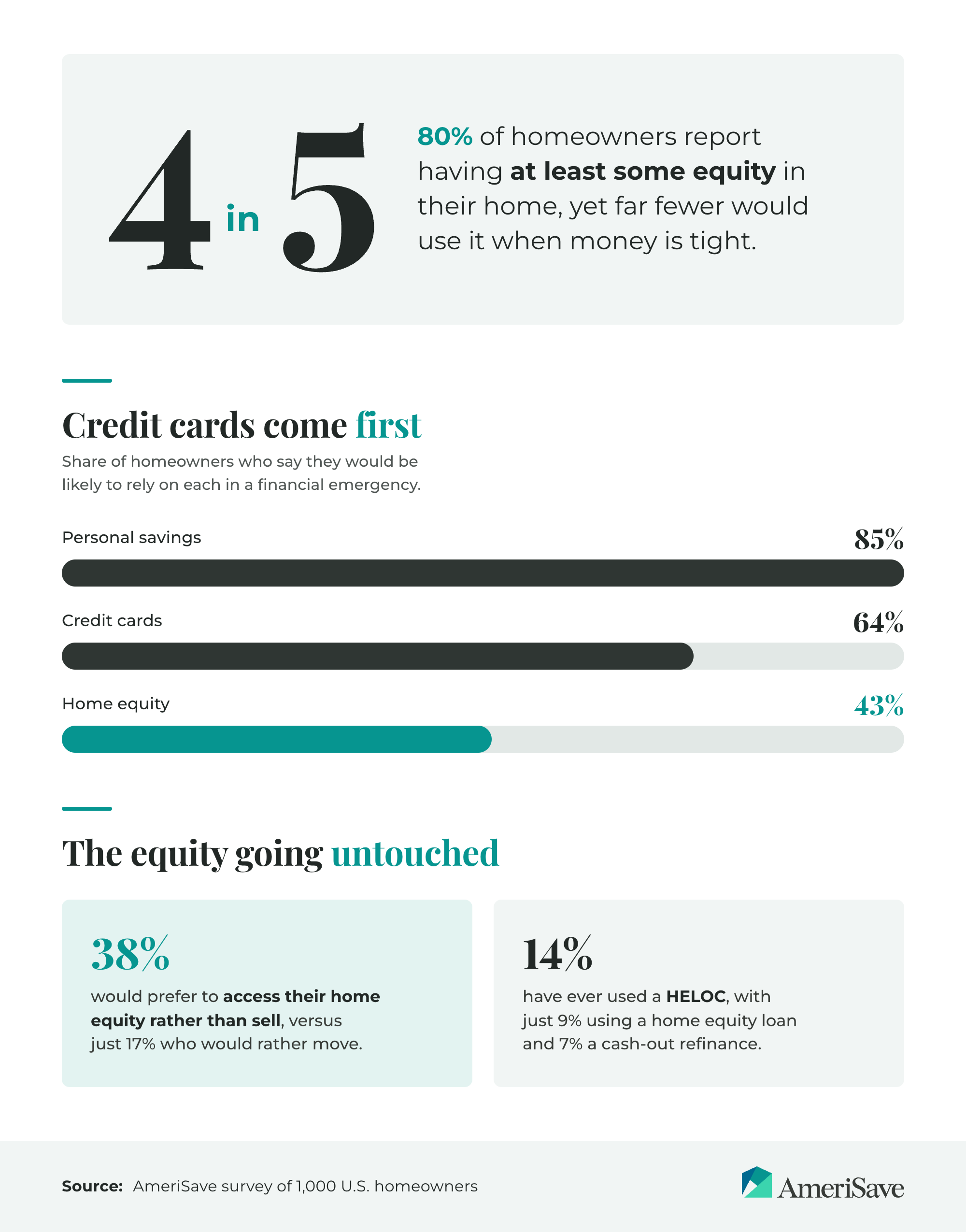
Four in five homeowners report having at least some equity, with 42% describing it as substantial and 41% as moderate. Yet faced with a financial emergency, only 43% said they would tap into that equity, while nearly twice that amount (85%) would dip into their savings. Another 64% would utilize a credit card, despite the average credit card carrying an interest rate of around 21%. The average interest rate of a home equity loan is below 8%, meaning those who reach for the card are paying more to borrow less.
The unfamiliarity shows up in the numbers. Relatively few homeowners have used the tools built to access equity: 14% have used or currently hold a HELOC, 9% have a home equity loan, and just 7% utilize a cash-out refinance. An additional 32% said they haven’t considered tapping their equity at all in the past year. Among those who would use their equity, the intended uses are practical: home repairs or maintenance (27%), emergency expenses (27%), home improvements (25%), and paying down debt (21%).
When the choice is framed as borrowing against the home rather than selling it, homeowners tend to stay. Over a third (38%) said they’d rather access their equity than sell, against just 17% who’d prefer to sell. The contrasts run along gender and income lines. Men are more likely than women to tap equity rather than sell (41% versus 35%), while women are far more likely to say they’ve never considered accessing their equity at all (37% versus 25%). Women tend to be more risk-averse with their finances and seem more likely to let their equity grow before utilizing it. Men, though, tend to view their equity as a utilizable asset.
Homeowners of different incomes had different experiences: 20% of lower-income homeowners weren’t sure how much equity they have, compared with 9% of middle-income homeowners and just 4% of higher-income homeowners. The less financial cushion a household has, the more likely its largest asset is also its least understood.
Why Homeowners Aren’t Selling
Plenty of homeowners know something has to give. The costs are real, the stress is real, and for some, the math on staying barely works. Leaving, though, has its own price tag. Between low locked-in rates, a pricey resale market, and the cost of moving itself, a large share of homeowners find themselves wedged between financial pressure and a short list of options.
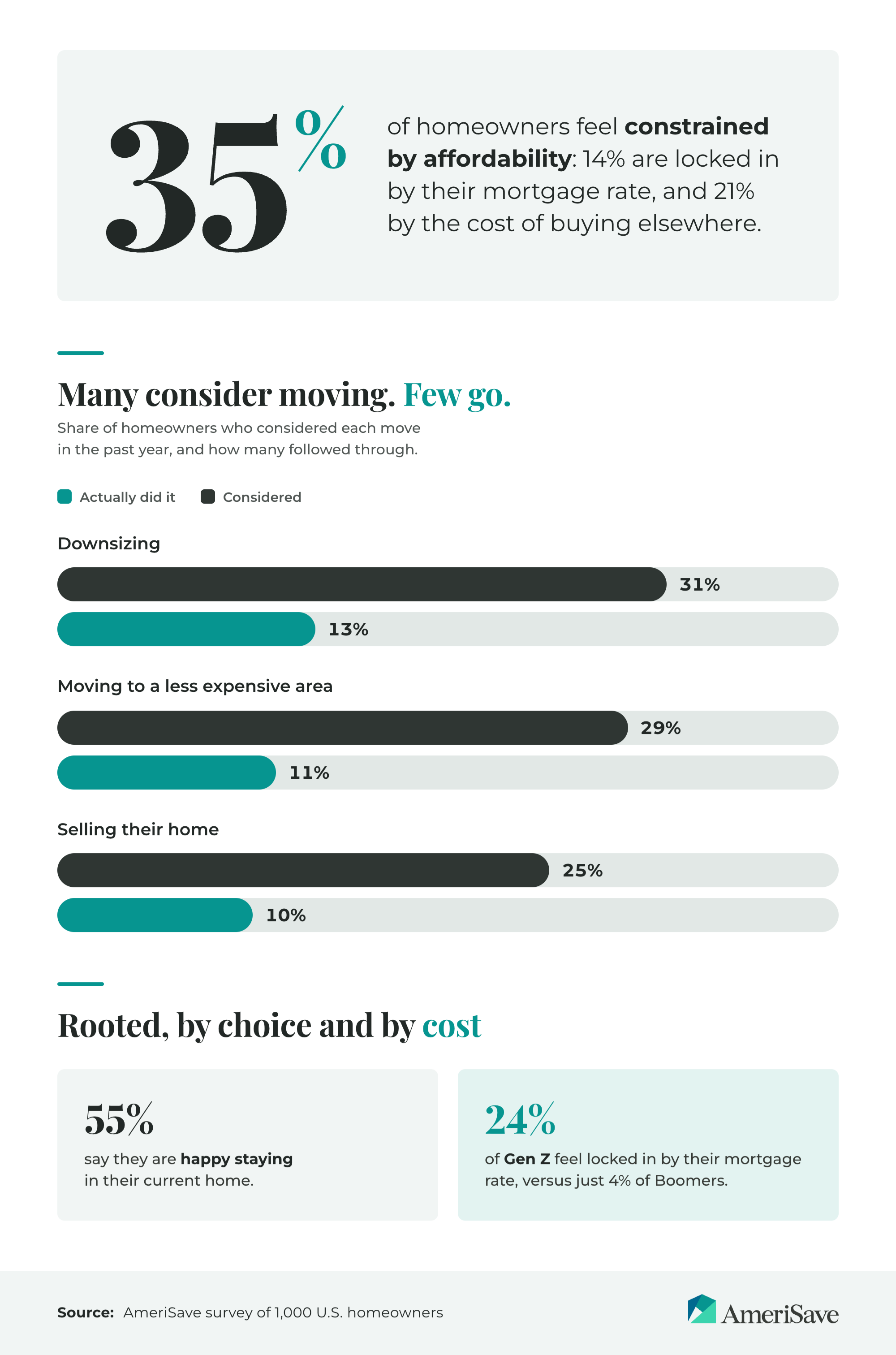
A majority of homeowners (55%) said they’re simply happy where they are. More than 1 in 3 homeowners (35%) say they would consider moving but feel constrained by affordability barriers. That includes 14% who feel locked in by their current mortgage rate and another 21% who say current home prices or costs make moving difficult. This is backed up by national data: the Federal Housing Finance Agency researchers found that for every percentage point by which today’s interest rates exceed a homeowner’s existing rate, the likelihood of selling falls by about 18%. Only a quarter (25%) have considered selling in the past year, and just 10% have done it. Downsizing (31% considered, 13% acted) and moving somewhere cheaper (29% considered, 11% acted) were also popular ideas among modern homeowners.
Gen Z was most likely to feel locked in by their rate (24%), compared with 18% of millennials, 8% of Gen X, and just 4% of Boomers. Homeowners who were able to buy in favorable times are naturally happier with their homes. By income, lower earners feel most constrained, with 37% locked in, compared with 36% of middle earners and 14% of higher earners.
Homeowners have concerns beyond the economy as well. Nearly half (49%) of homeowners are concerned that climate- or weather-related risks will make their homes harder or more expensive to insure, and 41% are openly questioning whether rising insurance costs will let them stay in the long term. Those concerns aren’t unfounded. A 2026 Government Accountability Office analysis found that while premiums rose only modestly nationwide, they climbed fastest in disaster-prone areas, where the link between climate risk and the cost of coverage is most direct. For homeowners who want to stay but feel the pressure building, the question becomes how to make the home work financially without leaving it.
Stress Test: The Emotional Reality of Owning a Home
Homeowners agree: buying a house is harder than they expected. It’s harder on the budget and harder on the nerves. But when asked whether they regret it, most said no. The stress is real, the commitment heavy, but having a home at the end of it is worth it for most Americans.
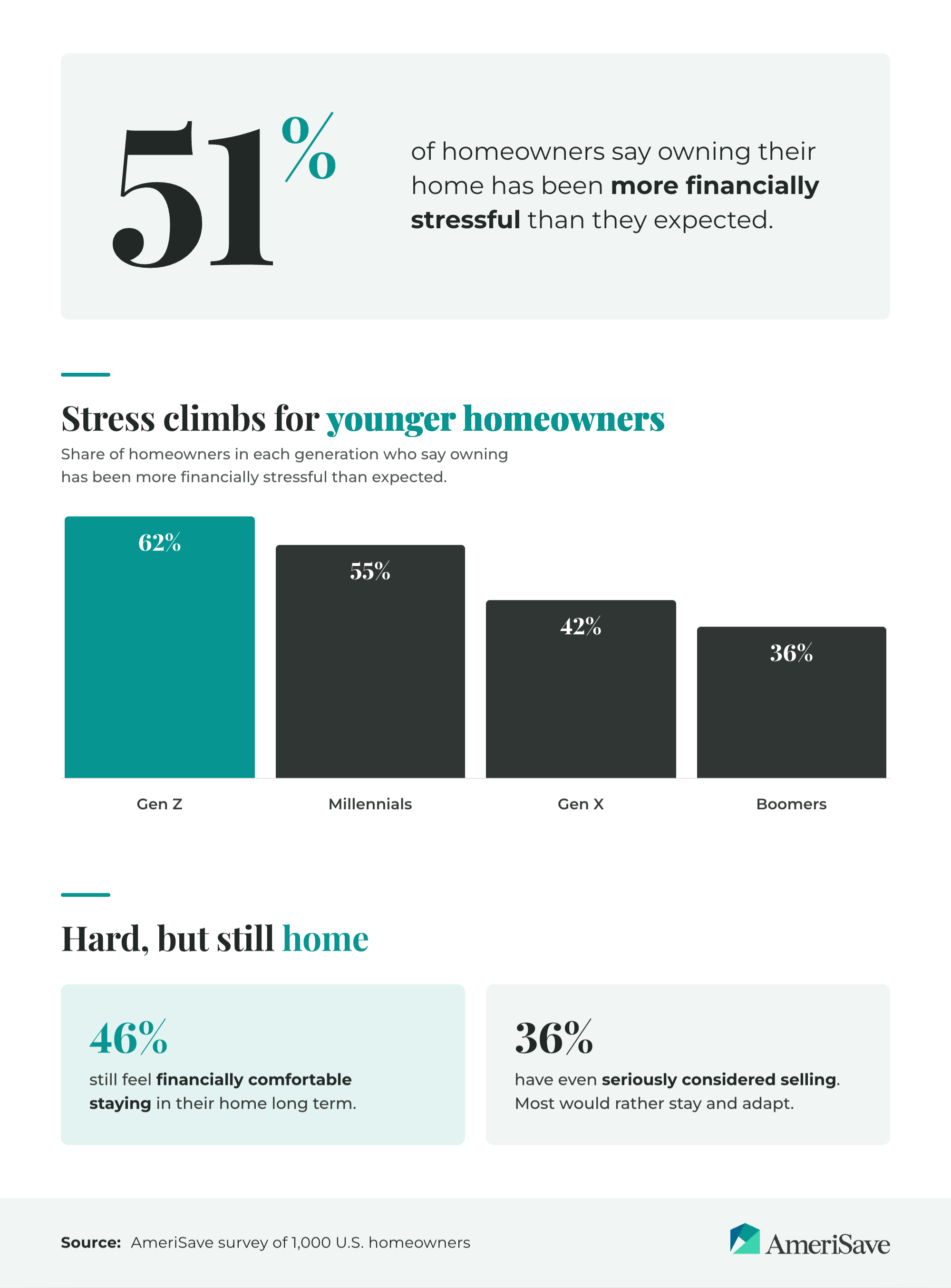
Over half of homeowners (51%) said owning has been more financially stressful than they expected. Yet 46% still feel financially comfortable staying long-term, and only 36% have even seriously considered selling. People are learning new ways to handle the stress rather than running away.
The stress climbs in near-perfect order by age. Among Gen Z, 62% said homeownership has been more financially stressful than expected, followed by 55% of millennials, and 42% of Gen X. Comfort runs the opposite way: Boomers report the lowest stress (36%) and the highest comfort staying (60%), while Gen Z reports the highest stress (62%) and the lowest comfort (39%). The pattern is intuitive, and it's also a description of a curve rather than a ceiling. Those with the most homeownership still ahead of them, the highest prices, and the smallest equity cushions feel the weight most, but they're also the group whose equity position will improve the fastest.
Homeowners are managing their stress in real time. The most common way they describe their situation is long-term wealth gains without day-to-day relief (33%), and the steps they’ve taken to cope are concrete: more than half have trimmed discretionary spending, and roughly a third have pulled from savings meant for other goals. A smaller but growing group is looking further out, with 17% increasingly worried about affording the home long term, and 7% already actively hunting for ways to ease the pressure. Taken together, the picture isn’t one of regret. It’s one of the people who took on a major commitment, found it heavier than they expected, and decided to make it work anyway.
What Comes After the Down Payment
Homeowners are sitting on substantial equity yet feeling financially stretched, and most are choosing to stay put rather than sell into a volatile market. The down payment was supposed to be the finish line. But for many homeowners, it became the starting line for a different race entirely.
The data also shows that the strain rarely stems from the home being a poor investment. The equity is real, and the long-term value is intact. The disconnect is between that value and the short-term cash flow required to hold on to it. The homeowners best positioned for what's ahead aren't necessarily the ones with the most equity. They're the ones who understand their equity and the options for putting it to work before a leaky roof or a surprise bill forces a rushed decision.
That starts with treating home equity as something more than a number to glance at once a year. Knowing roughly how much you've built changes the math. So does understanding the difference between borrowing against the home and selling it, and weighing what a credit card actually costs against a secured option at a fraction of the rate.
The squeeze facing homeowners is real, and it isn't going away on its own. But the same homes creating that pressure also hold the means to relieve it, and reaching that value doesn't require selling or surrendering a low mortgage rate. For homeowners who want to see what their equity could actually do, AmeriSave's home equity loans and lines of credit are built for exactly that gap.
Methodology
AmeriSave surveyed 1,000 U.S. homeowners through an online poll. The survey explored how homeowners perceive their current financial position, how housing costs have changed relative to income, which expenses or milestones they have cut back on, and whether they have used or considered tools like a HELOC, home equity loan, or cash-out refinance to access their equity. Results were analyzed across demographic segments, including generation (Gen Z, Millennials, Gen X, Baby Boomers), household income, and gender. Non-stratified figures were used due to sample sizes. Percentages reflect self-reported data and may sum to more than 100% when multiple selections were allowed.
About AmeriSave
AmeriSave is a national mortgage lender helping homeowners buy, refinance, and tap into the equity they’ve built, without giving up the low rate many locked in on their first mortgage. Through products like HELOCs, home equity loans, and cash-out refinancing, the company pairs digital-first tools with personalized lending support to guide buyers through today’s housing market, making the process more transparent and accessible.
Fair Use Statement
The information and findings on this page may be shared for non-commercial purposes only. If you reference or republish this research, please credit AmeriSave and include a link back to this original page so readers can access the full results.

Jon brings extensive experience in loan origination, sales leadership, and operations to AmeriSave, based in Waikiki, HI. Starting as a Loan Originator, he was promoted to Manager after 13 months and to VP eight months later, eventually managing 330 direct reports and establishing AmeriSave's Spanish lending channel. Married with three children, he specializes in transparent, technology-enabled lending that prioritizes client relationships and consumer empowerment.