


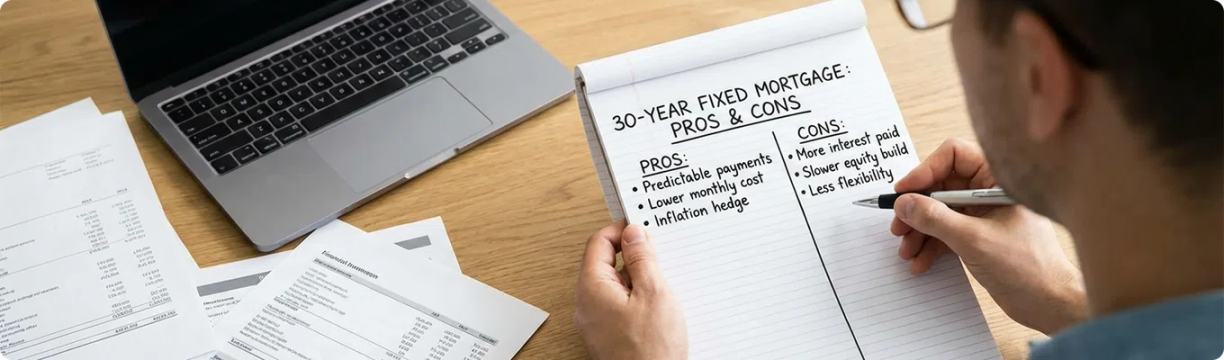
Pros and Cons of a 30-Year Fixed-Rate Mortgage in 2026


 FACT-CHECKEDFACT-CHECKED
Key Takeaways
- A 30-year fixed-rate mortgage spreads your payments over 360 months, which means your monthly payments are lower than they would be with a shorter-term loan.
- Your interest rate stays the same for the whole loan term, which protects you from changes in the market and rate increases.
- Because the repayment period is longer, borrowers usually pay more total interest over 30 years than they do over 15 years.
- If you have a $300,000 loan with a 6% interest rate, your monthly payments will be about $1,799 for the principal and interest.
- Most U.S. counties' conforming loan limit for single-family homes rose to $832,750 in 2026, giving buyers more room to borrow.
- Fixed-rate loans are the most common type of mortgage right now, but adjustable-rate mortgages are still popular with jumbo borrowers.
- Most conventional loans let you make extra payments toward the principal without any penalties. This will help you pay off the loan faster.
- AmeriSave has fixed-rate options for 30 years on conventional, FHA, and VA loans to fit the needs of different borrowers.

Why the 30-Year Fixed Mortgage Remains the Go-To Home Loan
If you've looked into mortgages at all, you've probably heard the phrase "30-year fixed" a lot. That's because of something. For decades, this type of loan has been the backbone of American homeownership, and it is still the most popular choice among buyers today. According to data from the Federal Reserve, this is the case for about two-thirds of all new purchase mortgages.
But just because something is popular doesn't mean it's right for every situation. A 30-year fixed-rate mortgage could be your best friend or a very expensive commitment, depending on how much money you make, what you want to do, and how long you plan to stay in the house. I've spent my whole career at AmeriSave helping people make this exact decision, and the one thing I always tell them is that the "right" loan depends on your life and what you want to do. So let's go over this step by step.

What a 30-Year Fixed-Rate Mortgage Actually Means
Let's start with the basics. A 30-year fixed-rate mortgage is a home loan that you repay over 30 years, which works out to 360 monthly payments. The "fixed-rate" piece means your interest rate is set at closing and won't change. Ever. That's the big selling point. Whether mortgage rates climb to 8% or drop to 4% five years from now, your rate stays exactly where it was on the day you signed your paperwork.
Compare that to an adjustable-rate mortgage, where the rate can shift after an initial fixed period, and you can see why so many home buyers prefer the certainty of a fixed rate. For someone budgeting month to month, knowing that your principal and interest payment won't jump around is a real comfort. Your escrow amount for taxes and insurance might change a bit year to year, sure, but the core payment stays steady.
One thing worth clarifying: just because the loan term is 30 years doesn't mean you have to take that long. Most conventional loans have no prepayment penalty, so you're free to make extra payments toward principal whenever you want. Plenty of borrowers set up biweekly payments or round up their monthly amount, which can shave years off the loan without the pressure of a shorter required term.
Breaking Down Your Monthly Mortgage Payment
Your mortgage payment isn't just one lump sum going toward your house. It's actually split into several pieces, and understanding each one helps you make smarter decisions about your budget.
Principal is the portion that actually reduces what you owe on the home. Early in the loan, only a small slice of your payment goes toward principal. Most of it covers interest. As the years go on, that ratio flips. By the last few years of a 30-year loan, nearly all of your payment is going toward principal. This is how amortization works, and it catches a lot of first-time home buyers off guard.
Interest is what the lender charges you for borrowing the money. On a $300,000 loan at around 6%, you'd end up paying roughly $347,000 in interest over 30 years. That's more than the amount you actually borrowed. I know that number can feel overwhelming when you see it on paper, and it's one of the biggest trade-offs of spreading payments over three decades.
Escrow covers your property taxes and homeowners insurance. Most lenders collect this monthly and hold it in an escrow account so those big annual bills get paid on time. Your escrow amount can change annually based on your tax assessment and insurance premiums.
Mortgage insurance applies if you put down less than 20% on a conventional loan. Private mortgage insurance (PMI) typically costs between 0.5% and 1% of the loan amount per year. On FHA loans, you'll pay a mortgage insurance premium (MIP) regardless of your down payment. The good news with conventional PMI is that it can be removed once you reach 20% equity in the home.
Types of 30-Year Fixed-Rate Mortgage Programs
Not all 30-year fixed mortgages look the same. The loan program you qualify for depends on your financial profile, your military service status, and where you're buying.
Conventional 30-Year Fixed Loans
Conventional loans aren't backed by a government agency. They follow guidelines set by Fannie Mae and Freddie Mac and are the most common type of mortgage in the market. For a single-family home in most parts of the country, the conforming loan limit sits at $832,750 for 2026, according to the FHFA. If you need to borrow more than that, you're looking at jumbo loan territory, which comes with different requirements. Most lenders expect a credit score of at least 620 for a conventional loan, though a score in the mid-700s will get you better pricing. At AmeriSave, we work with borrowers across the credit spectrum to find the best conventional option for their situation.
FHA 30-Year Fixed Loans
FHA loans are insured by the Federal Housing Administration and tend to be more flexible on credit scores and down payments. You can qualify with a score as low as 580 and a 3.5% down payment. Scores between 500 and 579 require at least 10% down. HUD announced that FHA loan limits for standard areas are tied to the conforming limit, making the floor $541,287 for a single-family home in most counties for 2026, with a ceiling of $1,249,125 in high-cost areas. FHA loans are a popular path for first-time home buyers, and AmeriSave processes a high volume of these through our FHA loan program.


VA 30-Year Fixed Loans
If you're an active-duty service member, veteran, or qualifying surviving spouse, VA loans offer some of the best terms in the market. There's no minimum down payment requirement, no ongoing PMI, and the VA doesn't set a minimum credit score, though individual lenders do. Bankrate's national average for a 30-year VA loan was 6.64% as of September 15, 2026, a bit below the 30-year conventional average in the same week. AmeriSave's VA lending team handles these loans regularly and can walk eligible borrowers through the Certificate of Eligibility process.
Where 30-Year Fixed Mortgage Rates Stand Right Now
Rates change all the time, so the number I give you today could be different by the time you read this. That being said, Freddie Mac's Primary Mortgage Market Survey put the average 30-year fixed rate at 6.76% for the week of September 10, 2026, up from 6.71% the week before. For context, the full-year average for 2025 was 6.60%, so rates have drifted a little higher over the past year rather than lower.
The Federal Reserve held its benchmark federal funds rate in a range of 3.50% to 3.75% at its July 28-29, 2026 meeting, with its next meeting set for September 15-16, 2026. But the federal funds rate and mortgage rates don't always go up and down at the same time. They are more closely related to the 10-year Treasury yield and the demand for mortgage-backed securities. AmeriSave updates its rates on its website every day, and I always tell people to check those before making any assumptions about what they can afford. Your credit score, down payment, the location of the property, and the loan program you choose will all affect your actual rate.
As a quick reference, if you borrow $300,000 at 6%, your monthly payment for principal and interest will be about $1,799. That number goes up to about $1,896 at 6.5%. If you take out a $400,000 loan at 6%, you'll have to pay back about $2,398 a month. Those numbers add up quickly, which is why a quarter-point difference in your rate over 30 years is so important.
The Advantages of Choosing a 30-Year Fixed Mortgage
Lower monthly payments. This is the biggest draw. Because you're stretching the balance over 30 years instead of 15 or 20, each monthly payment is smaller. That frees up cash for other priorities like retirement savings, emergency funds, or just everyday living expenses. For a lot of borrowers, especially first-time home buyers who are already stretching to cover a down payment and closing costs, that breathing room is essential.
Predictability you can count on. With a fixed rate, your principal and interest payment stays the same every month for the life of the loan. You're not watching the news and worrying about whether rates went up while you slept. That kind of stability makes budgeting straightforward, and I've talked to plenty of borrowers who picked a 30-year fixed specifically because they wanted that peace of mind.
Flexibility to pay ahead. Just because you have a 30-year term doesn't mean you're locked into making minimum payments. Most conventional and government-backed loans allow extra payments toward principal without any penalty. So if you get a bonus at work or come into some extra cash, you can throw it at the mortgage and cut years off your payoff date. You get the safety net of a lower required payment plus the option to accelerate when you can.
More home for your money. A lower required payment means you might qualify for a larger loan amount than you would with a 15-year term. If you're shopping in a competitive market or targeting a specific neighborhood, that extra buying power can make a real difference. At AmeriSave, we see borrowers use this to their advantage regularly, especially in areas like the DFW metroplex where home prices have climbed steadily.
The Drawbacks You Should Know About
You'll pay significantly more in total interest. This is the trade-off for those lower monthly payments. On a $300,000 loan at 6%, the total interest over 30 years comes to roughly $347,000. Run that same balance on a 15-year term at a lower rate, and you'd pay something closer to $127,000 in interest. That's a difference of more than $200,000, and it's the single biggest downside of the 30-year mortgage.
Equity builds slowly at first. Because of how amortization schedules work, the majority of your early payments go toward interest rather than principal. In the first five years of a 30-year loan, you might only pay down around 7% to 8% of the original balance. That slow equity buildup can be frustrating, especially if you're thinking about selling or refinancing in the near term.
Rates run higher than shorter terms. Lenders charge more interest on 30-year loans because they're taking on more risk by lending you money for a longer period. In Freddie Mac's September 10, 2026 survey, the 30-year fixed averaged 6.76% while the 15-year averaged 6.09%, a spread of roughly two-thirds of a percentage point. That may not sound like much, but over hundreds of thousands of dollars and 360 payments, it adds up.
Temptation to stay in debt longer. With 30 years on the clock, it's easy to get comfortable making minimum payments and never really attacking the balance. I've seen it happen. Life gets busy, other expenses pop up, and before you know it, you're 15 years in and still owe a lot of money on the house. Discipline matters here, and having a plan to make extra payments when possible keeps that from becoming your story.
Comparing 15-Year and 30-Year Fixed Mortgages
This is one of the most common questions I get from AmeriSave borrowers, and the honest answer is that it depends on your cash flow and your goals. A 15-year mortgage will save you a massive amount in interest and build equity much faster. But the monthly payment is going to be noticeably higher.
Let's put real numbers on it. On a $300,000 loan at 6% over 30 years, your monthly payment for principal and interest is roughly $1,799. On a 15-year loan at approximately 5.4%, that monthly payment jumps to around $2,412. That's an extra $613 per month. For some families, that gap is manageable. For others, it means choosing between homeownership and other financial goals.
The savings on a 15-year term are dramatic, though. Your total interest on the 15-year loan would be roughly $134,000 compared to $347,000 on the 30-year version. You'd also own your home free and clear in half the time, which is a powerful feeling. But if the higher payment would stretch your budget too thin, a 30-year fixed with extra payments when you can afford them is a reasonable middle ground.
Fixed-Rate Mortgages vs. Adjustable-Rate Loans
Adjustable-rate mortgages, or ARMs, start with a fixed rate for an introductory period, usually five, seven, or ten years. After that, the rate adjusts periodically based on a market index, with caps in place to limit how much it can change at each adjustment and over the loan's lifetime.
ARMs can offer lower initial rates than a 30-year fixed. That might be appealing if you're confident you'll sell or refinance before the adjustable period kicks in. Military families who relocate every few years sometimes favor ARMs for this reason. But if you plan to stay long-term or just want certainty, a fixed-rate product is usually the safer bet. Fixed-rate loans have dominated recent originations. According to Freddie Mac, the share of adjustable-rate products remains concentrated mainly among borrowers taking out jumbo-sized loans. For conforming loan amounts, the overwhelming majority of buyers choose fixed rates.
Figuring Out Which Loan Term Fits Your Life
It's not just a math problem to choose between a 30-year, 15-year, or adjustable-rate mortgage. It's a problem in life. You should think about your monthly budget, how stable your job is, what you want to do with the property, and what other financial goals are competing for your money.
If this is your first time buying a home and you want lower payments and more financial freedom, the 30-year fixed is probably the best place to start. If rates go down or your income goes up, you can always refinance later. If you've owned a home before, have a good income, and want to keep your overall borrowing costs as low as possible, a 15-year term might be a good idea. An ARM might save you money in the short term if you're buying a home you know you'll only live in for a few years.
We won't force you to buy one product over another at AmeriSave. That's not how we do things around here. My team's job is to give you the real numbers for each choice and let you choose what feels right. We have online tools and loan officers who can show you how different situations would play out so you can compare them fairly. Don't make a guess about something this big. Do the math, ask questions, and choose what is best for your family.
The Bottom Line on 30-Year Fixed Mortgages
A 30-year fixed-rate mortgage gives you stability, affordability, and flexibility that other loan types can't always match. You trade some interest savings for the comfort of knowing your payment won't change, and for a lot of home buyers, that's a trade worth making. Just go into it with your eyes open. Understand how much you'll pay in total interest, commit to making extra payments when you're able, and don't be afraid to compare different loan terms before you commit.
AmeriSave is here to help you work through those comparisons. Visit amerisave.com to see current rates, use our mortgage calculators, and connect with a loan officer who can break down the numbers for your specific situation. Getting the right mortgage starts with asking the right questions.
Freddie Mac. (2026). Primary Mortgage Market Survey.
Federal Housing Finance Agency. (2025). FHFA Announces Conforming Loan Limit Values for 2026.
U.S. Department of Housing and Urban Development. (2025). HUD's Federal Housing Administration Announces 2026 Loan Limits.
Federal Reserve Bank of St. Louis. (2026). 30-Year Fixed Rate Mortgage Average in the United States.
Mortgage Bankers Association. (2026). MBA Weekly Mortgage Applications Survey.
Board of Governors of the Federal Reserve System. (2026). Federal Reserve issues FOMC statement.
The Mortgage Reports. (2026). 30-Year Mortgage Rates Chart (Freddie Mac PMMS annual averages).
Bankrate. (2026). Compare Current VA Loan Rates Today.


Jerrie leads sales operations in the Dallas-Fort Worth region for AmeriSave, where his entire mortgage career has been spent since being recruited into the industry at age 18. Licensed as a Mortgage Loan Originator in 37 states, he specializes in making complicated loan options accessible and helping borrowers understand what matters most in their individual situations. He brings deep regulatory knowledge and a client-centric approach honed through progression from entry-level to upper management, including successfully onboarding and training 70 people from a closed Cleveland office.
Frequently Asked Questions
According to Freddie Mac's Primary Mortgage Market Survey for the week of September 10, 2026, the average 30-year fixed rate was 6.76%, up from 6.71% the week before. For context, the full-year 2025 average was 6.60%, so rates have moved a little higher over the past year. Rates are different for each person based on their credit score, loan-to-value ratio, and type of property. Your actual rate may be higher or lower depending on your financial situation. Most of the time, borrowers with credit scores over 740 and at least 20% down get the best rates. The rates also change depending on the loan program. For instance, Bankrate put the national average 30-year VA rate at 6.64% as of September 15, 2026, while FHA rates are usually a little higher than those of regular loans. You can find out what's available for you by going to AmeriSave's page and looking at today's rates. It's always a good idea to compare multiple offers because even small differences in rates can add up over 360 payments.
The monthly payment on a $300,000 30-year mortgage with a 6% interest rate is about $1,799. Property taxes, homeowners insurance, and mortgage insurance aren't included in that. Usually, these are included in your total monthly payment through escrow. Taxes and insurance could cost you $300 to $600 or more a month, depending on where you live.
The total interest over the full 30-year term at 6% would be about $347,000, which would make your total payments about $647,000. You don't have to pay PMI at all if you can put 20% down. Most of the time, FHA borrowers will have to pay a mortgage insurance premium for the life of the loan. AmeriSave's calculator lets you run your own numbers by taking into account taxes, insurance, and different interest rate scenarios.
Most 30-year conventional, FHA, and VA loans don't have penalties for paying them off early. Most home loans made today are qualified mortgages, which means that federal rules don't allow prepayment penalties on them. You can make extra payments on the principal at any time without paying anything extra.
If you have a $300,000 loan at 6% and make just one extra payment a year, you could pay it off four to five years earlier and save tens of thousands in interest. Biweekly payment plans work in a similar way: they split your monthly payment in half and pay it every two weeks, which means you make 13 full payments instead of 12. AmeriSave's can also help you figure out if refinancing to a shorter term might be better for your needs.
With a 30-year fixed mortgage, your interest rate stays the same for the whole 360-month repayment period. This means that your principal and interest payments will be the same every month. A fixed-rate mortgage starts with a fixed rate for a set amount of time, usually five to ten years, and then changes based on a market index.
ARMs usually have lower rates at first than fixed-rate products, which can save you money during the first few months. The risk is that your rate could go up a lot when adjustments start, which could mean your payment goes up by hundreds of dollars. Rate adjustment caps set a limit on how much your rate can change each period and over the life of the loan, but your payment isn't guaranteed to stay the same. If you care about stability, check out AmeriSave's page to see how ARMs stack up against fixed-rate loans.
Different loan programs have different credit score requirements. Most of the time, conventional loans need a score of at least 620, but higher scores can get you better rates and terms. If you put down 10% of the loan amount, FHA loans will accept scores as low as 500. If you put down 3.5%, they will accept scores as low as 580. The Department of Veterans Affairs doesn't set a minimum score for VA loans, but most lenders want at least 580 to 620.
Your score also has a direct effect on your interest rate. FICO data shows that borrowers with scores above 760 can get rates that are about 0.5% to 1% lower than those with scores between 620 and 639. Over 30 years, that rate difference could mean tens of thousands of dollars on a $300,000 mortgage. If you need to improve your credit score before you apply, AmeriSave's walks you through practical steps to do so.
Yes, the 30-year fixed is the most popular loan option for first-time home buyers, and for good reason. New buyers can afford to move, buy furniture, take care of their homes, and build an emergency fund because their monthly payments are lower than they would be with shorter terms. The fact that the payments are predictable also makes the transition less stressful financially.
There are also programs for first-time buyers that let them put down less money. FHA loans start at 3.5%, while conventional loans only require 3% down for qualified first-time buyers. The FHFA sets the conforming loan limit at $832,750 for most areas. This means you can borrow a lot of money and still get good conventional rates. To see all of your options, visit AmeriSave's to see how different terms affect your monthly payment and total cost.