


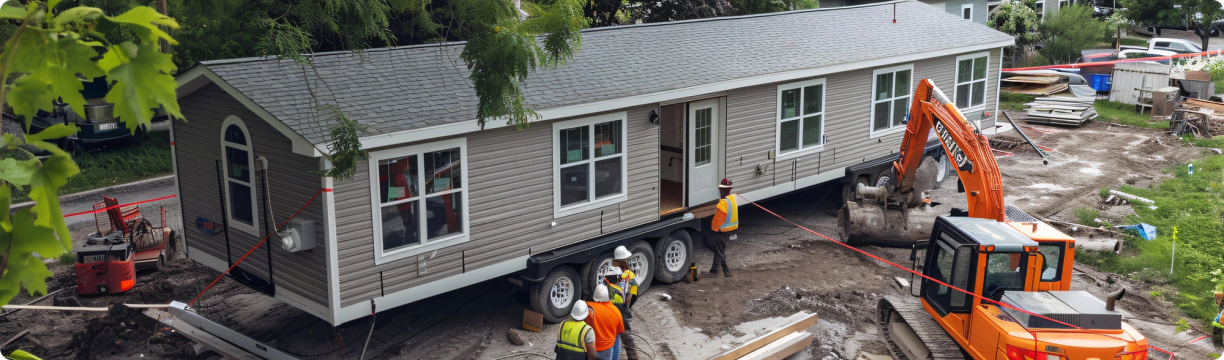
Manufactured Homes in 2026: 12 Essential Facts Every Buyer Should Know


 FACT-CHECKEDFACT-CHECKED
The average manufactured home costs about $120,000 ($85/sq ft) compared to up to $200/sq ft for traditional stick-built construction, and all units must carry HUD certification labels from the 1976 safety standards. In 2024, manufactured homes made up 10% of rural housing and 6% of all new single-family sales nationwide.
Key Takeaways
- The U.S. Census Bureau says that in October 2023, the average cost of a prefabricated house was $120,000, or about $85 per square foot. But regular stick-built houses can cost as much as $200 per square foot.
- If a house meets the strict safety standards set by the Manufactured House Construction and Safety Standards Act of 1976, the US Department of Housing and Urban Development (HUD) must give it the certification mark.
- According to the Manufactured Dwelling Institute, in 2024, manufactured homes made up 10% of all homes in rural areas and 6% of all new single-family home sales.
- There are a lot of ways to get money. For example, you can get a loan from Freddie Mac, a program from the Federal Housing Administration (FHA) under Titles I and II, or a loan from the Veterans Administration (VA) if you are a veteran and meet certain requirements.
- According to HomeAdvisor's 2025 building cost database, a basic slab foundation can cost as little as $5,000, while a full basement installation can cost as much as $40,000. This has a big impact on how much money is put in.
- The National Association of Housing and Redevelopment Officials says that manufactured home complexes charge between $100 and $800 per month for each site. Every year, these fees usually go up by 3% to 5%.
- Different people have different worries about depreciation. The Appraisal Institute says that a home with a fixed foundation is worth more than any other kind of property. Still, homes that are thought of as personal property may lose 3–5% of their value every year.
- The Department of Energy says that modern prefabricated homes use as much energy as regular homes, if not more. People who buy energy-efficient units with the ENERGY STAR label can save 15% to 30% on their yearly bills.

Understanding Manufactured Housing in 2026: Market Overview
Manufactured housing represents an increasingly important segment of the American housing market, particularly as affordability challenges intensify across the country. According to the Manufactured Housing Institute's December 2025 industry report, approximately 22 million Americans live in manufactured homes, representing about 6.7% of the total U.S. housing stock. In rural communities, this percentage climbs to 10-14%, highlighting manufactured housing's critical role in providing affordable homeownership opportunities.
Think of it like this: manufactured homes offer a practical pathway to homeownership for buyers priced out of traditional housing markets. While the median existing home price reached $410,200 in November 2025 according to the National Association of REALTORS®, manufactured homes average $120,000—providing an affordable alternative without sacrificing modern amenities, safety standards, or quality construction.
The distinction between manufactured homes and their predecessor mobile homes matters significantly. The National Mobile Home Construction and Safety Act of 1976 transformed the industry by implementing rigorous federal standards administered by the U.S. Department of Housing and Urban Development. These regulations ensure that modern manufactured homes meet comprehensive safety, durability, and energy efficiency standards—addressing historical concerns about quality and longevity that plagued earlier mobile home construction.
Current market dynamics favor manufactured housing consideration. According to the U.S. Census Bureau's housing survey data, manufactured home shipments increased 4.2% year-over-year in 2024, demonstrating growing consumer acceptance and improving industry standards. Modern manufactured homes bear little resemblance to the stereotypical mobile homes of decades past—today's units feature contemporary designs, high-quality materials, ENERGY STAR certification options, and customization choices rivaling traditional stick-built construction.

What Is a Manufactured Home? Technical Definition and Standards
Manufactured homes are residential structures built entirely in climate-controlled factory settings, according to federal building code established by HUD rather than local building codes governing site-built homes. This distinction carries significant legal, financial, and practical implications for buyers.
HUD Code Requirements and Certification
The HUD Manufactured Home Construction and Safety Standards, commonly called the HUD Code, establishes comprehensive requirements for design, construction, strength, durability, fire resistance, energy efficiency, and installation of manufactured homes. According to HUD's official guidelines, all compliant manufactured homes display a red certification label, often called a HUD tag or HUD seal, permanently affixed to the exterior of each transportable section.
HUD Code specifications cover:
Body and frame requirements ensuring structural integrity during transportation and installation.
Thermal protection standards mandating insulation values and energy efficiency.
Plumbing systems meeting national standards for water supply and drainage.
Electrical systems complying with National Electrical Code requirements.
Fire safety measures including smoke detectors, egress windows, and fire-resistant materials.
Wind zone ratings certifying homes for specific geographic wind load requirements.
These federal standards create consistency across all manufactured homes regardless of where they're built or installed. Unlike modular homes which must meet varying local building codes depending on installation location, manufactured homes built to HUD standards gain approval for placement anywhere in the United States, simplifying the purchasing and installation process.
Manufacturing Process and Quality Control
According to the Manufactured Housing Institute's industry process documentation, manufactured home construction follows systematic quality-controlled steps:
Steel chassis construction: Manufacturers begin with engineered steel I-beams forming the foundation and transportation system. This chassis provides structural integrity and allows safe highway transport from factory to home site.
Floor system installation: Workers install insulation (typically R-22 to R-33 values), moisture barriers, and subflooring systems. Modern manufactured homes often exceed traditional construction insulation standards due to controlled factory installation environments.
Wall framing and exterior: Factory workers construct wall systems including insulation (R-11 to R-21 typical), electrical wiring, plumbing rough-ins, and exterior siding. Walls install as complete units including windows and doors already installed and weather-sealed.
Roof system and interior: Roof trusses, sheathing, insulation (R-30 to R-49 typical), and roofing materials complete exterior envelope. Interior finishes including drywall, cabinetry, flooring, fixtures, and appliances follow.
Quality inspections: Third-party inspectors certified by HUD verify compliance with federal standards throughout construction. Final inspection confirms all requirements met before certification labels attach.
This controlled factory environment offers significant advantages over traditional construction. According to the National Association of Home Builders, weather delays account for 15-25% of typical construction timeline extensions for stick-built homes. Manufactured homes avoid these delays entirely through indoor construction, maintaining consistent schedules and quality standards regardless of external weather conditions.
Configuration Options: Single-Wide, Double-Wide, and Triple-Wide
Manufactured homes come in three primary width configurations, each offering different square footage, pricing, and property value implications:
Single-wide homes: Width dimensions of 14-18 feet, length typically 66-80 feet, total square footage ranging from 600-1,300 square feet, average cost of $45,000-$75,000 according to industry pricing data. Single-wide homes prove most economical but offer limited space for growing families. Resale values typically lag double-wide options due to smaller square footage and narrower width creating less desirable floor plans.
Double-wide homes: Width dimensions of 20-32 feet (two sections joined on-site), length typically 42-60 feet per section, total square footage ranging from 1,000-2,300 square feet, average cost of $90,000-$160,000. Double-wide homes offer superior livability with more traditional room proportions, better resale potential, and easier financing through conventional loan programs. Most buyers seeking manufactured homes as permanent primary residences select double-wide configurations.
Triple-wide and multi-section homes: Width dimensions exceeding 32 feet through three or more joined sections, total square footage ranging from 2,000-3,500+ square feet, average cost of $150,000-$250,000+. These larger homes approach traditional stick-built home proportions and pricing while maintaining manufactured housing efficiency benefits. Financing typically requires meeting MH Advantage or conventional loan standards with permanent foundation installation.
Manufactured vs. Modular vs. Stick-Built Homes: Key Distinctions
Understanding differences between housing types helps buyers make informed decisions matching their needs and financial circumstances.
Manufactured Homes Characteristics
Building code: Federal HUD standards applicable nationwide. Construction location: 100% factory-built in climate-controlled facility. Transportation method: Complete sections transported on permanent steel chassis to installation site. Foundation requirements: Can install on non-permanent foundations in some jurisdictions, though permanent foundations provide financing advantages. Property classification: May classify as personal or real property depending on foundation and title status. Typical cost: $85 per square foot on average, according to Census Bureau data.
Modular Homes Characteristics
Building code: Local or state building codes same as site-built homes. Construction location: 60-90% factory-built with remaining components assembled on-site. Transportation method: Sections transported without permanent chassis, then permanently installed on basement or crawl space foundation. Foundation requirements: Must install on permanent foundation per local building code. Property classification: Always classified as real property identical to traditional homes. Typical cost: $100-$150 per square foot, according to the Modular Home Builders Association.
Stick-Built Homes Characteristics
Building code: Local or state building codes with municipal inspections throughout construction. Construction location: 100% on-site construction exposed to weather delays. Transportation method: Materials delivered to site for assembly, no completed structure transportation. Foundation requirements: Permanent foundation per local code requirements. Property classification: Always classified as real property. Typical cost: $150-$250+ per square foot, according to National Association of Home Builders data.


These distinctions impact not only construction costs and timelines but also financing options, insurance requirements, property taxes, and long-term value appreciation. Buyers must carefully evaluate which housing type best matches their budget, timeline, and long-term financial goals.
Comprehensive Advantages of Manufactured Homes
Modern manufactured homes offer substantial benefits beyond simple cost savings, making them attractive options for diverse buyer demographics.
1. Significant Cost Savings Compared to Traditional Construction
The most compelling manufactured home advantage involves dramatic cost savings versus traditional construction. According to the U.S. Census Bureau's October 2023 housing data, manufactured homes average $85 per square foot compared to $150-$250+ for stick-built homes.
Worked cost comparison example: A 1,800 square foot home costs approximately:
Manufactured home: 1,800 sq ft × $85 = $153,000 base cost. Traditional stick-built home: 1,800 sq ft × $200 (median) = $360,000 base cost. Cost savings: $207,000 or 57.5% less expensive.
These savings stem from multiple factors. Factory assembly eliminates weather delays, reducing construction timelines by 30-50%, according to industry estimates, decreasing financing carrying costs. Bulk material purchasing and streamlined processes reduce material waste—traditional construction wastes 10-15% of materials according to the National Association of Home Builders, while factory production waste averages under 5%. Labor efficiency in controlled factory settings reduces total labor hours by 40-60% compared to on-site construction. Transportation of complete sections rather than thousands of individual components reduces logistics costs.
For buyers with limited down payment funds or modest incomes, these savings create homeownership opportunities otherwise unavailable. A household earning $60,000 annually struggles to qualify for conventional mortgages on $300,000-$400,000 homes but comfortably affords manufactured homes in the $120,000-$180,000 range.
2. Extensive Customization Options
Modern manufactured homes offer customization rivaling traditional construction despite factory production methods. According to the Manufactured Housing Institute, typical customization options include:
Floor plan modifications: Buyers select from dozens of standard layouts or request custom room configurations, bedroom counts, bathroom layouts, and open concept versus traditional layouts. Most manufacturers accommodate special requests like home offices, craft rooms, or accessible design features.
Interior finishes: Cabinet styles and colors (typically 10-20 options), countertop materials (laminate, solid surface, or granite/quartz upgrades), flooring (carpet, vinyl plank, tile, hardwood), fixtures and hardware, appliance packages, and paint colors. Premium finish packages add $10,000-$30,000 to base pricing but remain less expensive than comparable traditional home upgrades.
Exterior customization: Siding materials and colors (vinyl, fiber cement, or metal), roofing colors and styles, porch and deck additions, dormer windows, garage attachments, and landscaping packages. Manufacturers increasingly offer contemporary exterior designs, eliminating visual distinction from traditional homes.
Energy efficiency upgrades: ENERGY STAR certification packages, upgraded insulation (R-value increases), high-efficiency HVAC systems, solar panel pre-wiring, tankless water heaters, and low-E windows. According to the U.S. Department of Energy, ENERGY STAR certified manufactured homes reduce utility costs by 15-30% annually—approximately $300-$600 savings for typical households.
3. Rapid Construction and Installation Timelines
Manufactured homes offer dramatically faster timelines compared to traditional construction. According to the Census Bureau's Survey of Construction, average stick-built home construction takes 6.5-8 months from permit to completion, while manufactured homes typically complete within 6-12 weeks from order to installation.
Timeline breakdown:
Weeks 1-2: Design selection and financing approval, deposit payment and order placement.
Weeks 3-8: Factory production (typically 4-6 weeks for standard configurations), simultaneous site preparation and foundation installation.
Weeks 9-10: Home transportation to site (1-3 days depending on distance), installation and setup on foundation (3-5 days).
Weeks 11-12: Utility connections, final inspections, and certificate of occupancy.
This expedited timeline benefits buyers needing immediate housing. Families displaced by natural disasters, job relocations requiring quick moves, or first-time home buyers transitioning from rentals with lease expirations find manufactured homes provide practical solutions traditional construction cannot match. Additionally, faster construction reduces interim housing costs—6 months of rental payments at $1,500 monthly total $9,000 saved through accelerated manufactured home timelines.
4. Rigorous Safety and Quality Standards
HUD Code requirements ensure manufactured homes meet or exceed many traditional construction standards. According to HUD's Office of Manufactured Housing Programs, federal standards mandate: Wind zone certification requiring homes withstand specific wind loads (Zone I: 70 mph, Zone II: 100 mph, Zone III: 110 mph). Seismic zone requirements for earthquake-prone regions. Fire safety standards including smoke detectors in each bedroom, fire-rated walls between living spaces and utility rooms, and egress windows in sleeping areas. Structural integrity testing ensuring homes survive highway transportation and installation without damage. Energy efficiency minimums reducing utility consumption and costs.
Independent third-party inspectors certified by HUD inspect production at multiple stages, verifying compliance before certification labels attach. This oversight exceeds typical municipal inspection frequency for site-built homes, where inspectors visit only at specific milestones rather than monitoring continuous production.
According to the Insurance Information Institute, modern manufactured homes meeting current HUD standards perform comparably to traditional homes during natural disasters. Well-installed manufactured homes on permanent foundations survived Hurricane Michael (2018) and Hurricane Laura (2020) with damage rates similar to nearby stick-built homes, demonstrating improved construction quality versus historical mobile home vulnerabilities.
5. Environmental Sustainability Benefits
Factory construction reduces environmental impact through several mechanisms. The National Association of Home Builders' Green Building research indicates: Material waste reduction: Factory production generates 5% material waste versus 10-15% for site construction, conserving resources and reducing landfill burden. Transportation efficiency: Delivering complete home sections requires fewer trips than thousands of individual material deliveries for traditional construction. Energy efficiency: Modern manufactured homes built to ENERGY STAR standards consume 15-30% less energy than typical existing homes according to the U.S. Department of Energy. Water conservation: Factory-installed low-flow fixtures and efficient appliances reduce water consumption by 20-30% versus older housing stock.
Buyers prioritizing environmental responsibility find manufactured homes offer sustainable housing options at accessible price points.
Comprehensive Disadvantages and Challenges of Manufactured Homes
Understanding manufactured housing limitations helps buyers set realistic expectations and make informed decisions.
1. Foundation and Land Acquisition Requirements
Unlike recreational vehicles or mobile homes (pre-1976), modern manufactured homes require permanent or semi-permanent installation locations. According to HomeAdvisor's 2025 construction cost database, foundation options include:
Pier and beam foundation: Cost range $8,200-$22,000 depending on home size and soil conditions. Construction time 3-7 days. Steel straps anchor home to concrete piers supporting weight at specific load points. Best for sloped lots or areas with expansive soil.
Slab foundation: Cost range $5,000-$40,000 depending on site preparation requirements. Construction time 7-14 days including curing period. Poured concrete slab with embedded anchors provides stable, moisture-resistant base. Most common foundation type in warm climates without frost depth concerns.
Basement foundation: Cost range $13,000-$30,000 for crawl space, $25,000-$50,000 for full basement. Construction time 2-4 weeks. Provides additional living or storage space, superior insulation, and protection from tornadoes. Required in cold climates with deep frost lines.
Additionally, buyers must secure suitable land. According to the National Association of REALTORS®, rural land averages $2,000-$5,000 per acre in most states, though prices vary dramatically by location, access to utilities, and development potential. Land acquisition adds substantial upfront costs—a one-acre lot at $3,500 per acre plus $15,000 foundation totals $18,500 before the home itself.
Alternatively, buyers can lease space in manufactured home communities. While eliminating land purchase costs, this introduces ongoing monthly expenses and reduces equity-building potential discussed in the next section.
2. Manufactured Home Community Fees and Regulations
Manufactured home communities (formerly called mobile home parks) offer turnkey installation sites with existing infrastructure. According to the National Association of Housing and Redevelopment Officials, approximately 38% of manufactured homes place in communities, while 62% install on privately-owned land.
Community fee structures: Monthly lot rent: $100-$800 depending on location, amenities, and lot size. National average approximately $350 monthly according to industry surveys. Community amenities: Often include common areas, playgrounds, pools, clubhouses, and maintenance services. These amenities justify higher fees but may go unused by residents. Annual fee increases: Lot rent typically increases 3-5% annually per lease terms, similar to apartment rent escalations. Over 20 years, $400 monthly lot rent inflating at 4% annually grows to $870 monthly—significantly impacting housing affordability.
Worked comparison example: Sarah purchases a $120,000 manufactured home with two location options:
Option A—Community Placement: Initial cost: $120,000 home only, monthly lot rent: $400, annual increases: 4%, total rent over 20 years: $147,800.
Option B—Owned Land: Initial cost: $120,000 home + $18,000 land/foundation = $138,000 total, no ongoing rent payments, property taxes: $100-$200 monthly (varies by jurisdiction).
Despite higher upfront costs, land ownership eliminates perpetual rent obligations and builds equity through land appreciation. However, buyers with limited capital may find community placement provides the only accessible entry point to manufactured homeownership.
3. Depreciation and Long-Term Value Concerns
Manufactured home appreciation patterns depend critically on property classification—real property versus personal property—according to the Appraisal Institute's manufactured housing valuation research.
Personal property classification (common scenarios): Home on leased land in manufactured home community, home on non-permanent foundation, home with vehicle title rather than real estate deed. Depreciation typical: 3-5% annually similar to vehicles. Appreciation potential: Minimal—value tracks home condition rather than market trends. Financing limitations: Chattel loans only with higher interest rates and shorter terms.
Real property classification (favorable scenarios): Home on permanent foundation on owned land, home with real estate deed (not vehicle title), home meeting local building code requirements. Appreciation typical: 2-4% annually in line with local housing markets. Appreciation potential: Strong—value tracks both home condition and land appreciation. Financing options: Conventional mortgages with competitive rates and 30-year terms.
Worked depreciation comparison: Marcus purchases a $120,000 manufactured home with two different scenarios:
Scenario 1—Personal Property (community, non-permanent foundation): Purchase price: $120,000, annual depreciation: 4%, value after 10 years: $79,600 (loss of $40,400 or 33.7%).
Scenario 2—Real Property (owned land, permanent foundation): Purchase price: $138,000 ($120,000 home + $18,000 land/foundation), home appreciation: 2% annually, land appreciation: 3% annually, value after 10 years: $170,600 (gain of $32,600 or 23.6%).
The $73,000 value difference after 10 years ($170,600 versus $79,600) demonstrates why buyers treating manufactured homes as long-term investments should prioritize real property classification through permanent foundations and land ownership.
4. Financing Challenges and Higher Interest Costs
According to the Consumer Financial Protection Bureau's manufactured housing finance research, buyers face more limited financing options and potentially higher costs versus traditional home purchases.
Chattel loans (personal property): Interest rates: 7-10% typical in December 2025 markets, loan terms: 15-20 years maximum, down payment: 10-20% required, credit score: 600-650 minimum. Monthly payment example: $100,000 loan at 8.5% for 15 years requires $984 monthly payment. Total interest paid: $77,120 over loan life.
Conventional mortgages (real property): Interest rates: 6.5-7.5% for MH Advantage or conventional loans, loan terms: 30 years typical, down payment: 3-20% depending on program, credit score: 620-680 minimum depending on program. Monthly payment example: $100,000 loan at 7.0% for 30 years requires $665 monthly payment. Total interest paid: $139,400 over loan life but with lower monthly obligation.
The financing cost difference ($984 versus $665 monthly) totals $319 monthly or $3,828 annually—significant expense for budget-conscious buyers. This disparity incentivizes buyers to pursue permanent foundations and real property classification enabling conventional mortgage access.
5. Social Stigma and Resale Challenges
Despite substantial quality improvements, manufactured homes still face negative perceptions in many markets. According to the Manufactured Housing Institute's consumer perception research, approximately 32% of Americans hold negative views of manufactured housing based on outdated mobile home associations.
Resale challenges include limited buyer pool due to stigma and financing difficulties, appraisal challenges as comparable sales may be limited, potential for community rejection in neighborhoods with restrictive covenants, and reduced equity accumulation if classified as personal property depreciating over time.
However, these challenges vary significantly by region. Rural areas and markets with established manufactured housing presence demonstrate stronger acceptance and resale markets. Buyers in these areas experience easier resales and better appreciation. Conversely, attempting to place manufactured homes in affluent suburban areas with strict covenants may prove difficult or impossible regardless of home quality.
Summary
Manufactured homes represent a practical homeownership path for buyers seeking affordability without sacrificing quality, safety, or modern amenities. Average costs of $85 per square foot and total home prices around $120,000 provide dramatic savings versus traditional construction averaging $150-$250+ per square foot.
Modern manufactured housing has evolved substantially since pre-1976 mobile homes, with comprehensive HUD Code standards ensuring safety, durability, and energy efficiency. Factory construction in climate-controlled environments eliminates weather delays, reduces material waste, and delivers homes in 6-12 weeks versus 6-8 months for stick-built alternatives.
However, buyers must carefully evaluate long-term value implications. Homes placed in manufactured housing communities on non-permanent foundations typically depreciate as personal property, losing 3-5% value annually. Conversely, homes installed on permanent foundations on owned land with proper real property classification appreciate comparably to traditional homes, building equity through both home maintenance and land value growth.
The key decision factors include upfront capital availability (land purchase and permanent foundation add $15,000-$50,000 to costs), long-term residency plans (permanent installation on owned land makes sense for 10+ year timelines), financing capabilities (conventional mortgages require real property classification), and local market dynamics (manufactured housing acceptance varies regionally). Buyers understanding these nuances make informed decisions matching their financial circumstances and homeownership goals.
Manufactured Housing Valuation Research.
Appraisal Institute · 2024 · appraisalinstitute.org

Manufactured Housing Finance Report.
Consumer Financial Protection Bureau · 2025 · consumerfinance.gov
Construction Cost Database.
HomeAdvisor · 2025 · homeadvisor.com
Manufactured Housing Insurance Analysis.
Insurance Information Institute · 2024 · iii.org
Industry Data and Production Report.
Manufactured Housing Institute · 2024 · manufacturedhousing.org
Cost Comparison Analysis.
Modular Home Builders Association · 2025 · modular.org
Housing Statistics and Construction Data.
National Association of Home Builders · 2024 · nahb.org
Manufactured Housing Community Report.
National Association of Housing and Redevelopment Officials · 2024 · nahro.org
Housing Market Statistics.
National Association of Realtors · 2025 · nar.realtor
Manufactured Housing Survey Data.
U.S. Census Bureau · 2023 · census.gov
ENERGY STAR Manufactured Homes Program.
U.S. Department of Energy · 2024 · energystar.gov
Manufactured Housing Standards.
U.S. Department of Housing and Urban Development · 2025 · hud.gov

Casey brings extensive mortgage industry experience spanning banking, underwriting, and technology development at AmeriSave. Currently pursuing a Master's of Social Work (MSW) while managing project delivery in digital lending, she specializes in creating consumer-forward mortgage content, calculators, and educational tools for first-time home buyers. Based in Louisville, KY with her husband, two children, two dogs, and two cats, she combines technical expertise with an empathetic, educational approach to home financing.
Frequently Asked Questions
The most up-to-date numbers from the U.S. According to the Census Bureau, the average price of a prefabricated house is $120,000, or about $85 per square foot. This data is for the month of October 2023. However, the size and features of the item have a big effect on the price. Costs between $45,000 and $75,000, or $75 per square foot. ft. is a single-wide house that can be anywhere from 600 to 1,300 square feet. ft. You can buy a double-wide house for between $90,000 and $160,000, or $90 per square foot. The house can be between 1,000 and 2,300 square feet. ft. A three-story or multi-part house with more than 2,000 square feet costs between $150,000 and $250,000, or $95 per square foot. ft. The starting prices only include the prefabricated house. In addition to the initial cost of $2,000 to $5,000 per acre in rural areas and much more in developed areas, there are other costs to think about. These costs include buying the land (which can cost between $5,000 and $50,000 per acre), laying the foundation, getting the site ready, connecting utilities, moving and setting up the house (which can cost between $3,000 and $8,000 depending on how far away it is), and finally, getting permits and inspections (which can cost between $500 and $2,500). People who want to live in a community instead of on their own property should plan to spend between $100 and $800 a month on lot rent. This does not include the cost of the land and foundation. Moving into a standard double-wide house costs between $120,000 and $200,000, which includes everything. Building a new house with the same amount of space usually costs between $270,000 and $450,000, so this is still a lot cheaper.
If the prefabricated house is seen as real estate or personal property, you won't have as many options for financing. Fannie Mae's MH Advantage program offers traditional loans for mobile homes that are on real property. This means that the house needs to be built on land that the owner owns and have a real estate title. You can get a 30-year loan with a down payment of 3% to 5% with this plan. In December 2025, the average interest rate was between 6.5 and 7.5%. A permanent chassis, 400 sq. It is important that the building has at least 1,000 square feet of living space and meets MH Advantage building standards for the foundation, siding, and roof pitch. Manufactured homes that meet Freddie Mac's requirements, such as having a permanent foundation, being classified as real property, and having a minimum square footage, can get conventional loans with the same terms. For a home with one section, the most you can borrow with a Title I FHA loan is $92,904. For a home with more than one section, the most you can borrow is $160,356. You can borrow money with a 5% down payment and pay it back over 20 years. The Title II program (real property) offers standard FHA financing for homes on owned land with a stable foundation. The terms are 30 years and the down payment is 3.5%. Veterans who qualify can buy prefabricated houses on solid foundations with VA loans that don't require a down payment and have low interest rates. Specialized lenders offer chattel loans to help pay for manufactured homes, whether they are put in a neighborhood or built on a foundation that isn't permanent. Interest rates range from 7% to 10%, down payments range from 10% to 20%, and loan terms range from 15 to 20 years. The Consumer Financial Protection Bureau says that chattel loans have interest rates that are 2% to 3% higher than regular mortgages. This is the case because there is no land collateral and the chance of default is higher. To get conventional financing, which usually has better terms, lower lifetime interest rates, and more potential for value, buyers should build a permanent foundation on their own property whenever possible.
The Appraisal Institute found that the value of prefabricated homes changes a lot depending on the type of property and how it was installed. Like cars, personal property like prefabricated houses usually loses value by 3% to 5% each year. This includes houses in mobile home parks, houses on leasehold property, homes on foundations that aren't permanent and could be moved, and homes that are registered as vehicles instead of real estate. The value of a $120,000 prefabricated house will have dropped by $79,600, or $40,400, after 10 years because the value drops every year. After 20 years, the value drops to $52,800, which is a loss of 56%. This pattern of depreciation means that prefabricated houses are less of an investment and more of a need than a way to make money in the long run. In the same market, on the other hand, conventional site-built houses and prefabricated homes that are placed on permanent foundations on land that the owner owns both appreciate at the same rate because they are both considered real property. The Federal House Finance Agency's house price index says that homes that meet these criteria go up in value by 2% to 4% each year, depending on how the local market is doing. The same house, which cost $120,000 up front (plus $18,000 for the land and foundation), will be worth about $170,600 after ten years, which is a $32,600 increase, or 23.6%. The value has gone up to $215,000 over the past twenty years, which is an increase of $77,000 (or 55.8%). There are many things that affect the market value of a prefabricated house, such as the type of property. Think about these things: how healthy the local housing market is (appreciation follows broader market trends), how good the community is (well-maintained homes keep their value better), how often and how much repairs and upgrades are needed, how much land is owned, and how fast land value is growing compared to home structures. If someone wants to buy a prefabricated home for the long term, they should pay attention to how the land is categorized and make sure it has a permanent foundation. They can avoid losing money because of depreciation and get the most out of their investment with this.
The Manufactured Housing Institute says that modern manufactured homes built to meet the latest HUD Code may last longer than traditional homes if they are well cared for. The U.S. Department of Housing and Urban Development says that a well-kept prefabricated house can last 55 to 60 years or more. The Department of Housing and Urban Development. This is about the same amount of time that a typical site-built home lasts, which is 60 to 80 years. But how long an item's effect lasts depends on a number of things. The date of compliance with the HUD Code affects how long a mobile home will last. A mobile home built before 1976 (when federal rules went into effect) usually lasts 30 to 40 years and has a lot of structural and safety problems. The first HUD rules for manufactured homes, which were met after 1976, said that these homes should last 40 to 50 years. Most manufactured homes built after 1994 that meet the new HUD standards (which include stricter rules for wind and snow loads) last for 50 to 60 years. The quality of the foundation has a big impact on how long something lasts. Permanent foundations, like a basement, crawl space, or well-designed slab, last the longest because they don't settle, let water in, or put stress on the structure. Houses built on non-permanent foundations (like pier and beam without enough engineering) fall apart faster because they move and don't have enough support. The quality of the upkeep determines how long something will last. The National Association of Home Builders says that main systems should be replaced on a regular basis. For instance, you should change your roof every 20 to 30 years, depending on the material. Every 15 to 20 years, you need to replace your HVAC system, water heater, appliances, and outside cladding. If you don't fix small roof leaks right away, they could turn into big structural problems that take a lot of work to fix. There are many things that can affect how long something lasts, like the weather and the environment. Homes in harsh climates (very hot, very cold, very humid, or very severe weather often) wear out systems faster than homes in temperate climates. When installed correctly, insulation, vapor barriers, and weatherproofing can help buildings last longer in harsh climates. If you take good care of it, a modern prefabricated house can last fifty to sixty years or more. Checking and fixing the roof, heating, ventilation, and air conditioning system, plumbing, painting or siding the outside, and the foundation are all examples of routine maintenance tasks. Also, they are a lot cheaper than the average house.
Both large insurance companies and small, specialized insurance companies that only cover manufactured homes offer homeowners insurance for prefabricated homes. The Insurance Information Institute says that the way a property is installed and the type of property affect the prices and types of coverage. Standard homeowners insurance plans (HO-3) cover manufactured homes that are built on fixed foundations. Homeowners, personal property, and liability insurance protect against damage to or injuries sustained on the property as well as additional living costs in the event that the house is deemed uninhabitable. Rates range from $800 to $1,500 a year, depending on things like the value of the home, where it is, the deductible, and the limits on coverage. This is about the same price as regular house insurance in a lot of places. Specialty mobile home insurance plans (MH-7) offer similar coverage, but the premiums are usually a little higher ($1,000-$2,000 per year) because prefabricated houses that are considered personal property or that are not on permanent foundations are seen as being at a higher risk. Some standard insurance companies won't cover prefabricated houses as personal property, so only specialist insurers can help. There are many things that affect the cost of prefabricated home insurance, not just the type of property. Wind zone certification has a big effect on premiums. The quality of the installation is very important. In areas that are prone to hurricanes, homes that are rated for Wind Zone II or III, which means they can withstand more wind, are cheaper. The rates for homes that are fully built on engineered foundations with the right tie-downs are better than those that are only partially built. It costs 15–20% more to insure a car for a house that is older than a modern one. The cost of weather risk insurance changes based on where the property is. These places have higher premiums because they are more likely to get damaged. You can save money on home insurance by combining it with auto insurance (which can save you 10–20%), adding a security system or monitored alarms (which can save you 5–15%), raising the deductible (from $500 to $1,000–$2,500), and adding wind mitigation features like storm shutters and reinforced roof attachments (which can save you 10–25% in windy areas). It is best for buyers to get quotes from a number of different insurance companies. This includes both traditional insurance companies like Farmers, Allstate, and State Farm, as well as more specialized ones like Foremost and American Modern, which only insure prefabricated homes. With this information, it will be easy for them to compare prices and policies.
Even though they are both made in a factory, prefabricated and modular homes are very different when it comes to how they are built, how they are classified, how they need to be installed, and the rules that apply to them. No matter where it is installed, a prefabricated home must meet the federal HUD Code. Every system, finish, and part of these houses is made in a factory. Permanent steel frames are built into the housing and stay there after construction, making it easier to move. Some places may allow temporary installations because of foundation restrictions, but permanent foundations are better for both the money and the value they add. Real property, like a real estate deed, is owned by the land and foundation. Personal property, like a car title, is owned by the person. Almost $85 per square foot. The going rate is $1.00 per square foot. Even though rules about modular homes may be different in different places, they all have to follow the same rules as homes built in the traditional way. The foundations, garages, and porches of these houses are made in factories, and the rest of the house is put together on-site. Modules are put on prepared foundations, and the chassis is taken off after installation. The chassis is not included in the transportation. Local building codes say that you need a permanent foundation, like a basement, crawl space, or slab. The deed for the property is the same as the deed for a regular house, and the property is always considered real estate. Most of the time, you should expect to pay between $100 and $150 per square foot. The way the test is done is another important difference. During factory manufacturing, an independent group that HUD has approved checks the manufactured houses. Both the factory that makes modular homes and the regional building official check them out, just like regular homes. There are different ways to pay for different kinds of manufactured homes. Unlike homes built on site, modular homes can always get conventional mortgages. For manufactured homes with non-permanent foundations, chattel loans are necessary. But if the manufactured home has a permanent foundation, you might be able to get a regular mortgage. When it comes to resale and appreciation, prefabricated houses lose value in the personal property category and gain value in the real property category. The value of a modular home will always be higher than that of a regular home in any market. Your priorities should help you choose a buyer. If you want to live in a home rather than buy an investment property, manufactured homes are the best choice because they are cheap, easy to buy, and quick to set up. Modular homes are a great investment if you can afford to pay more per square foot because they are real property, can be financed in traditional ways, have a better chance of increasing in value, and get rid of the stigma that comes with prefabricated housing.
Manufactured homes built after 1976 that meet the current HUD Code standards are much better able to withstand bad weather than older mobile homes. However, it is very important for safety that wind zones are installed and certified correctly. According to HUD's rules for manufactured homes, homes must be certified for one of three wind zones. Most inland areas that aren't likely to get hurricanes or tornadoes are in Zone I. The wind resistance requirement is 70 mph. Zone II is for coastal areas and places with a moderate risk of severe weather. Zone III is for coastal areas that are likely to get hurricanes and places with a high risk of severe weather. Both zones must be able to withstand winds of 100 mph. The Insurance Information Institute says that manufactured homes with the right wind zone certification and a permanent foundation were damaged at the same rate as nearby site-built homes during Hurricane Michael (2018, Category 5) and Hurricane Laura (2020, Category 4). One of the most important things to do to stay safe during bad weather is to hire a professional to install tie-down systems. The manufacturer's instructions and local building codes say that these systems should hold the house to the foundation. Not having enough tie-downs is the most common reason for failure in high winds. Basements, engineered slabs, and crawl spaces that are well-designed are examples of permanent foundations that are much stronger than pier-and-beam or temporary foundations. It is very important for the site to have the right wind zone certification. Wind Zone I homes don't do well in storms in Zones II and III, but homes approved for higher wind zones do well in all weather. Regular maintenance, like fixing siding and trim, checking window and door seals, and testing the tie-down system, keeps the structure waterproof. However, manufactured homes do have their own set of problems. Even though manufactured homes have gotten better, they still can't stand up to tornadoes as well as houses built on site. All types of homes can be damaged by tornadoes of F3 or higher, but prefabricated homes are more likely to be damaged by tornadoes of F2 or lower than homes built in the traditional way. Site-built houses are just as likely to flood, but damage may happen faster because of the wood floor systems. Fire resistance meets HUD Code standards, but site-built masonry often uses materials that are less likely to catch fire. Your home could be the best built in the world, but it won't keep you safe from Category 5 hurricanes or F4/F5 tornadoes. If you live in an area that is likely to have these kinds of storms, it's a good idea to buy a home that is Wind Zone II or III certified, even if it only meets the minimum requirements for Zone I. Once you have your home, make sure to put it on permanent foundations with engineered tie-down systems, add storm shutters or impact-resistant windows in hurricane zones, and get ready for an emergency evacuation.
Yes, you can customize a lot when you order a prefabricated house, and you can make even bigger changes after it is built. The Manufactured Housing Institute says that some common ways to customize a home before it is built include choosing a floor plan from a library of hundreds of standard layouts or changing the size of the rooms, the number of bedrooms, the layout of the bathrooms, and even the style of the home's architecture, from open concept to more traditional. Most builders will work with you to meet your specific needs, whether that means adding a home office, craft room, mudroom, or ADA-compliant design elements that make the space easier to get around. You can change the interior finish in many ways, such as the styles and colors of the cabinets, the type of countertops (laminate, solid surface, granite, quartz, etc.), the flooring (carpet, luxury vinyl plank, tile, or hardwood), the lighting, the ceiling fans, the appliance packages (standard or premium stainless steel), and the paint colors for each room. When you customize the outside of your home, you can choose from a wide range of siding materials and colors. You can choose between asphalt shingles, metal shingles, or architectural shingles for the roof. You can cover, screen, or leave open the extras on your porch and deck. You can improve your windows by making them bigger, adding more windows, or getting high-efficiency packages. Add single or double garages. You can change the look of your yard with the landscaping packages. The ENERGY STAR certification package is one example of an update that can make a home more energy efficient. It can cut yearly power costs by 15% to 30% for a cost of $5,000 to $15,000. Installing high-efficiency HVAC systems (with SEER 16+ air conditioning and 95% AFUE furnaces), tankless water heaters, insulation that boosts R-values by 20% to 50% beyond normal, pre-wiring for solar panels, and low-emissivity windows that decrease heat transmission are just a few of the many other improvements that can be made. When put together, modular homes are much more flexible than other types of homes. You can, for example, remodel the inside (new fixtures, flooring, paint, and appliances), build an outbuilding (room additions that fit in with the existing structure), build a garage, add to an existing porch or deck, put in new windows (engineering is needed to make sure the structure stays strong), and make the heating, ventilation, and air conditioning (HVAC) system better. But there are some limits. An engineer must check a manufactured home's load-bearing wall before taking it down or moving it to make sure the building stays standing. This is because the structure of a prefabricated house is different from that of a regular house. Any changes to the roof, such as adding dormers, skylights, or changing the pitch, must be approved by the manufacturer or an engineer. Because of the way the plumbing and floors are already set up, it is hard to move them. Any changes to the foundation must be made by a professional engineer to make sure the home is stable and meets HUD Code standards. Customers should write down all the ways they want to customize their purchase when they make it. Because of this, costs will go down. Because of how factories work and how much money you can save by buying materials in bulk, changes made during production may be 30–50% cheaper than changes made after installation. If you want to make any changes after installation, you should hire a licensed contractor who knows how to build manufactured homes and the HUD Code. This will make sure that the structure is strong, meets codes, and keeps its value.
The National Association of Counties says that property taxes on prefabricated homes are very different from state to state and property type. A prefabricated house is real property and subject to the same property taxes as a regular site-built home if it has a permanent foundation on land that the owner owns and a real estate title. The local millage rate is used to figure out how much the house and land are worth together. The total assessed value would be $150,000 for a prefabricated house worth $120,000 and land worth $30,000. At the normal millage rate of 1.2%, the yearly property tax bill is $1,800, or $150 a month. Personal property taxes, which include mobile homes, can be very different from state to state. This includes things like car titles, foundations that aren't permanent, and land that is rented. Some states charge personal property taxes on mobile homes instead of property taxes. The money for this comes from the fees people pay to register their cars with the Department of Motor Vehicles. The annual costs, which usually range from $50 to $500, depend on the age and value of the house. This is a small amount compared to property taxes. In some states, taxes on personal property are set up in a way that is similar to taxes on cars. The rates for this year are between 0.5% and 2.0% of the value that was set. Depreciation schedules lower the taxable value over time, while real estate can go up in value. If you live in a registered manufactured housing community where the land is the only property owner, you might be surprised to learn that some states don't tax your personal property. Texas has a unique tax system. Real property taxes apply to prefabricated homes on owned land over one acre, but personal property taxes apply to homes on leased land or lots smaller than one acre, which lowers the rates. In Florida, prefabricated houses built before 1994 are considered personal property and must be registered every year. Real estate taxes start in 1994 for houses built on fixed foundations. In California, all prefabricated houses, no matter what kind of foundation they have or who owns the land, have to pay property taxes like real property. Still, their evaluation is different from that of homes built on-site. There are many ways to lower your tax bill. If you pay more in registration fees than property taxes, you might be able to lower your tax bill by changing the ownership of your house from personal property to real property using the title elimination process, which is available in most states. If you live in a state that lets you claim a homestead exemption or has other ways to lower your property taxes, you might save money by putting your home on permanent foundations. In many places, the first $25,000 to $50,000 of assessed value is not taxed. Not owning land isn't always a dealbreaker when buying a home in a manufactured housing community, especially if the community is well-run and has nice amenities. If you want to buy a mobile home, you should look into the local tax laws by calling the county tax assessor or the state department of motor vehicles. The total cost of carrying the property, including taxes, community fees, and insurance, may be higher than first-time buyers expect.
As you choose between a mobile home and an apartment, think about your goals, dreams, and budget. The average monthly cost of owning a mobile home is $798. This amount includes a 30-year mortgage payment of 7.0% on a $120,000 house, property taxes of $150, homeowners insurance of $125, a maintenance reserve of $100 a month (1% a year), and community lot rent of $350 a month, if applicable. The monthly cost for private land is $1,173, and for communal land it is $1,523. The Census Bureau says that two-bedroom apartments with 900 square feet of living space usually rent for $1,400 a month. The tenant and landlord may have to split the cost of utilities and renters insurance, which costs about $20 a month. This depends on the contract. Renting an apartment will cost you between $1,500 and $1,600 a month. At first glance, the monthly prices may seem the same, but there are big differences that need to be taken into account. The first costs are very different. The down payment for a prefabricated house is between $8,000 and $15,000, and the closing costs are usually between $3,000 and $8,000. You will need between $11,000 and $23,000 to buy one of these homes. The price of an apartment is between $2,850 and $3,000. This is because of the $1,400 security deposit, the $50 to $200 application fee, and the $1,400 first month's rent. The chance to build equity is what makes owning a home different from renting one. When you buy a manufactured home, you can build equity in a few different ways. One is paying the monthly mortgage, which starts at $158 in the first year and goes up over time. Another option is to wait for the property to go up in value, either as real estate (2–4% per year on owned land) or as long as you own the land (usually 3–5% per year). Rent payments don't help apartment tenants build wealth; they just pay for their housing. It's better to rent because it gives you more freedom and mobility. When a tenant's lease ends, they can easily and cheaply move. But homeowners have to wait months and pay between $15,000 and $40,000 to sell their homes (this includes real estate fees, closing costs, and renovations). Owners have to pay between $1,200 and $3,000 a year for repairs and upkeep, while renters are only responsible for damage that goes beyond normal wear and tear. In the long run, the money outcomes are very different. After 30 years, people who buy manufactured homes can expect to have a net worth of $250,000 to $400,000 from the value of the land (if they own it) and the equity in their home (if they own it). This is based on a 2% annual increase in the value of the home and a 3% annual increase in the rent. Tenants pay almost $750,000 in rent over 30 years without ever owning any property, so they don't build up any wealth in real estate. If you plan to stay in the area for at least five years, have enough savings for a down payment and unexpected repairs without going into debt, want to build equity and long-term wealth, are okay with the responsibilities and risks of homeownership, and can get good rates on financing, whether it's chattel or conventional, you should think about buying a manufactured home. Renting an apartment can be a good choice when you're going through a change, like getting a new job, moving to a new city, or not knowing what your long-term plans are. It's also a good choice if you don't have enough money saved up for a down payment and closing costs, want a pool and gym but don't want to have to take care of them yourself, and if your job or life situation requires you to be flexible and possibly move. If you're not ready to buy a home yet, you might want to think about a hybrid approach: rent for a while to save up for a bigger down payment, learn as much as you can about manufactured home communities and options, and then buy when you're sure about your choice and your budget.
You need to know about zoning rules, how to get utilities to the site, and how to prepare the land for a mobile home in order to find the right property. According to the National Association of REALTORS®, the best way to buy land is to use a methodical approach. To make sure that prefabricated houses are allowed, it is best to call the county's planning or zoning department. Local zoning laws, subdivision covenants, or minimum floor space requirements often limit where manufactured homes can be built. In some areas, it is against the law to build prefabricated houses in certain communities or on certain plots of land. You could save a lot of money by knowing the rules before you buy a house. Real estate agents who specialize in selling land know a lot about where to put prefabricated homes, what land prices are like, and what kinds of development are needed. The Multiple Listing Service (MLS) gives agents information about available lots, such as their size, utilities, and any restrictions. Zillow's land search, Land And Farm, and LandWatch are all online tools that can help you find properties by size, price, and location. These services gather listings from a number of sources to give you a full picture of the market. You can talk directly to the owner of undeveloped land and agree on a price without having to pay a realtor's fee. The county tax assessor websites have the owner's contact information. A lot of landowners decide to sell their land privately instead of paying commissions. Remember that the land's features affect its value and usefulness. The availability of utilities has a big effect on the costs of development. It could cost between $3,000 and $8,000 to connect a property to an existing power, water, and sewage system. But running utilities to a property from a long-distance connection point could cost anywhere from $10,000 to $50,000 or more, depending on the distance and the terrain. It costs between $8,000 and $20,000 to dig wells, and between $10,000 and $30,000 to install septic systems, depending on the type of system and the condition of the soil. The cost of the foundation depends on the type of soil. On stable, well-drained soil, site preparation is only needed a little bit and costs $2,000 to $5,000. If a property has a lot of clay or unstable soil, it needs engineered foundations that cost between $8,000 and $15,000. It is very hard and expensive (between $15,000 and $40,000) because the ground is rocky or the water tables are high. Depending on the land, grading the site to make a flat placement pad can cost between $2,000 and $8,000. Building a private road to the property can cost between $5 and $15 per linear foot, and fixing any drainage problems can cost between $3,000 and $10,000. Before you put a prefabricated house in a certain area, make sure you know about the area and its property values. If most of the homes in the area are site-built, your neighbors may not like it, and the value of your land may go down. In places where they are common, the acceptance and value of prefabricated houses tend to go up at the same time. The property is less expensive and it's easier to put up prefabricated houses in rural areas, but the distances to connect utilities may be longer. The cost of a title search ($300–$500), the cost of the permits needed (electrical $75–$200, plumbing $75–$200, septic permit $200–$500), and the cost of looking up the property's deeds, covenants, and easements to find out if there are any restrictions are all legal issues to think about. The total cost of land development includes buying the land (in rural areas, $10,000 to $30,000 for 1 to 2 acres and $30,000 to $100,000 or more in suburban areas), preparing the site and building the foundation ($8,000 to $25,000), connecting utilities ($5,000 to $30,000), getting permits and surveys ($1,000 to $3,500), and setting aside 10 to 20% of the total budget for unexpected problems. Before a prefabricated house can be put on it, buying and building land usually costs between $25,000 and $85,000. This is a lot of money, and you need to carefully plan and budget for it so that you don't go bankrupt or have to stop the project halfway through.