



Home Insurance Is Up 22% in Two Years and Now Beats Property Tax in 12 States. Nobody Shops It.


 FACT-CHECKEDFACT-CHECKED
Homeowners argue with the county over property tax and never make a single call about the bill that's actually growing. AmeriSave's funded loans show homeowners insurance up 22.3% in two years against 0.8% for property tax, and in 12 of the 26 states with enough data, insurance is now the larger of the two lines in the monthly payment.
Key Takeaways
- Homeowners insurance inside the mortgage payment rose 22.3% in two years; property tax rose 0.8%.
- In 12 of 26 published states, insurance now costs more each month than property tax; in Alabama it's 84% of escrow.
- The typical homeowners premium in the data is $1,800 a year, about 0.46% of home value.
- The premium on a loan application runs about 8.5% below the policy that gets bound, so treat it as a floor.
- Re-quote the policy before every annual escrow review, with matched coverage and deductible.


How Much Should Homeowners Insurance Cost?
Start with the number the data gives you. Across the loans AmeriSave closed this year, the typical homeowners premium is $1,800 a year, about 0.46% of the home's value. If yours is well above that and you don't live in a storm or flood state, you have a question worth asking.
Then look at what the bill has done. Over two years, the insurance collected inside the mortgage payment rose 22.3%. Property tax, the line homeowners fight about, rose 0.8% over the same two years. Figure 1 shows the gap.
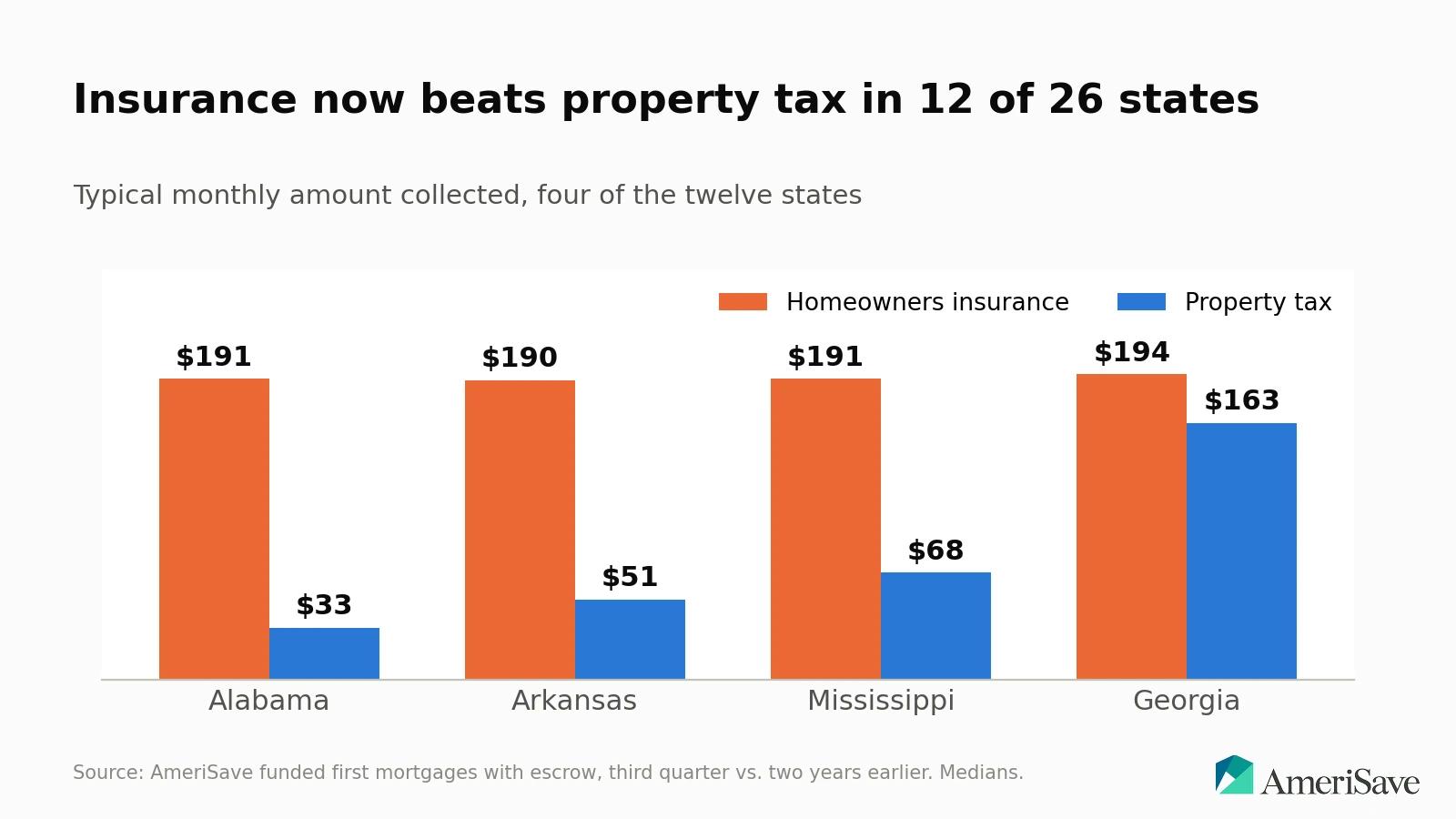
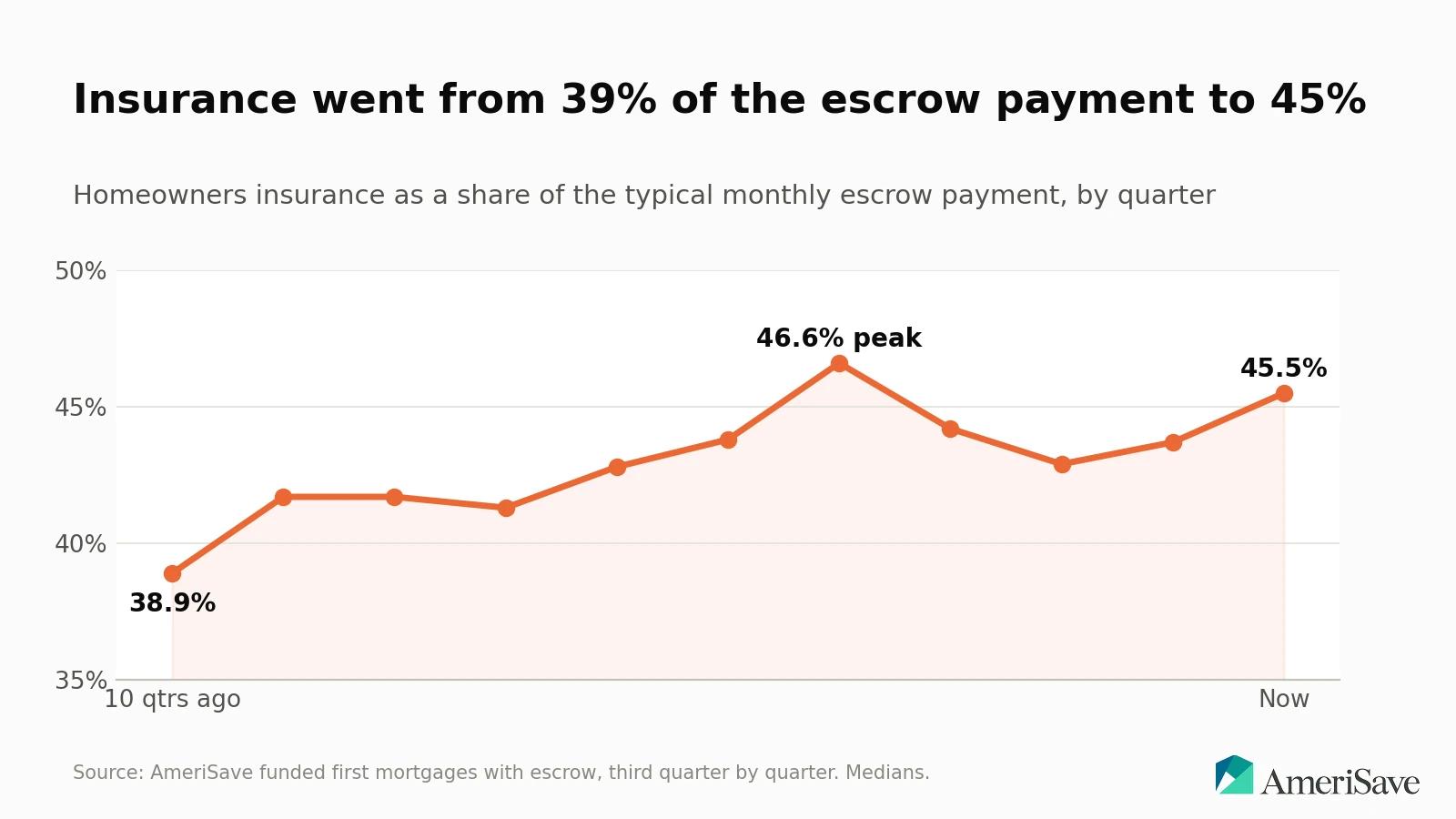
The result is a payment that changed shape while nobody was looking. Ten quarters ago, insurance was about 39% of the typical escrow payment. Now it's about 45%. In 12 of the 26 states with enough loans to publish, the monthly insurance collection is larger than the monthly tax collection. The flip is most extreme in Alabama, where the typical escrowed homeowner pays $191 a month for insurance and $33 for property tax, so insurance is 84% of the escrow payment. Figure 2 traces the national share by quarter, and the table below lists the twelve states.
| State | Monthly insurance | Monthly property tax |
|---|---|---|
| Alabama | $191 | $33 |
| Arkansas | $190 | $51 |
| Mississippi | $191 | $68 |
| South Carolina | $174 | $88 |
| Missouri | $192 | $140 |
| Kentucky | $183 | $139 |
| Tennessee | $150 | $101 |
| Georgia | $194 | $163 |
| Indiana | $159 | $138 |
| Arizona | $142 | $117 |
| Florida | $222 | $164 |
| North Carolina | $130 | $122 |
At the other end, tax still dominates where it always has. New Jersey's typical escrowed homeowner pays $630 a month in property tax against $169 in insurance, and Massachusetts, Connecticut, and Maryland run the same way. Table 2 shows that end.
| State | Monthly property tax | Monthly insurance |
|---|---|---|
| New Jersey | $630 | $169 |
| Massachusetts | $539 | $166 |
| Connecticut | $516 | $200 |
| Maryland | $353 | $147 |
| California | $314 | $144 |
| Washington | $304 | $167 |
After three decades in mortgage finance, my observation is that the process is built so the homeowner never shops the insurance line. The premium on the loan application is a floor: in the data, the application figure runs about 8.5% below the policy that actually gets bound. The servicer renews whatever policy is on file. The escrow analysis that reveals the increase arrives after the money has been collected. Nobody in that chain is paid to find you a cheaper policy.

The Homeowner in Georgia Who Never Called
Picture an escrowed homeowner in Georgia, one of the 12 flipped states. The monthly collection runs about $194 for insurance and $163 for property tax. When the assessment notice arrives, they file an appeal, because everyone they know appeals. When the insurance renewal arrives, they do nothing, because the servicer pays it from escrow and the number never passes through their hands.
Two years of renewals later, the insurance line has grown by more than a fifth and the tax line has barely moved. The escrow analysis raises the payment. The homeowner blames the county.
Two phone calls in two years would have changed the outcome. The premium is the one escrow line you can change without a hearing, a lawyer, or a refinance. Matched coverage, matched deductible, two or three competing quotes, and the new policy on file before the servicer runs its analysis. Your servicer must pay the new policy from escrow once you notify it.
Run the Numbers on a Typical Policy
The data gives two anchors: a typical premium of $1,800 a year and a typical cost of 0.46% of home value. Table 3 applies the second one to common home values, next to the two states where the share runs highest.
| Home value | At the national 0.46% | At Texas 0.74% | At Louisiana 1.11% |
|---|---|---|---|
| $250,000 | $1,150 | $1,850 | $2,775 |
| $318,850 (typical escrowed home) | $1,467 | $2,360 | $3,539 |
| $400,000 | $1,840 | $2,960 | $4,440 |
| $500,000 | $2,300 | $3,700 | $5,550 |
If your premium is well above the national column for your home's value and you’re not in a storm or flood state, you have a question worth asking an agent.
Here is why the re-quote matters more than it looks. In the twelve flipped states the typical insurance line is about $190 a month, or roughly $2,280 a year. If a re-quote with matched coverage trims that by a tenth, the saving is about $228 a year, or $19 a month, which offsets most of the $21.57 monthly escrow increase the typical homeowner saw this year. A re-quote that lands before the servicer's annual analysis changes next year's payment. One that lands after it waits a full cycle.
One more number from the data worth knowing when you buy or refinance. The premium on the loan application runs about 8.5% below the policy that gets bound. On the typical $1,800 application figure, the bound policy is closer to $1,950, which is about $13 a month more flowing into escrow than the estimate showed. Ask for the bound quote before you rely on the number.
What to Check Tonight
Find the declarations page and compare the premium with $1,800 and with 0.46% of what your home is worth. Neither is a rule; both are the center of the data, and a bill far above both deserves a reason.
Find the renewal date and work back four to six weeks. That’s your shopping window. If the renewal falls after your servicer's annual escrow analysis, a lower premium won’t reach your payment until the following year, so the timing matters as much as the quote.
Then look at the whole payment. Budget about 1.5% of home value a year for taxes and insurance nationally, and 2% or more in the heaviest states. If the two moving lines have grown past what the budget can carry, the only lever with enough size is the loan itself.
The full report, Homeowners Insurance Now Costs More Than Property Tax in 12 States, and It Is Up 22% in Two Years, has all 26 states and the two-year detail.
Methodology
The two-year and 12-state figures come from AmeriSave first mortgages that funded with an escrow account, comparing the third quarter of this year with the same quarter one and two years earlier, in states with at least 30 such loans in both periods. The $1,800 premium and the application-versus-policy gap come from all loans funded this year, with premiums taken from the final loan application. Each figure is a median across different loans in each period, so part of any change reflects who borrowed rather than what insurers charged. Data through October 29.
The Bottom Line
The bill that rose 22% in two years is the one almost nobody shops. In 12 states it's now bigger than property tax, and the process is designed to keep it out of your hands. Compare your premium with $1,800, re-quote it before every escrow review, and budget 1.5% of home value for the two moving lines. When those lines outgrow the budget, a rate check against your current loan is the next call, and AmeriSave's rate-and-term refinance is where a lower principal and interest payment can absorb what insurance keeps adding.
AmeriSave internal funded-loan data, Escrow Shock Index, first liens funded with escrow, data through October 27, 2026. Internal, not publicly available.
AmeriSave internal funded-loan data, Climate Risk and Insurance Report, all loans funded year to date, data through October 29, 2026. Internal, not publicly available.
AmeriSave, "Homeowners Insurance Now Costs More Than Property Tax in 12 States, and It Is Up 22% in Two Years," the full report behind this article.
Consumer Financial Protection Bureau, Regulation X, 12 CFR 1024.17, Escrow accounts; supports the annual escrow analysis and servicer payment of insurance from escrow:
Consumer Financial Protection Bureau, "What is an escrow or impound account?"; supports the escrow account definition:


Cam brings 30 years of expertise in capital markets, residential mortgage lending, and risk management to AmeriSave. A Certified Mortgage Banker (CMB) with dual degrees in Business with a Finance & Economics specialization, he previously led capital markets at GoodLeap and managed derivative books at Discover Financial. Originally from Australia, he is now a single father of two based in Newport Beach, CA, focused on translating complex market dynamics into actionable insights for homeowners and industry professionals.
Frequently Asked Questions
Partly because premiums rose across the board, and partly because nobody shopped yours. In AmeriSave's data, homeowners insurance inside the mortgage payment rose 22.3% over two years, far faster than property tax. The premium on your loan application was also a floor; the policy that was bound typically ran about 8.5% higher. After that, your servicer renewed whatever policy was on file each year. Compare your premium with $1,800 a year and with 0.46% of your home's value, the center of the data, and if you’re well above both, get competing quotes with matched coverage.
Yes. You can switch insurers at any time. Notify your servicer, provide the new policy, and the servicer pays the new premium from the escrow account at renewal. The servicer cannot require you to keep a particular carrier, only coverage that meets the loan's requirements. The practical catch is timing: the servicer runs its escrow analysis once a year, and a lower premium that arrives after the analysis won’t lower your monthly payment until the next cycle. Shop four to six weeks before renewal, and aim to have the new policy on file before the analysis date.
Twelve of the 26 states with enough loans in AmeriSave's data: Alabama, Arkansas, Mississippi, South Carolina, Missouri, Kentucky, Tennessee, Georgia, Indiana, Arizona, Florida, and North Carolina. The flip is largest in Alabama, where insurance is $191 a month against $33 for tax. The tax-heavy end runs the other way: New Jersey collects $630 a month in property tax against $169 in insurance, with Massachusetts, Connecticut, Maryland, California, and Washington also tax-dominant. In the flipped states, the insurance line is the one with the most room to shop.
Every renewal, and at least once a year. Get competing quotes four to six weeks before the renewal date, match the coverage limits and the deductible so the comparison is fair, and ask your current carrier to review the premium before you switch. Then time the new policy so it's on file before your servicer's annual escrow analysis, because that analysis sets your payment for the following year. In the 12 flipped states the insurance line is already the larger of the two, so a single successful re-quote can offset most of a year's escrow increase.