


Did You Know Your Storm Deductible Could Be $8,000, Not $1,000? 1 in 8 Policies Work This Way.


 FACT-CHECKEDFACT-CHECKED
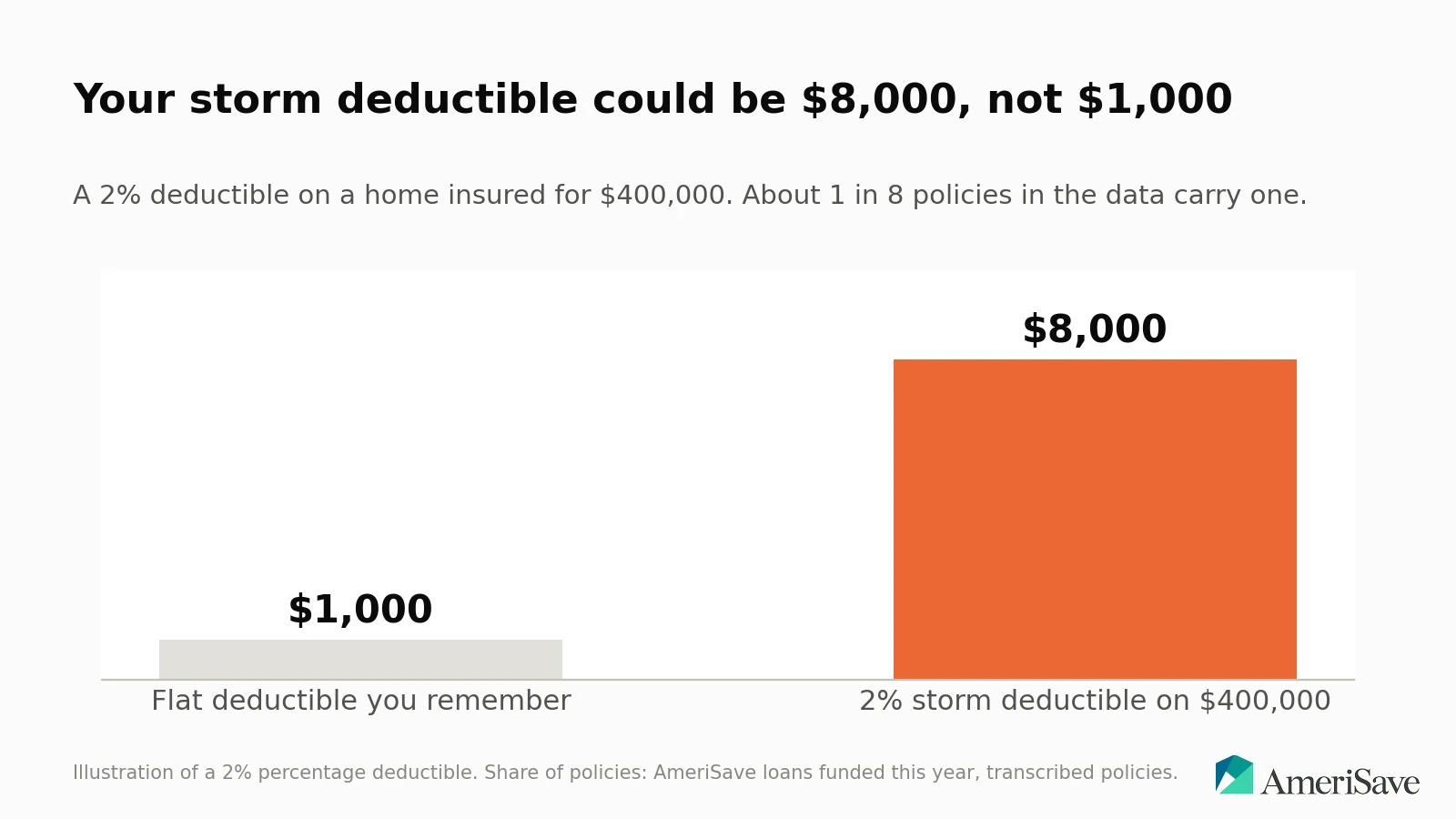
You know your deductible: $1,000. Then a storm hits and the adjuster explains that for wind, your deductible is a percentage of what the house is insured for, so on a $400,000 home at 2% that's $8,000 before the policy pays a dollar. AmeriSave's funded loans show about 1 in 8 homeowners policies carry a percentage deductible.
Key Takeaways
- 12.3% of homeowners policies in the data, about 1 in 8, carry a percentage deductible instead of a flat dollar amount.
- A 2% deductible on a home insured for $400,000 is $8,000 out of pocket before the policy pays.
- A third of financed homes sit in a county with a federally declared disaster in the prior three years.
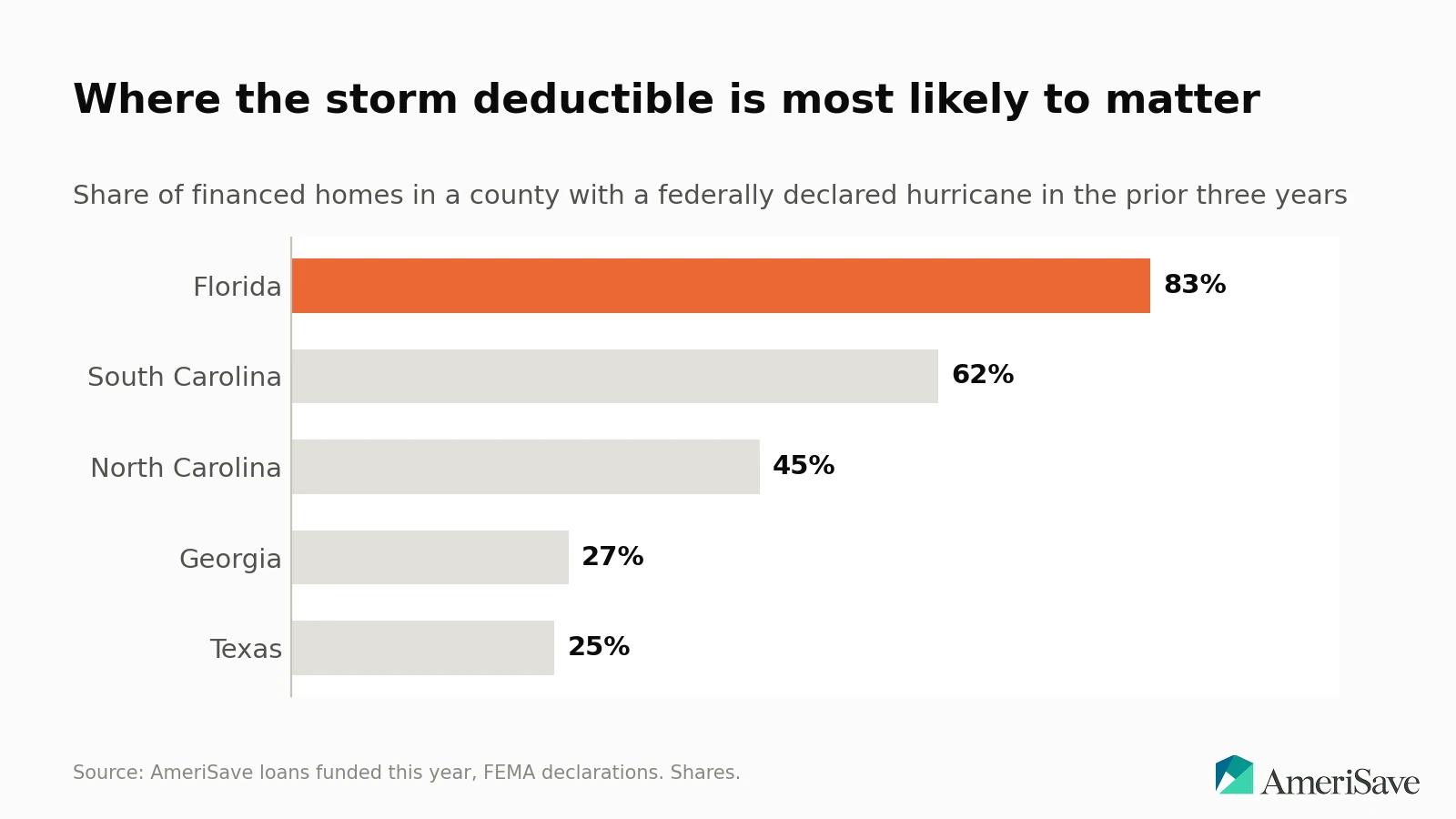
- Nearly 83% of financed Florida homes are in a county with a declared hurricane in the prior three years.
- Find the percentage deductible on the declarations page tonight, and have a plan for the cash.


What Is a Hurricane Deductible?
It's a separate deductible, usually for wind or named-storm damage, written as a percentage of the amount your home is insured for rather than a flat dollar figure. The Insurance Information Institute's own example is a home insured for $100,000 with a 2% deductible: $2,000 comes off any claim. Scale that to a home insured for $400,000 and the deductible is $8,000. At 5%, it's $20,000. Table 1 does the arithmetic for common coverage amounts.
| Home insured for | 1% deductible | 2% deductible | 5% deductible |
|---|---|---|---|
| $200,000 | $2,000 | $4,000 | $10,000 |
| $300,000 | $3,000 | $6,000 | $15,000 |
| $400,000 | $4,000 | $8,000 | $20,000 |
| $500,000 | $5,000 | $10,000 | $25,000 |
The flat deductible you remember still applies to the fire and the burst pipe. The percentage deductible applies to the storm, which is the claim most likely to be large. Figure 1 shows the gap.
Across the homeowners policies transcribed on AmeriSave's loans this year, 12.3% carry a percentage deductible, about 1 in 8. The policies are concentrated where storms are. A third of financed homes in the data sit in a county with a federally declared disaster in the three years before the loan closed. Nearly 83% of financed Florida homes are in a county with a declared hurricane in that window, along with 62% in South Carolina, 45% in North Carolina, and a quarter in Texas. Figure 2 ranks those states.
Two more lines from the data belong next to that number. 1.36% of transcribed policies are written by an insurer of last resort, the state-run plan a homeowner ends up with when no private carrier will write the house, led by North Carolina, Florida, California, and Texas. And 0.33% of loans carry a separate wind or hurricane policy at closing, at a typical $2,563 a year. These are the homes where the storm deductible is the whole story. Table 2 collects the policy and exposure figures.
| Measure | Share |
|---|---|
| Policies with a percentage deductible | 12.3% |
| Policies from an insurer of last resort | 1.36% |
| Loans with a separate wind or hurricane policy (typical $2,563 a year) | 0.33% |
| Homes in a county with any declared disaster in the prior three years | 32.6% |
| Severe storm or tornado | 18.9% |
| Flooding | 15.8% |
| Hurricane or tropical storm | 13.5% |
| Wildfire | 2.5% |
| Winter storm | 2.0% |

The Homeowner Who Found Out After the Storm
Picture a homeowner in Charleston with a home insured for $400,000. The declarations page lists a $1,000 deductible on the first line, and that's the number they remember. Three pages later, in a section headed "named storm," the deductible is 2%.
A hurricane takes part of the roof and floods the garage. The repair estimate is $19,000. The homeowner expects a check for $18,000. The adjuster explains the named-storm deductible: $8,000 comes off first, and the check is $11,000. The homeowner doesn’t have $8,000. The roof waits, the next rain makes it worse, and the repair bill grows.
The policy did exactly what it said. The homeowner never read the page. In my experience in risk, this is the single most common surprise after a storm, and it's entirely findable in advance.
In Florida and Louisiana, the hurricane deductible applies once per season rather than per storm, which is a small mercy in a bad year. Everywhere else it applies to each event.
Run the Numbers on a Storm Claim
Table 1 shows the deductible. Table 3 shows what it does to a claim, using the Charleston example of a home insured for $400,000 with $19,000 in storm damage.
| Deductible on the policy | Comes off the claim first | Check from the insurer | Cash the homeowner needs |
|---|---|---|---|
| $1,000 flat | $1,000 | $18,000 | $1,000 |
| 1% of $400,000 | $4,000 | $15,000 | $4,000 |
| 2% of $400,000 | $8,000 | $11,000 | $8,000 |
| 5% of $400,000 | $20,000 | none (claim is below the deductible) | $19,000 |
The last row is the one that surprises people. At a 5% deductible, a $19,000 repair is entirely out of pocket, because the damage never clears the deductible. The policy is still doing its job for the catastrophic claim, the one that takes the whole roof and the second floor with it, but the ordinary storm is the homeowner's to fund.

So the planning question is the right-hand column: where does that cash come from in the week after a storm? Three answers show up in practice. Savings set aside for exactly this, which costs nothing but takes time to build. A lower deductible bought with a higher premium, where the comparison is the extra premium each year against the deductible difference; paying a few hundred dollars more a year to bring a $20,000 deductible down to $8,000 can be sound for a household that could not raise $20,000 quickly. Or a home equity line of credit opened in advance and left undrawn, which costs little or nothing until a storm, and turns a $8,000 problem into a payment plan on the week it's needed. In Texas, where the typical premium is already $2,978 a year, the third option is often the cheapest way to carry the risk.
What to Check Tonight
Pull the declarations page and read every deductible line, not just the first. Look for the words "wind," "hail," "named storm," or "hurricane," and look for a percentage. If you find one, multiply it by the dwelling coverage amount. That number is your real deductible for the claim you're most likely to make.
If the number is larger than the cash you could raise in a week, that's the gap to close. Some homeowners build the reserve in savings. Some set up a home equity line of credit they never draw on, so the money is available the week the storm comes rather than the month after. Either way, the plan has to exist before the season does.
If you're buying in a storm state, ask for the deductible structure on the bound quote, not the premium alone. A cheaper policy with a 5% storm deductible is not cheaper after the storm.
The full report, Texas, Not Florida, Has the Highest Homeowners Insurance Bills, has the state detail on hurricane exposure and insurers of last resort.
Methodology
The percentage-deductible, insurer-of-last-resort, and separate wind policy figures come from homeowners policies transcribed on AmeriSave loans funded this year, all products. Disaster and hurricane exposure count financed homes in a county with a federally declared event in the three years before funding, using the FEMA declaration list the lender maintains for re-inspections, which lags new declarations. The $8,000 figure and Table 1 are illustrations of percentage deductibles at common coverage amounts, not figures from the data. Data through October 29.
The Bottom Line
About 1 in 8 homeowners policies in the data carry a percentage deductible, and on a $400,000 home at 2% that's $8,000 out of pocket before the policy pays. Most homeowners learn the number from the adjuster. Read every deductible line tonight, multiply the percentage by the dwelling coverage, and decide where that cash comes from before the season starts. For homeowners who would rather have the reserve ready than hope for it, AmeriSave's HELOC is one way to have the money available the week it's needed, without drawing a dollar until it is.
AmeriSave internal funded-loan data, Climate Risk and Insurance Report, all loans funded year to date, data through October 29, 2026. Internal, not publicly available.
AmeriSave, "Texas, Not Florida, Has the Highest Homeowners Insurance Bills. Louisiana Pays More Than 1% of Home Value Every Year," the full report behind this article.
Insurance Information Institute, "Understanding your insurance deductibles"; supports the percentage deductible mechanics and the once-per-season rule in Florida and Louisiana:
FEMA, Disaster Declarations Summaries (OpenFEMA); supports the declared-disaster concept:
Consumer Financial Protection Bureau, "What you should know about home equity lines of credit"; supports HELOC mechanics:


Casey brings 28 years of comprehensive mortgage industry experience spanning operations, compliance, and capital markets to AmeriSave. She has led teams across disclosure, compliance, processing, underwriting, and post-closing while navigating three market crashes since 1998, and previously served as Managing Partner at Groundwork Consulting LLC. Based in Texas, specializes in risk mitigation, pricing integrity, and translating complex market dynamics into actionable borrower guidance.
Frequently Asked Questions
It's a deductible calculated as a percentage of the amount your home is insured for, rather than a flat dollar amount, and it usually applies only to wind, hail, hurricane, or named-storm claims. A 2% deductible on a home insured for $400,000 is $8,000; at 5% it's $20,000. The flat deductible on the first page of your policy still applies to other claims. In AmeriSave's data, 12.3% of transcribed homeowners policies carry a percentage deductible, about 1 in 8, concentrated in coastal and storm-prone states. It's listed on the declarations page, usually under its own heading.
Read the declarations page of your homeowners policy, which is the summary at the front, and look for a separate line for wind, hail, hurricane, or named-storm deductible. If it shows a percentage, multiply it by the dwelling coverage amount, not the home's market value, to get the dollar figure. If you cannot find it, call the agent and ask directly. Then ask whether it applies per storm or per season; in Florida and Louisiana, hurricane deductibles apply once per season. Write the dollar figure on the policy so the number is in front of you before a storm, not after.
Yes, in most states you can choose a lower percentage or a flat storm deductible for a higher premium, and in some coastal areas insurers set a minimum percentage you cannot go below. Compare the premium difference with the deductible difference: paying a few hundred dollars more a year to cut a $20,000 deductible to $8,000 can be worth it if you could not raise the larger amount quickly. The alternative is to keep the higher deductible and hold the cash in reserve, either in savings or through a credit line you leave undrawn until a storm.
Because declared disasters are common and cover large areas. In AmeriSave's data, a third of financed homes nationally sit in a county with a federally declared disaster in the three years before the loan, counting severe storms, flooding, hurricanes, wildfire, and winter storms. Nearly 83% of financed Florida homes are in a county with a declared hurricane in that window, with South Carolina at 62% and North Carolina at 45%. A declaration means the county qualified for federal aid, not that the home was damaged, and it's a reasonable signal that the storm deductible on that home will matter.