



Did You Know 1 in 4 Flood Insurance Buyers Found a Cheaper Policy and Saved About $230 a Year? The Other 3 Never Asked.


 FACT-CHECKEDFACT-CHECKED
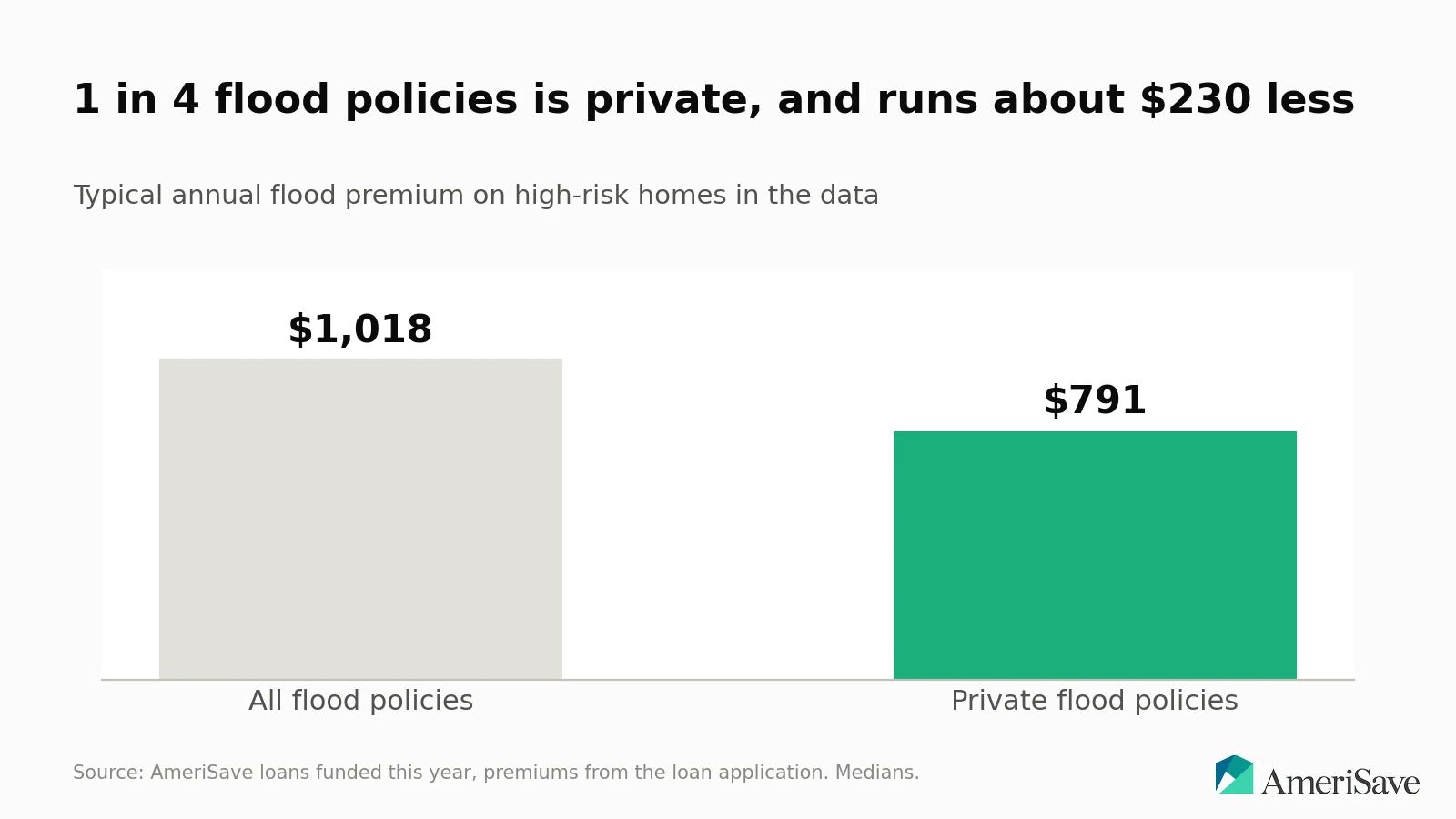
If your house is in a high-risk flood zone, your lender requires flood insurance, and most people take the federal program by default. AmeriSave's funded loans show that about 1 in 4 flood policies on file are private instead, at a typical $791 a year against $1,018 for flood policies overall. That's roughly $230 a year for asking one question.
Key Takeaways
- 25.8% of flood policies on file are private rather than federal, at a typical $791 a year against $1,018 overall.
- Nearly 94% of high-risk first mortgages carry flood insurance, and nearly all of them escrow it.
- A high-risk home pays about $2,622 for homeowners insurance and about $3,640 with flood added, roughly double a no-risk home.
- Lenders must accept a private flood policy that meets the federal standard.
- Ask for a private flood quote alongside the federal one before you accept either.

How Much Is Flood Insurance?
About $1,018 a year for the typical high-risk home in AmeriSave's data with a priced policy. That's the center of all flood policies on file. Split them by who wrote the policy, and the picture changes. 25.8% of the transcribed flood policies are private rather than written through the federal program, and the typical private policy runs $791 a year, about 22% below the overall figure. Figure 1 shows the gap.
The data shows which policy ended up on file, not who shopped. What it cannot show is why the other three in four took the federal program. My experience in risk is that the answer is usually default. The flood determination comes back, the lender says flood insurance is required, the agent writes the federal policy because that's the path everyone knows, and nobody asks whether a private carrier would price the same house lower.
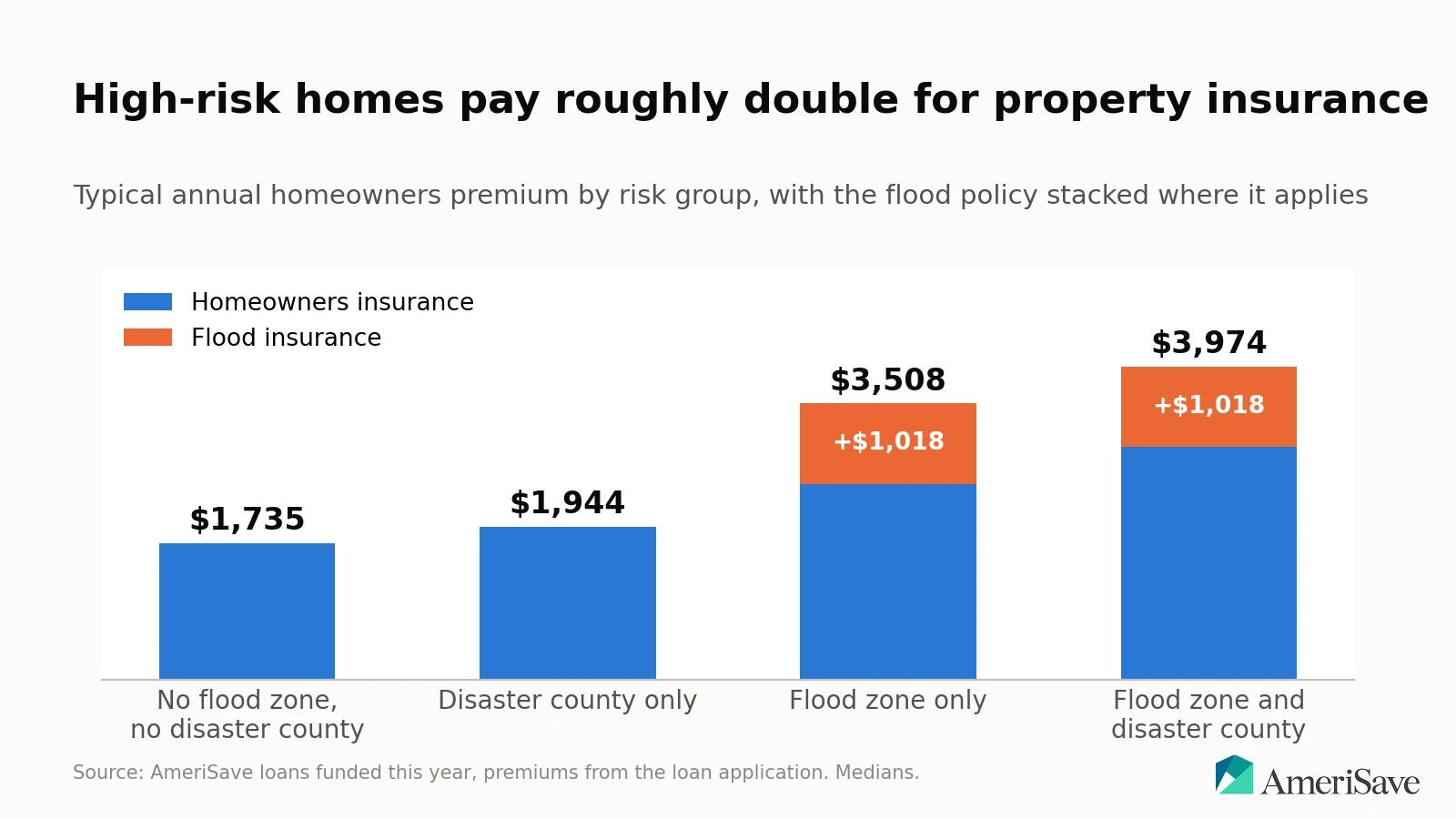
Flood insurance is a second policy on top of homeowners insurance, and in a high-risk zone both run high. The typical homeowners premium in a high-risk A zone is $2,622 a year, about 46% above the $1,800 in minimal-risk zones. Add the flood policy and a high-risk home carries about $3,640 a year in property insurance, against $1,735 for a home with neither a flood zone nor a recent disaster in its county. Roughly double. Figure 2 shows the four risk groups with the flood policy stacked on the two flood-zone groups, and Table 1 lists the figures.
| Risk group | Typical homeowners premium | Typical flood premium | Together |
|---|---|---|---|
| No flood zone, no disaster county | $1,735 | not required | $1,735 |
| Disaster county only | $1,944 | not required | $1,944 |
| High-risk flood zone only | $2,490 | $1,018 | $3,508 |
| High-risk flood zone and disaster county | $2,956 | $1,018 | $3,974 |

The Buyer in Baton Rouge Who Took the Default
Picture a buyer in Baton Rouge. Across Louisiana, one in five financed homes in the data sits in a high-risk flood zone. The flood determination comes back high-risk. The lender requires a policy. The agent quotes the federal program, the buyer accepts because the closing date is close, and the policy gets escrowed at about $1,000 a year.
Nothing goes wrong. The house is covered. But the buyer never saw a second quote, and over the years they own the home, the difference between the default and a private policy on the same house adds up to a few thousand dollars that bought nothing.
The buyer next door asked one question: "Can I get a private flood quote too?" The agent came back with one. The lender accepted it, because federal rules require lenders to accept a private policy that meets the standard. Same house, same coverage requirement, about $230 a year less.
Private is not always cheaper, and for some properties the federal program is the better price or the only option. Which program wins matters less than the pattern: one in four buyers got a second quote and three in four did not.
Run the Numbers on a Flood Zone House
Start with the two policies. The typical flood policy in the data costs $1,018 a year, about $85 a month in escrow. The typical private policy costs $791, about $66 a month. The gap is about $19 a month, $227 a year, and about $2,270 over ten years of owning the home, for one extra quote. Table 3 shows the full picture for a high-risk home against one with no risk flags.


| No flood zone, no disaster county | High-risk flood zone, federal flood policy | High-risk flood zone, private flood policy | |
|---|---|---|---|
| Homeowners premium | $1,735 | $2,622 | $2,622 |
| Flood premium | not required | $1,018 | $791 |
| Total per year | $1,735 | $3,640 | $3,413 |
| Total per month in escrow | $145 | $303 | $284 |
The totals are sums of medians, not a single household's bill, but the shape is what matters: a high-risk home carries roughly double the property insurance of a no-risk home, and the one line in that total a buyer can shop before closing is the flood policy.
When you ask for the second quote, make the comparison fair. Give both agents the same building coverage amount, the same contents coverage, and the same deductible, and ask whether the private policy meets the federal standard your lender requires. Then ask one more question that the data cannot answer for you: whether the private carrier will renew at the same terms. A lower first-year price is a real saving; a lower price that resets at renewal is a reason to shop again next year, which you should do anyway.
What to Check Tonight
If you’re buying, ask whether the house is in a FEMA Special Flood Hazard Area before the inspection period ends. The lender's flood determination will tell you; so will FEMA's flood maps. If it is, ask the insurance agent for two flood quotes, federal and private, on the same coverage.
If you own in a flood zone, pull the flood policy's declarations page. If it's a federal policy you accepted at closing and never re-quoted, get a private quote at the next renewal. Your lender must accept a qualifying private policy, and your servicer will pay it from escrow once notified. Table 2 shows where high-risk flood zones are most common in the data.
| State | Share of financed homes in a high-risk flood zone |
|---|---|
| Louisiana | 20.4% |
| Florida | 11.2% |
| Hawaii (small base) | 7.9% |
| South Dakota (small base) | 5.7% |
| Mississippi | 5.5% |
| New Mexico | 4.7% |
| West Virginia | 4.3% |
| South Carolina | 4.0% |
| National | 2.84% |
Either way, read the homeowners policy with the flood policy next to it. In a high-risk zone the two together are the second-largest line in your payment after principal and interest, and both can be shopped.
The full report, Texas, Not Florida, Has the Highest Homeowners Insurance Bills, has the flood zone and risk group detail by state.
Methodology
The figures come from all AmeriSave loans funded this year, all products. Flood zone comes from the flood determination on every loan. The flood premium figures use high-risk loans with a priced flood policy on file; the private share counts transcribed flood policies and reflects which policy was bound, not whether the borrower shopped. Premiums are from the final loan application and run below bound policies, so treat them as floors. Risk groups combine the flood zone with federally declared disasters in the county in the three years before funding; the totals in Table 1 are sums of medians. Data through October 29.
The Bottom Line
One in four flood policies in the data is private, and the typical private policy costs about $230 a year less than flood policies overall. The other three in four took the default, and the process never asked them to do otherwise. Get two flood quotes on the same coverage, know the flood status before the inspection period closes, and re-quote at renewal. A purchase preapproval through AmeriSave that flags flood status early is where that question gets asked before the closing date decides it for you.
AmeriSave internal funded-loan data, Climate Risk and Insurance Report, all loans funded year to date, data through October 29, 2026. Internal, not publicly available.
AmeriSave, "Texas, Not Florida, Has the Highest Homeowners Insurance Bills. Louisiana Pays More Than 1% of Home Value Every Year," the full report behind this article.
FEMA, National Flood Insurance Program; supports the federal program description:
FEMA, Flood Zones; supports the Special Flood Hazard Area definition:
FDIC, Interagency Questions and Answers Regarding Flood Insurance; supports the private flood acceptance rule and the mandatory purchase requirement:


Casey brings 28 years of comprehensive mortgage industry experience spanning operations, compliance, and capital markets to AmeriSave. She has led teams across disclosure, compliance, processing, underwriting, and post-closing while navigating three market crashes since 1998, and previously served as Managing Partner at Groundwork Consulting LLC. Based in Texas, specializes in risk mitigation, pricing integrity, and translating complex market dynamics into actionable borrower guidance.
Frequently Asked Questions
Yes. Federal rules require lenders to accept a private flood policy that meets the federal standard for coverage, and many carriers write them. In AmeriSave's data, 25.8% of flood policies on file are private, at a typical $791 a year against $1,018 for flood policies overall. Private is not cheaper for every property, and for some homes the federal program is the only option, so the practical step is to ask your agent for both quotes on the same coverage and let the numbers decide. Your servicer pays whichever policy you choose from escrow once notified.
Check FEMA's flood map for the address, and ask the seller's agent for any existing flood policy or elevation certificate. Once you’re under contract, the lender orders a flood determination that states whether the home sits in a Special Flood Hazard Area, the high-risk zone where flood insurance is required on a federally backed or federally regulated loan. In AmeriSave's data, 2.84% of financed homes nationally are in that zone, but the share is 20.4% in Louisiana and 11.2% in Florida. Get the determination before the inspection period ends so the cost can still change your decision.
About $85 a month at the typical $1,018 a year, escrowed alongside taxes and homeowners insurance; at the typical private policy's $791 it's about $66. The larger effect is the combination. A home in a high-risk flood zone in AmeriSave's data carries a typical homeowners premium of $2,622 plus the flood policy, about $3,640 a year together, against $1,735 for a home with no flood zone and no recent disaster in its county. Nearly 94% of high-risk first mortgages in the data carry flood insurance, and nearly all of them pay it through escrow.
Yes, if the new policy meets the federal coverage standard, whether it's written through the federal program or by a private carrier. Notify your servicer, provide the new declarations page, and the servicer pays the policy from your escrow account at renewal. The one caution is timing: don’t let the old policy lapse before the new one is bound, because a gap in required flood coverage lets the lender place its own policy at your expense. Line up the private quote four to six weeks before renewal so the switch is clean.