



When the Fed Cuts Rates, Your Mortgage Rate Can Go Up. It Did After 4 of the Last 6 Cuts.


 FACT-CHECKEDFACT-CHECKED
The Fed cuts, the headlines say rates are falling, and then the rate you're quoted goes up. AmeriSave's lock desk data shows this is normal, not a fluke: after four of the last six Fed cuts, the average rate on cash-out loans borrowers locked that week was higher than the week before. Here's why, and what to do instead of waiting.
Key Takeaways
- After 4 of the last 6 Fed cuts, the average rate on cash-out loans locked that week rose; across all products, 3 of 6.
- The Fed sets an overnight rate; a 30-year mortgage prices off the 10-year Treasury and mortgage-bond spreads.
- Lock activity moved less than 4% on average in either direction after cuts, holds, and hikes alike.
- Roughly half to two-thirds of borrowers lock within a day of starting their file, Fed or no Fed.
- Lock when the file is ready to close inside the lock period; if the downside worries you, price a float-down.

Will Mortgage Rates Go Down After a Fed Rate Cut?
Not reliably, and the lock desk proves it. Simply stated, the Fed controls an overnight rate that banks charge each other. A 30-year mortgage is priced off the 10-year Treasury yield plus the extra return investors demand to hold mortgage bonds. Both of those move on expectations about inflation and about what the Fed will do next, and they move weeks before the vote.
By the time the statement prints, the cut is already in the price. What moves mortgage rates on Fed day is what the Fed says about next time. If the message is "fewer cuts ahead," the 10-year yield rises, and the rate on your quote rises with it, on the same afternoon the Fed cut.
That's why the data looks the way it does. AmeriSave compared the average rate on loans borrowers locked in the seven days after each of the last six Fed cuts with the seven days before. On the cash-out refinance product, the average locked rate was higher after four of the six cuts. Across all loan products, it was higher after three of six. The moves were small, a few hundredths to a few tenths of a point, but the direction is the point. Figure 1 shows each cut.
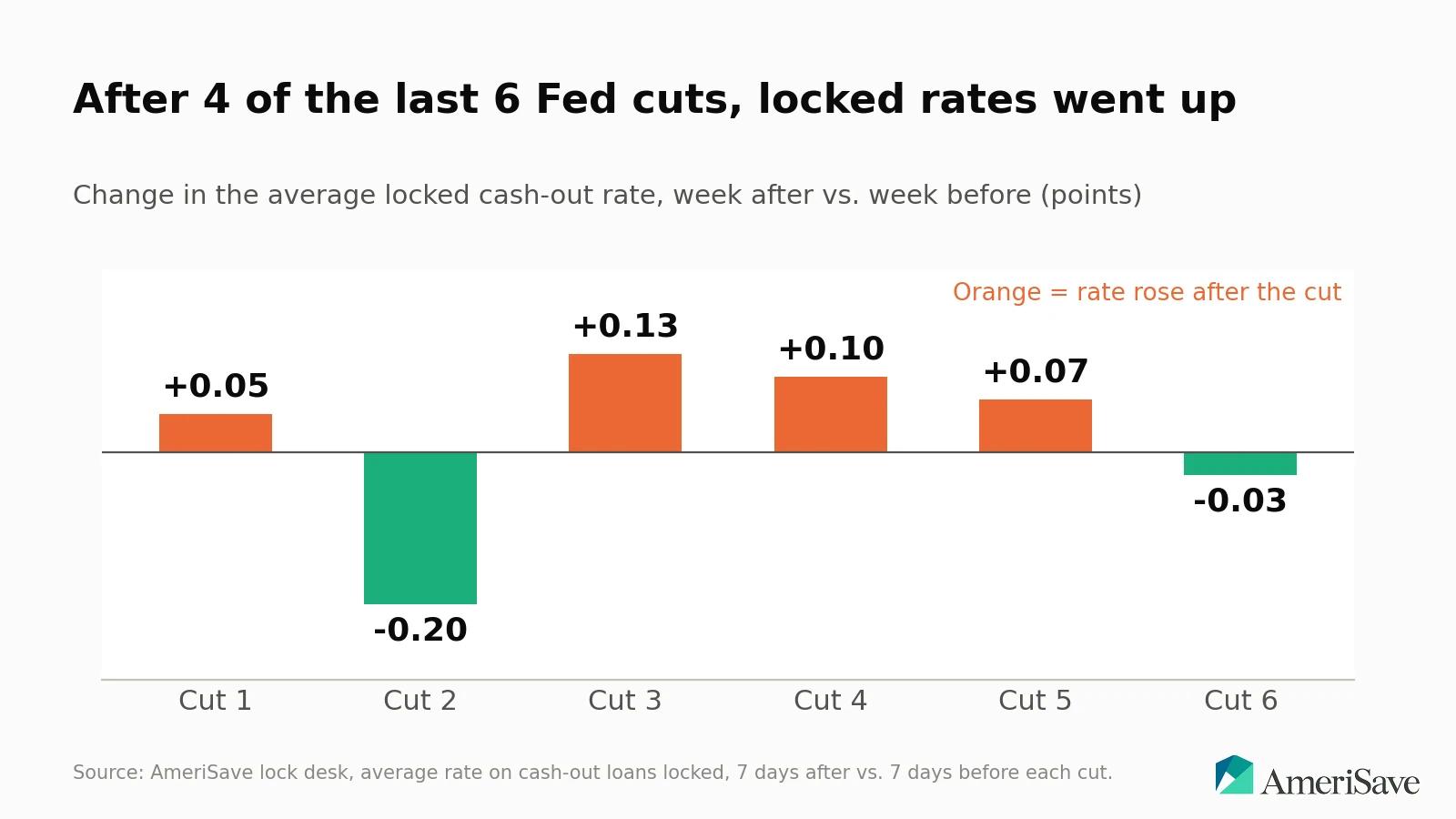
The one clear exception was the November cut two years ago, when the average locked rate fell 0.18 of a point and lock activity rose 13.2% in the week. That's the exception that proves the rule. The other five did not behave that way. Table 1 lists all six.
| Cut | When | Cash-out locked rate, change | All products, change |
|---|---|---|---|
| Cut 1 | September, two years ago (half-point cut) | +0.05 | -0.09 |
| Cut 2 | November, two years ago | -0.20 | -0.18 |
| Cut 3 | December, two years ago (holiday week) | +0.13 | +0.41 |
| Cut 4 | September, last year | +0.10 | +0.14 |
| Cut 5 | October, last year | +0.07 | +0.15 |
| Cut 6 | December, last year | -0.03 | -0.05 |

The Buyer Who Waited for Fed Day
Picture a buyer with an accepted offer and a complete loan file. The Fed meets in nine days. A friend says wait, rates are about to drop. The buyer floats.
Fed day arrives. The cut lands as expected. The press conference signals a slower path from here. The 10-year yield rises that afternoon, mortgage-bond pricing follows, and the next morning the buyer's quote is a tenth of a point higher than it was the day the offer was accepted. The buyer locks anyway, because the closing date is fixed, and pays a little more every month for nine days of waiting.
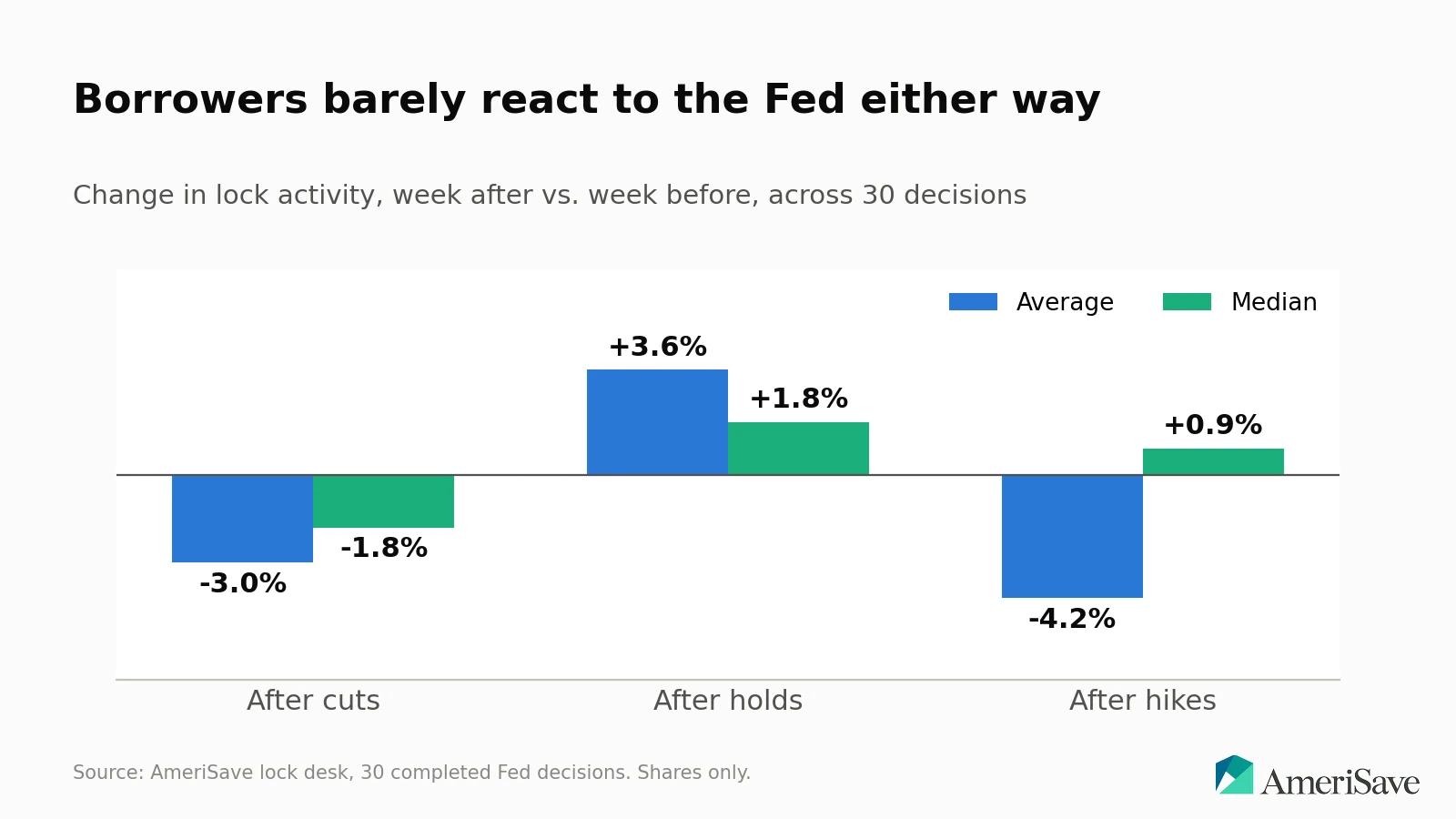
The data shows this is not a rare outcome. It also shows what most borrowers actually do. In every window around every Fed decision, roughly half to two-thirds of borrowers locked within a day of starting their file. Lock activity moved less than 4% on average in either direction after cuts, holds, and hikes alike. The first 24 hours after a meeting swing in both directions, which makes them noise, not signal. Waiting for Fed day is a lottery ticket, and the expected value is negative. Locking is not.
Figure 2 shows how little lock activity moves after any type of decision, and Table 2 adds the speed-to-lock and lock-length figures.
| Decision type | Lock activity, average change | Lock activity, median change | Share locking within a day, change | Average lock period, change |
|---|---|---|---|---|
| After cuts | -3.0% | -1.8% | +0.5 points | 0.0 days |
| After holds | +3.6% | +1.8% | -0.7 points | -0.1 days |
| After hikes | -4.2% | +0.9% | +1.1 points | +0.1 days |
Run the Numbers on the Typical Loan
The moves in Table 1 look tiny. On a real loan they’re not. The typical escrowed first mortgage in AmeriSave's data is about $195,360, and on a 30-year loan of that size each half-point of rate changes principal and interest by roughly $60 to $65 a month in the rate range borrowers have seen over the past two years. Scale that down and Table 3 shows what each post-cut move in Table 1 would have meant to a borrower who floated through Fed day instead of locking the week before.


| Change in the locked rate | Monthly payment difference on a $195,360 loan | Over 30 years |
|---|---|---|
| +0.05 points (Cut 1) | about $6 | about $2,300 |
| +0.10 points (Cut 4) | about $13 | about $4,500 |
| +0.13 points (Cut 3) | about $16 | about $5,900 |
| +0.07 points (Cut 5) | about $9 | about $3,200 |
These are illustrations of payment arithmetic, not rate offers, and they assume the borrower keeps the loan for its full term. Most people refinance or move sooner, so the lifetime figures are a ceiling. Even so, the monthly figures are the cost of nine days of waiting, and they land on a decision the borrower could have made for free.
Now the float-down. The average lock in the data runs about 43 days. If a lender charges a fee for the right to take a lower rate once before closing, compare that fee with the monthly saving at the improvement the float-down requires. A float-down that triggers at a quarter-point improvement is worth roughly $30 a month on the typical loan; if the fee is less than two to three years of that saving and you plan to hold the loan at least that long, it's reasonable protection. If the loan closes in three weeks, the fee rarely earns its keep, and a plain lock does the job.
What to Check Tonight
Check whether your file is complete enough to close inside a lock period. That's the test for locking, not the Fed calendar. A lock fixes your price for a set number of days; if the loan can close in that window, the lock is doing its job.
Check whether the fear of locking too high is what's keeping you floating. If it is, ask your loan officer to price a float-down. A float-down lets you take a lower price once if the market improves before closing, usually for a fee or a slightly higher starting price. Pay for the protection. Don’t pay for it by waiting.
Check the headline against the mechanism. If a story says the Fed's cut will lower mortgage rates, ask what the 10-year Treasury did that day. That number, not the Fed's, is the one on your quote.
The full report, After 4 of the Last 6 Fed Rate Cuts, the Rates Borrowers Locked Went Up, Not Down, walks through all 30 decisions across the past three and a half years, including holds and hikes.
Methodology
The figures come from AmeriSave's lock desk, counting only loans that locked a rate. Each window is the seven days before and seven days after 2:00 PM Eastern on the Fed's decision day, so both contain the same weekdays. Rate figures are simple averages on locked loans and move with product and borrower mix, which is why the cash-out product row is the primary comparison and all products is the check. No rate level is stated; only the direction and size of the change. The October meeting this year is excluded because its after window was still open. Data through October 29.
The Bottom Line
The Fed sets an overnight rate. Your mortgage prices off the 10-year Treasury and mortgage-bond spreads, which move on what the Fed says about next time, not on the cut itself. That's why locked rates rose after four of the last six cuts. Lock when your file can close inside the lock period, buy a float-down if the downside keeps you up at night, and ignore the calendar. AmeriSave's fixed-rate loan with a lock placed on the file's timing, not the Fed's, is how that discipline becomes a payment.
AmeriSave internal lock desk data, Borrower Reaction Report, locked loans around each FOMC decision since February 2023, data through October 29, 2026. Internal, not publicly available.
AmeriSave, "After 4 of the Last 6 Fed Rate Cuts, the Rates Borrowers Locked Went Up, Not Down," the full report behind this article.
Board of Governors of the Federal Reserve System, FOMC meeting calendars and statements; supports decision dates and actions:
Consumer Financial Protection Bureau, "What's a lock-in or a rate lock?"; supports lock and float-down mechanics:
Freddie Mac, Primary Mortgage Market Survey; supports the statement that mortgage rates move with Treasury yields rather than the federal funds rate:


Joe brings extensive capital markets expertise to AmeriSave, specializing in pricing analysis, secondary markets, and risk oversight. He holds a B.S. in Finance from Saint Joseph's University's Haub School of Business and has managed billions of dollars in interest rate risk throughout his career with NewRez, GMAC, and Allied Mortgage Group. Based in Schwenksville, PA, he translates high-level risk and pricing mechanics into protections that benefit everyday borrowers.
Frequently Asked Questions
No. The Fed sets the federal funds rate, an overnight rate banks charge each other, and it influences short-term borrowing like credit cards and some home equity lines. A 30-year fixed mortgage is priced off the 10-year Treasury yield plus the spread investors demand on mortgage bonds. Both move on expectations about inflation and future Fed policy, often weeks before a meeting. A Fed cut can coincide with a rise in mortgage rates when the market reads the Fed's statement as a sign of fewer cuts ahead, which is what AmeriSave's lock data shows happened after most recent cuts.
No. In AmeriSave's data, the average rate on cash-out loans locked in the week after a cut was higher than the week before after four of the last six cuts, and lock activity moved less than 4% on average around any decision. The first day after a meeting swings in both directions, which makes it noise. The right trigger for a lock is a loan file complete enough to close inside the lock period. If you want protection against rates falling after you lock, price a float-down rather than floating through the meeting.
Yes, if the downside is what's keeping you from locking. A float-down is an option attached to a rate lock that lets you take a lower rate once if the market improves before closing, usually for a fee or a slightly higher starting price. It converts the fear of locking too high into a known cost instead of an open-ended gamble. Compare the fee with how much you'd save per month if rates moved in your favor by the amount the lender's float-down requires. If the loan closes soon, the fee often isn't worth it; on a longer lock, it can be.
Because the cut was already priced in and the Fed's message about the future was not. Mortgage rates follow the 10-year Treasury and mortgage-bond spreads, which move weeks ahead on expectations. When the Fed cuts but signals a slower path from there, the 10-year yield can rise the same afternoon, and mortgage pricing rises with it. AmeriSave's lock desk saw the average locked cash-out rate rise after four of the last six cuts, by a few hundredths to a few tenths of a point. The November cut two years ago, when locked rates fell 0.18 of a point, was the exception.