


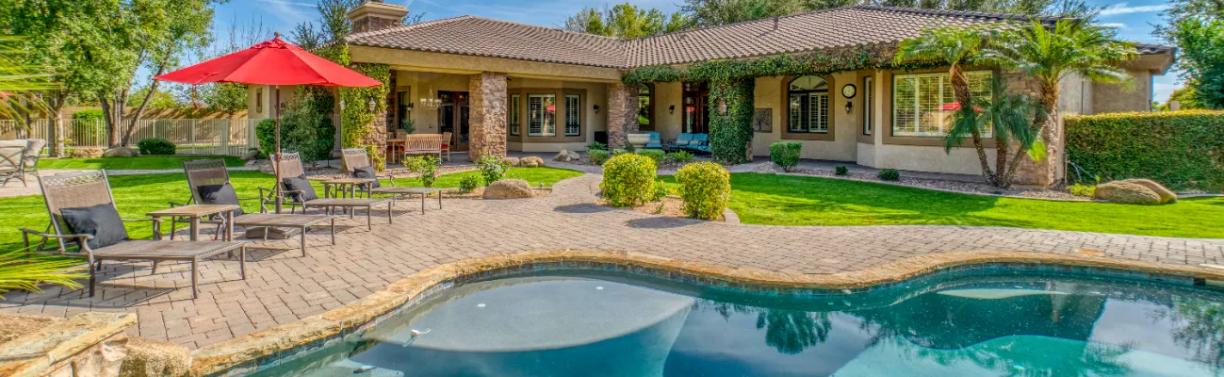
Can You Use a Home Equity Loan for a Pool? A 2026 Guide to Borrowing Smart


 FACT-CHECKEDFACT-CHECKED
A backyard pool carries a real price tag. Inground builds typically run $44,500 to $87,500, before closing costs, insurance, and permits. A home equity loan can be cost-effective for that investment, but only once you understand the full borrowing picture.
Key Takeaways
- A home equity loan funds a lump sum at a fixed rate, predictable if you have a firm contractor bid.
- Most lenders cap combined loan-to-value at 80%, so a $400,000 home with a $220,000 mortgage leaves $100,000 available.
- Home equity loan rates run well below personal loan rates on a comparable 10-year term.
- IRS Publication 936 allows interest deductions on pool loans that count as a substantial improvement, if you itemize.
- Inground pools add 5%-8% to home value nationally; above-ground pools rarely add resale value.


What a Home Equity Loan Is and How It Works for a Pool
The Consumer Financial Protection Bureau defines a home equity loan as a product in which you receive a lump-sum amount and repay it through fixed monthly payments over a set term, at a rate that's typically fixed for the life of the loan. Because the loan is secured by your home, the consequences of non-payment include foreclosure risk, the same exposure as a first mortgage. That stakes level makes understanding the full cost picture a genuine prerequisite before you sign.
For pool financing specifically, the lump-sum structure is an asset. Pool contractors submit firm bids; they don't typically draw project funds incrementally the way a home remodel might. You receive the full loan amount at closing, pay the deposit and milestone payments to the contractor, and begin making equal monthly payments on a fixed schedule you knew before you signed. That payment certainty is a significant operational advantage over variable-rate alternatives.
Repayment terms typically run from five to twenty years. Closing costs generally land between 2% and 5% of the loan amount, covering application, title, appraisal, origination, recording, and attorney fees. These are real costs that belong in your total project budget before the contractor quote arrives.
The loan's funding mechanics also align well with pool permit timelines. Nearly every municipality requires a building permit before installation can begin, and approval runs two to six weeks nationally, stretching to eight weeks in high-regulation markets. Because a home equity loan closes and funds as a lump sum, you can pay a contractor deposit and cover early project costs while permit clearance proceeds. If you go this route, you're not waiting on a draw disbursement schedule the way a construction loan borrower would be. The permit clock and the contractor mobilization calendar can run in parallel.
Understanding the qualification bar also matters before you get to the rate and cost conversations. Lenders assess your credit score, your debt-to-income ratio, and the equity position in your home. For the detailed credit-score requirements and qualification framework, AmeriSave's complete guide to home equity loan credit requirements covers that ground in depth. This article focuses on the pool-specific financial and compliance picture.

The CLTV Calculation: How Much Can You Actually Borrow?
A common planning mistake is assuming you can borrow the full gap between your home's value and your mortgage balance. Lenders don't look at equity that way. They apply a combined loan-to-value cap: a ceiling on the total of all liens against the property as a percentage of the home's current appraised value.
Home equity lender requirement data puts the standard combined loan-to-value ceiling at 80% for most lenders, with some willing to stretch to 85% or 90% if your credit score is above 760. That cap applies to the sum of your first mortgage balance plus any new home equity loan, not just to the second lien in isolation.
Example A: Maximum Borrowing Calculation (illustrative figures)
Here's how the math works on a typical scenario:
- Home value: $400,000 (illustrative)
- First mortgage balance: $220,000 (illustrative)
- Lender CLTV cap: 80%
Step 1: Maximum combined liens = 80% × $400,000 = $320,000
Step 2: Available to borrow = $320,000 − $220,000 = $100,000
If a pool contractor quotes $75,000 for an inground build, that leaves you $25,000 of buffer inside the available window. A bid at $95,000 still qualifies. A bid at $110,000 requires either a higher-CLTV lender, more equity, or a redesigned project scope.
Credit score and income matter alongside equity. Minimum credit score floors for home equity loans typically run from 620 to 640; most lenders prefer 660 to 680. Debt-to-income ratios at or below 43% are the standard floor, with some lenders extending to 50% when compensating factors are present. AmeriSave's home equity loan requirements page has the specific qualification detail for its own product.
In processing, I regularly see homeowners run the informal math in their head ("my home is worth $400,000 and I owe $200,000, so I can pull $200,000") and get surprised when the lender says the maximum is lower. The CLTV cap doesn't permit access to the entire equity gap. It caps the total liens as a percentage of value, and your existing mortgage reduces the available window further. Running this calculation before the contractor meeting prevents a frustrating reset when the loan estimate arrives.
If you're close to the CLTV limit, it's worth considering whether a home value increase, through a fresh appraisal after documented improvements, changes the math. Appraisals for home equity loans reflect current market conditions, and if your property has appreciated since purchase, you may have more usable equity than you realize.
Rate Reality: Home Equity Loan vs. Personal Loan vs. HELOC
The rate advantage of a home equity loan over unsecured financing is the central financial argument for choosing it. National lender survey data puts the current average 10-year home equity loan rate in the 8% range. The Federal Reserve's G.19 consumer credit data tracks personal loan rates at commercial banks. On a 10-year timeline, the spread between secured home equity lending and unsecured personal lending is substantial, typically several percentage points or more.
That spread compounds over the life of a pool loan into thousands of dollars. The worked scenario below puts real numbers to the comparison.
Example B: 10-Year True Cost of Pool Ownership (illustrative)
Inputs for this scenario:
- Pool loan: $65,000 at 8% fixed over 10 years (illustrative; use your lender's actual quote for your own scenario)
- Closing costs: 3% of loan amount = $1,950
- Liability insurance increase: $60 per year = $600 total over 10 years
- Annual maintenance: $2,500 per year = $25,000 total over 10 years
Step 1: Monthly payment on $65,000 at 8% over 120 months ≈ $789
Step 2: Total interest paid over 10 years ≈ $29,700
Step 3: Total financing cost = $65,000 + $29,700 + $1,950 = $96,650
Step 4: Add maintenance and insurance = $96,650 + $25,000 + $600 = $122,250
Typical appraised value added by an inground pool nationally: $24,000-$36,000 (40%-60% of install cost).
The gap between true 10-year cost and value typically recovered is real and significant. The NAR and HomeAdvisor data make plainly clear that a pool is primarily a lifestyle upgrade carrying a long-run cost rather than a wealth-building purchase. Knowing that cost before you borrow is what separates a sound financial decision from a regrettable one.
The HELOC comparison. A home equity line of credit also draws on your built-up equity, but it functions as a revolving credit line rather than a lump sum. You access funds over a draw period, repay what you use, and often can redraw. The CFPB notes that HELOC rates are variable and adjust periodically, which introduces payment uncertainty over a multi-year horizon. If you have a firm contractor bid and a defined construction timeline, that variability is a drawback: you already know the project cost, and a payment that can shift adds risk you don't need. The fixed-rate, lump-sum home equity loan is built for exactly that scenario.
The HELOC becomes more compelling if your project is still in early planning. If you're getting quotes from multiple contractors, haven't locked scope, and aren't sure of the final number, the HELOC's draw-as-needed structure reduces the risk of borrowing and paying interest on dollars you may not use. The decisive variable is how firm your project scope is at the time you need to fund.
The personal loan comparison. Personal loans are unsecured, which is why their rates run materially higher than home equity loans on a comparable term. If you lack sufficient equity or prefer not to put your home up as collateral, a personal loan may be your only option, but the per-dollar cost over 10 years is significantly higher. The rate spread matters more, not less, the longer the repayment term runs.
Construction loans. Construction loans use draw-period disbursements at short-term rates typically above what a home equity loan charges. They're designed for ground-up building projects where funds need to flow incrementally to contractors over months. Most pool contractors accept lump-sum payment at project start or on a simple milestone schedule, which aligns with the home equity loan's closing mechanics rather than a construction loan's phased draw process. Construction loans are rarely the right vehicle for pool financing.

The Tax Deduction: When It Applies and When It Does Not
Mortgage interest deductibility on home equity loan funds is a legitimate tax benefit for some homeowners and meaningless for others. The gap between those two cases depends on three specific conditions.
Condition 1: What the funds are used for. IRS Publication 936 makes clear that interest on a home equity loan is deductible only when the loan proceeds are used to buy, build, or substantially improve the taxpayer's home that secures the loan. IRS Publication 936 defines a substantial improvement as work that adds to the value of the home, prolongs the home's useful life, or adapts it to new uses. A permanently installed inground pool (connected to the home's plumbing and electrical systems, embedded in the property) meets that definition. If you use the funds for other purposes, like paying off credit cards or financing a vacation, they don't qualify.
Condition 2: The combined debt cap. IRS Publication 936 caps the deductible interest on all combined acquisition debt and home improvement debt at $750,000 for loans originated after the Tax Cuts and Jobs Act cutoff date. Consider two scenarios:
- If you have a $500,000 first mortgage and add a $70,000 pool loan, your combined debt is $570,000, inside the cap. Full interest deductibility applies to the pool loan.
- If you have a $700,000 first mortgage and add a $70,000 pool loan, your combined debt is $770,000, which is $20,000 above the cap. Only the interest attributable to the $50,000 portion inside the cap is deductible. The remaining interest isn't.
Condition 3: Itemizing. The deduction is available only when you itemize deductions on Schedule A. If you claim the standard deduction, you get no benefit from home equity interest, regardless of how you used the loan proceeds. IRS Publication 530 covers the mechanics of deduction choice. If you're already carrying significant mortgage interest and property taxes, you're frequently itemizing anyway. In that case, adding pool interest to your Schedule A is a natural extension of an existing strategy. If you have fewer deductions, you may find that the standard deduction remains the better choice even after adding pool interest.
The practical takeaway: consult a tax professional before counting on the deduction. The three conditions define the window precisely. When all three are met, the deduction is real, trackable through your annual mortgage interest statement, and potentially meaningful on a multi-year pool loan.
Does a Pool Add Home Value? What the Data Actually Shows
A common assumption going into a pool financing conversation is that the pool will pay for itself in increased home value. The data tells a more calibrated story.
NAR's Remodeling Impact report on outdoor features tracks this directly. Nationally, inground pools add 5% to 8% to home value. In Sun Belt markets where pools are usable for a longer portion of the year, the premium climbs toward 10%-15%. But the percentage of install cost recovered in appraised value typically runs between 40% and 60%. A $60,000 pool commonly adds somewhere in the $24,000-$36,000 range to what an appraiser will credit the home. That's a real return, simply not a dollar-for-dollar return. The same NAR data applies to outdoor features broadly: buyers pay a premium for outdoor living space, but not at replacement cost.
That finding is a reason to enter the pool decision with accurate inputs rather than optimistic assumptions.
Pool type matters significantly for appraisal. Inground pools (whether concrete, fiberglass, or vinyl-lined) are treated as permanent improvements to real property. They're attached to the home's infrastructure and are factored into the appraised value. Above-ground pools are treated differently. Most appraisers classify them as personal property: they aren't permanently affixed to the structure, they can be disassembled and relocated, and buyers frequently view them as a maintenance burden rather than a feature. The result is that above-ground pools rarely add measurable resale value regardless of what you paid for one. If value recovery matters to your financial decision, the inground versus above-ground distinction is the most consequential choice you'll make before the financing conversation.
Regional fit shapes buyer perception. A pool in a climate where it sits covered for five or six months of the year adds less to a buyer's perceived value than the same pool in a market where it's usable year-round. Buyers in colder markets frequently discount pool value, seeing the maintenance cost without the proportional seasonal benefit. Appraisers in those markets may apply smaller premiums accordingly. Knowing where your market falls on that spectrum helps you calibrate realistic expectations.
Ongoing maintenance is a permanent cost center. Chemicals, cleaning equipment, filter maintenance, heating, and periodic equipment replacement add up. HomeAdvisor consumer data on pool maintenance puts the 10-year total commonly in the $20,000-$30,000 range or above. That cost sits entirely outside the financing math. It doesn't reduce the loan balance, doesn't affect the appraised value calculation, and doesn't go away. Treating maintenance as negligible at the decision stage and encountering it as an annual reality are two very different experiences. Budget for it before you close the loan.
Safety, Permits, and Insurance: What Happens After the Pool Is Built
The safety, permitting, and insurance landscape around residential pool ownership is real, specific, and directly relevant to a complete cost picture, even after the loan itself is settled.
Federal safety standards. The Virginia Graeme Baker Pool and Spa Safety Act is administered by the Consumer Product Safety Commission and mandates anti-entrapment drain covers on public pools. Residential pools aren't federally mandated to comply. The CPSC's position is a firm recommendation, and it's grounded in documented data: CPSC drowning reports show more than 70% of fatal child drownings occur in residential settings, with an annual average of 376 fatal drownings among children under 15 across a recent three-year measurement period. Anti-entrapment drain covers meeting the VGB standard are inexpensive relative to the total pool cost and recommended by every safety authority in this space. Installing them isn't a regulatory requirement for most residential pools, but treating them as optional is a risk calculation that carries serious consequences.
Permits and the construction timeline. Nearly every municipality requires a building permit for residential pool installation. Many also require separate electrical and grading permits. Approval timelines run two to six weeks nationally; high-regulation markets push to eight weeks. The home equity loan's lump-sum funding structure is compatible with this reality. You can close the loan and pay contractor deposits during the permit wait, rather than sitting idle until the permit clears. Confirming fencing requirements early matters too: some jurisdictions require installed fencing as a permit condition and inspect before granting final approval.
Pool construction itself runs eight to sixteen weeks once the permit is in hand and ground is broken. That timeline interacts with loan closing: if you close the home equity loan while the permit is still pending, you have funds in hand and can fund contractor mobilization costs without delay once approval arrives.
Insurance obligations are real and specific. Adding a pool materially changes your homeowners insurance liability exposure. The industry guidance from The Zebra and ValuePenguin is consistent: insurers recommend raising liability coverage from the standard $100,000 floor to between $300,000 and $500,000 when a pool is added. In non-Sun Belt markets, that adjustment adds roughly $50-$75 to the annual premium, a modest cost on the scale of a pool investment. An umbrella policy providing $1,000,000 in additional liability coverage costs $150-$300 per year and is frequently recommended alongside the homeowners liability increase for pool owners. Some insurers will decline to issue or renew a policy if a pool on the property is unfenced. Confirm that requirement with your carrier before construction begins, so fencing is already in place when the inspector visits.
The insurance conversation is also a lender conversation. Some home equity lenders verify homeowners coverage at closing and want to see adequate liability limits in place. Addressing that with your insurer before the loan closes avoids last-minute complications.
Comparing Your Pool Financing Options
When homeowners ask me which financing structure makes sense for a pool, I work through four things before answering: how much you plan to borrow, what the money is specifically being used for, how much you already owe on the first mortgage, and what other debt you're carrying. That math is what determines the product that fits.
For pool financing, the decision grid simplifies around three realistic options: a home equity loan, a home equity line of credit, and a personal loan. Construction loans exit the conversation for most pool buyers for the reasons noted above, because pool contractors work with lump-sum payments and the draw-period mechanics of a construction loan add complexity and cost without adding benefit.
The home equity loan's case is strongest when three conditions align: the project has a defined scope, the contractor quote is firm, and you want a payment that doesn't move for the life of the loan. Fixed rate, lump-sum disbursement, predictable amortization: that combination is built for exactly that scenario.
The HELOC's case is strongest if your scope is still evolving. If you're talking to contractors, comparing design options, and not yet ready to commit to a final number, you can use the HELOC's draw structure to access only what the project actually requires. If the project comes in below budget, you pay interest on a lower balance. If scope expands, headroom exists without a new loan application. The tradeoff is rate variability. HELOC rates adjust periodically, which creates payment exposure over a long draw and repayment horizon. If you choose a HELOC for budget flexibility and then carry a large balance at a rising rate, you've traded one form of certainty for another form of risk.
The personal loan is typically the highest per-dollar cost of the three options. If you lack sufficient equity (a recently purchased home where appreciation hasn't yet built a meaningful cushion, or a market where values have been flat), the personal loan may be your only path that doesn't require collateralizing the home. The rate premium is real and compounding; knowing that cost upfront is what makes the choice informed rather than accidental.
The core decision framework. I tell homeowners to focus on two things: the total interest paid over the life of the loan and the monthly payment increase relative to what you can absorb without payment shock. The option that minimizes total interest paid while keeping the monthly increase manageable is almost always the right one. The product description is secondary to those two numbers.
Getting the Project Budget Right Before You Borrow
The biggest variable in pool financing is the project budget itself. HomeAdvisor data puts the inground pool cost range at $35,000 to over $120,000, with most builds landing between $44,500 and $87,500 and the national median around $66,000. That's a wide band, and it moves based on material choice, pool shape, depth, decking, lighting, heating equipment, and fencing requirements.
Concrete pools are the most durable and most customizable inground option but also the most expensive, typically running at the higher end of the cost range. Fiberglass pools arrive as a pre-formed shell, install faster, and require less ongoing chemical maintenance, a feature that affects the 10-year maintenance budget as well as the upfront cost. Vinyl-lined pools are the most affordable inground option but require periodic liner replacement, usually every 10 to 15 years.
Material choice affects both the financed amount and the ongoing cost picture. If you plan to stay in the home for 20 or more years, your calculation looks different than if you expect to sell in seven. The liner replacement schedule on a vinyl pool is a cost that surfaces well after the home equity loan is paid off, and it belongs in your total ownership plan regardless.
Before committing to a loan amount, get at least two to three detailed contractor quotes that include excavation, equipment, decking, electrical, fencing, and landscaping restoration. Pool installation quotes vary significantly by contractor, and the difference between a comprehensive quote and a minimum-scope quote can easily run $15,000 to $20,000 on a single project. The contractor quote that wins on price but omits fencing or decking will surface those costs as change orders after construction begins, at which point they arrive as surprises rather than planned expenses.
The CLTV math in Example A is only as useful as the accuracy of the project budget going into it. If you borrow against $75,000 in anticipated costs and encounter $90,000 in actual costs, you'll need either a new borrowing arrangement or a project scope reduction mid-construction, neither of which is a comfortable position. Getting the scope right before the loan closes is the cleanest version of this process.
Applying for a Home Equity Loan: What to Expect
The application process for a home equity loan follows a sequence that AmeriSave's home equity loan application step-by-step guide covers in detail. At a summary level, the major phases are: application and documentation submission, home appraisal, underwriting, and closing. The factors that most consistently accelerate your file through that sequence are the same ones that apply to any secured loan: complete documentation on the first request, responsive communication with your loan officer and processor, and proactive disclosure of anything that might raise a question during underwriting.
Income documentation for a home equity loan typically includes recent pay stubs, W-2s or tax returns if you're self-employed, proof of current homeowners insurance, and a copy of your mortgage statement. Getting these organized before you apply eliminates the most common source of processing delay.
The appraisal is a required step for most home equity loans because the lender needs to confirm the current value of the property against which it's lending. If your home has appreciated since purchase (which is true for many homeowners), the fresh appraisal may establish a higher value than you expected and expand your available borrowing window.
Underwriting reviews the full credit, income, and property picture. If something in your file raises a question (a gap in employment history, an unusual income source, a lien the title search surfaces), the underwriting team will request an explanation or additional documentation. Responding to those requests promptly is your strongest tool for keeping the timeline on track.
The loans that move through fastest and close cleanest are almost always the ones where you and the lender both stay engaged throughout the process. Persistence works in both directions: if something feels unclear, ask. If a step seems to be taking longer than expected, check in. The mortgage process rewards active participation more than it rewards patience.
Timing relative to pool construction. Home equity loan closing timelines for AmeriSave are detailed at the full timeline guide linked above. In general, the appraisal and title work set the pace. Submitting documentation completely on the first request is the most effective single action you can take to keep the timeline compressed. Once the loan closes and funds disburse, the money is in hand and ready for contractor deposits, which means construction can begin as soon as permitting clears.
The Bottom Line
A home equity loan is a strong vehicle for pool financing when the underlying math supports it: sufficient equity, a credit profile that meets lender requirements, a firm project scope, and a clear-eyed picture of the true long-run cost. The rate advantage over unsecured financing is genuine. The potential tax deduction is real if you itemize and use the funds for a qualified substantial improvement. The fixed payment is useful if you want certainty over a 10-year repayment schedule.
The favorable rate doesn't change the fundamental arithmetic: a $65,000 pool at an 8% illustrative rate over 10 years, with maintenance and insurance factored in, carries a realistic all-in 10-year cost well north of $100,000, against a typical appraised value addition in the $24,000-$36,000 range. Millions of homeowners make that investment every year and value it accordingly. That gap is a reason to make the decision with full information rather than optimistic assumptions about how the numbers will fall.
Check your CLTV math before the contractor meeting. Know your credit and DTI position before you apply. Understand the tax conditions before you count on the deduction. Account for safety, insurance, and permit costs as part of the total project budget. And when you're ready to run the numbers with a lender, AmeriSave's home equity loan product and the technology that surfaces the option saving you the most money monthly are worth bringing into that conversation.
The loans that serve you best are the ones where both sides, you and the lender, know exactly what's in front of them before anyone signs anything.
IRS, Publication 936: supports the home mortgage interest deduction rules, the substantial-improvement test, and the combined debt cap.
IRS, Publication 530: supports the mechanics of choosing between itemizing and the standard deduction.
HomeAdvisor: supports the inground pool cost range and the 10-year maintenance cost estimate.
National Association of REALTORS®, Remodeling Impact Report: Outdoor Features: supports the home value added by inground pools and the recoverable-cost percentage.
Consumer Product Safety Commission: supports the childhood drowning data and the anti-entrapment drain cover recommendation.
Consumer Financial Protection Bureau: supports the definition and cost structure of a home equity loan.
Consumer Financial Protection Bureau: supports the definition and variable-rate structure of a HELOC.
Pool Research: supports the pool permit approval timelines.
The Zebra: supports the recommended liability coverage increase and umbrella policy cost when adding a pool.


Jerrie leads sales operations in the Dallas-Fort Worth region for AmeriSave, where his entire mortgage career has been spent since being recruited into the industry at age 18. Licensed as a Mortgage Loan Originator in 37 states, he specializes in making complicated loan options accessible and helping borrowers understand what matters most in their individual situations. He brings deep regulatory knowledge and a client-centric approach honed through progression from entry-level to upper management, including successfully onboarding and training 70 people from a closed Cleveland office.
Frequently Asked Questions
Yes. A home equity loan provides a lump sum at closing, which you can direct toward pool construction costs. Most pool contractors accept lump-sum payment and work well with the home equity loan closing timeline. The core qualification requirements are sufficient equity to meet the lender's combined loan-to-value cap (typically 80%), a minimum credit score in the 620-680 range depending on the lender, and a debt-to-income ratio at or below 43%. Your borrowing ceiling is calculated by subtracting your first mortgage balance from the maximum combined lien the lender permits based on your home's appraised value. Closing costs of 2%-5% are part of the upfront project budget. AmeriSave's home equity loan page covers the application process in detail.
Under IRS Publication 936, home equity loan interest is deductible when the funds are used to substantially improve the home that secures the loan. A permanently installed inground pool meets that definition. Two additional conditions apply: combined acquisition and home improvement debt must stay at or below $750,000 to receive full deductibility; and you must itemize deductions on Schedule A rather than claiming the standard deduction. If you're already carrying significant mortgage interest and property taxes, you frequently meet the itemizing threshold and may deduct pool interest as part of an existing Schedule A. A tax professional can confirm which scenario applies given your specific debt picture and deduction profile.
An inground pool adds approximately 5%-8% to home value nationally, rising to 10%-15% in warm-weather markets where pools are usable most of the year. Recoverable value typically runs 40%-60% of installation cost. A $60,000 pool commonly adds $24,000-$36,000 to appraised value. Above-ground pools are treated as personal property by most appraisers and rarely produce measurable resale value. Regional climate significantly affects buyer perception and appraiser premiums: colder markets discount pool value relative to Sun Belt markets. A pool is best framed as a lifestyle investment rather than a wealth-building one for most homeowners and most markets.
Adding a pool materially increases your homeowners insurance liability exposure. Insurers generally recommend raising liability coverage from the standard $100,000 to between $300,000 and $500,000. In non-Sun Belt markets, that adjustment typically costs $50-$75 more per year. A personal umbrella policy providing $1,000,000 in additional liability coverage runs $150-$300 annually and is frequently recommended for pool owners. Some insurers will decline or non-renew coverage for unfenced pools, so confirming fencing requirements with your carrier before construction begins avoids surprises. Contact your insurer as part of the planning process, well before the pool is installed.
A home equity line of credit and a home equity loan both draw on your built-up equity but work differently. A home equity loan delivers a lump sum at a fixed rate, giving you a predictable payment from day one. A HELOC provides a draw line at a variable rate that adjusts periodically. If you have a firm contractor bid and a defined construction timeline, the home equity loan's predictability is generally advantageous: you know what it costs and what you owe each month. The HELOC's draw-as-needed flexibility is more valuable when your project scope is still evolving and the final cost isn't yet committed. The decisive variable is how firm your project scope is when funding is needed.
Nearly every municipality requires a building permit for residential pool installation; many also require separate electrical and grading permits. Nationally, permit approval runs two to six weeks, with high-regulation markets extending to eight weeks. Your home equity loan can close and fund during the permit wait. Contractor deposits are payable while the permit is in review, which keeps the construction timeline moving. Some jurisdictions require installed fencing as a permit condition and conduct an inspection before final approval. Confirm specific requirements with your local building department early in the planning process, before your contractor schedules mobilization.
Pool ownership carries ongoing costs that sit entirely outside the financing picture. Chemicals, cleaning equipment, filter maintenance, heating, and periodic equipment replacement commonly total $20,000 to $30,000 or more over a 10-year ownership period. These costs don't contribute to the appraised value of the home and don't affect loan terms. They're an operational expense of ownership. Factoring them into your total 10-year cost is essential to an honest view of the pool decision. The most common financial planning mistake with pool ownership is treating maintenance as a minor rounding error. Over a decade, it represents a significant and predictable cash outlay that belongs in the budget from day one.
Timelines vary by lender, property, and documentation complexity. AmeriSave's complete home equity loan timeline guide at amerisave.com/learn covers each phase from application to funding in detail. In general, the appraisal and title work drive the timeline, with underwriting following both. The single most effective action you can take to compress the timeline is submitting complete documentation on the first request: recent pay stubs, W-2s or returns, homeowners insurance confirmation, and your current mortgage statement. If you stay engaged with your loan officer and processor, you'll consistently see faster closings than if you wait passively for updates. Once funds disburse, pool construction can begin as soon as the permit clears.