


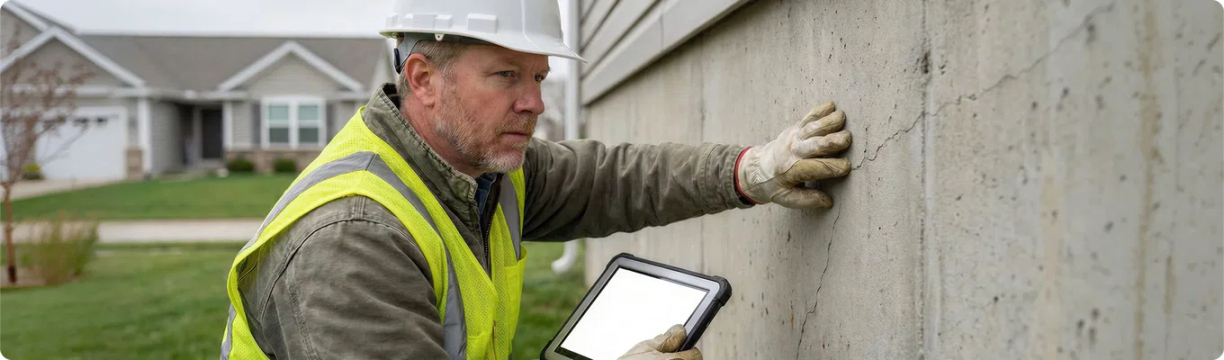
Buying a House With Foundation Issues: A 2026 Guide to Risks, Repairs, and Financing

Although they change the math, foundation issues do not automatically rule out buying a house. The right call depends on the specific damage, what repairs will cost, the loan program you’re using, and how much the seller is willing to come down. This article explains how to finance the job, what to negotiate, and what to inspect.
Key Takeaways
- The type of damage is more important than the existence of any cracks, and foundation issues can range from aesthetic hairline cracks to active structural collapses.
- When foundation issues arise, the advice of a certified structural engineer is more reliable than that of a typical home inspection.
- The cost of repairs ranges from few hundred dollars for tiny cracks that are patched to more than $40,000 for the installation of a pier or complete underpinning.
- Before closing, structural flaws must often be fixed or escrowed for conventional, FHA, USDA, and VA loans.
- Qualified buyers can incorporate major repairs into their mortgage through the FHA 203k and Fannie Mae HomeStyle Renovation programs.
- States have different disclosure requirements, but most of them mandate that sellers disclose known foundation flaws in writing.
- A price decrease, an escrow holdback, or a seller-funded repair credit at closing are typical negotiation strategies.
- The quality of the repair documentation and any transferable contractor warranty have a significant impact on the long-term resale value.
- When the expense of repairs exceeds the attainable price decrease or when the soil conditions ensure recurrence, it makes sensible to walk away.
- The leverage point is an inspection contingency; a foundation issue found prior to closing is nearly always preferable than one found after move-in.


How Foundation Issues Reshape the Math of a Home Purchase
Every borrower's circumstance is unique, and this is particularly evident in homes with foundation issues. The same hairline fissure in the same spot may be the first indication of expansive clay heaving the slab a quarter of an inch every year, or it may be a ten-year-old settlement pattern that has long since stopped moving. Which of those scenarios is truly in front of you will determine the appropriate response to the question of whether you should purchase.
Because foundation issues alter every aspect of the transaction, this is important at the borrower level. Because no sane buyer would pay full market for a house that requires $25,000 in structural work, the price fluctuates. Because most lenders want repairs or an escrow holdback before to closing, the timeline is altered. Because a Fannie Mae HomeStyle Renovation loan is designed to integrate the repair into the mortgage, it will handle an active foundation defect differently from a Federal Housing Administration loan. Additionally, the long-term value varies since the home's appraisal and subsequent sales are influenced by the quality of the repairs and their documentation.
This advice is intended for purchasers who are thinking about purchasing an older property in an area where soil instability is known, have noticed anything during a showing, or received an inspection report that raised concerns. The intention is to provide you with the framework to consider foundation issues from the perspective of a structural engineer, a lender, and a seasoned loan officer. Some houses with foundation issues are great investments. Some are costly errors. Usually, the distinction lies in what you learn before to drafting the offer.

Common Foundation Problems and What Causes Them
Foundation problems generally fall into a handful of recognizable patterns, and identifying which pattern is in front of you is the first step. Expansive soils, which are clays that swell when wet and shrink when dry, are widely distributed across the country. The U.S. Geological Survey publishes a national map of swelling clays showing the heaviest concentrations across portions of Texas, Colorado, Wyoming, and the southern Mississippi Valley. Long-standing damage estimates compiled by the American Society of Civil Engineers and other geotechnical sources place annual property losses from expansive soils above the combined annual losses from floods, hurricanes, tornadoes, and earthquakes. That sounds dramatic until you’ve seen it firsthand. A house in central Texas, eastern Colorado, or parts of Oklahoma sitting on the wrong soil profile can experience two to four inches of vertical movement across a single seasonal cycle.
Settlement Cracks Versus Active Structural Movement
Most homes settle. Standard residential building-science guidance recognizes that minor surface cracking in concrete and masonry is normal as new structures load and the soil consolidates beneath them. The distinction that matters is whether the movement has stopped or is still happening. Settlement cracks that stabilized within the first few years of construction read as cosmetic; they’re typically narrow, run vertically or diagonally, and don’t change shape over time. Active movement looks different. The crack widens at one end. Doors that used to close stick. The drywall above an interior door tears in a stair-step pattern. A monitored crack widens over a six-month observation window.
If you can find an old inspection report from a previous owner, or photos from a real estate listing five years back, comparing them against today is one of the cheaper diagnostic tools available. A REALTORS®-issued listing photo from a prior sale is a free baseline. If the cracks look the same as they did then, the foundation has likely stopped moving. If they’re visibly worse, you’re looking at active settlement, and that’s a different conversation.
Expansive Clay Soils and Foundation Heave
Heave is the opposite of settlement. The soil pushes the foundation up rather than letting it drop. The U.S. Geological Survey publishes a national map of swelling-clay distribution, and the heaviest concentrations sit across portions of Texas, Colorado, Wyoming, Mississippi, and Alabama. In these regions, soil under the slab can change volume substantially between wet and dry seasons, with documented expansion of 10% or more in the most reactive clay profiles. The visible signs include a slab that has cracked along the perimeter and lifted in the center, doorframes that bind at the top, and tile floors that develop ridges along the slab joint. Building-science research from groups like the Insurance Institute for Business and Home Safety emphasizes that the cycle of wetting and drying around the perimeter, not the absolute soil moisture level, is what tends to drive the worst structural damage.
What the soil is doing matters because it tells you whether a repair will hold. Underpinning a house on stable soil is a one-time fix. Underpinning a house on active expansive clay without addressing drainage and moisture management can produce a repaired foundation that fails again within a decade.
Water Intrusion, Hydrostatic Pressure, and Bowing Walls
For homes with basements, the most common foundation failure mode involves water rather than soil. Hydrostatic pressure, which is the lateral force exerted by water-saturated soil pushing against a basement wall, can crack and bow concrete or masonry walls inward over time. Horizontal cracks running across the middle third of a basement wall are a recognized warning sign of structural distress in residential building science, distinct from the vertical hairline cracks that are usually cosmetic. A wall that is visibly bowing more than an inch toward the interior is a serious finding regardless of cause.
Drainage is the upstream variable. Gutters that dump water at the foundation, downspouts that discharge less than six feet from the house, and grading that slopes toward the structure rather than away from it are the trio of conditions that turn a well-built basement wall into a bowed one. The fix is rarely just the wall. Anyone who repairs the wall without correcting the drainage is selling a six-figure problem dressed up as a five-figure one.
Slab, Crawl Space, and Basement Considerations
Foundation type changes the symptoms you should look for and the repair methods that apply. Slab-on-grade foundations, common across the South and Southwest, hide most of the structural concrete from view; the diagnostic clues are upstairs: doors that don’t close, tile cracks, gaps between cabinets and the wall. Crawl space foundations expose the framing for inspection but introduce moisture, mold, and pier-and-beam settlement issues that slab homes don’t face. Full basements are the most diagnostic from an inspection standpoint because the structure is visible, but they carry the highest risk of water-driven failure when drainage is poor.
The International Code Council’s residential building codes set minimum standards for footing depth, frost protection, and drainage, and most jurisdictions adopt some version of these codes. Older homes built before modern code adoption may have shallower footings, no perimeter drain, or unreinforced concrete walls. None of this is automatically a dealbreaker, but it changes how aggressively you should inspect.
How to Spot and Verify Foundation Problems Before You Buy
Warning Signs to Watch For During a Showing
Anyone who understands what to look for can see the fingerprints left by the majority of foundation issues. Most homes will have at least one or two of these indicators at some point, and none of them is definitive on its own. More important than any one observation is the pattern.
Examine door operations throughout the house's floor plan. Doors that won't lock without lifting or that constantly bind at the same corner of the frame indicate that the frame has racked. Whether you're walking barefoot or in flat shoes, notice if the floors feel level or if you're intentionally moving upward toward a corner. In the kitchen and main living space, drop a few marbles. A ball rolling steadily in one direction over a finished floor can reveal information about the slab's real levelness.
Check the drywall surrounding windows and above internal doorframes. Classic shear patterns from foundation movement include diagonal cracks that run from the upper corners of door and window openings or stair-step cracks that follow the seams of brick or block. Typically, vertical fractures that appear after drywall seams are just joint compound settlement cracks. The pattern to be flagged is the diagonal one.
Take a stroll around the outside and examine the foundation wall. Indicators worth looking into include gaps where the brick has split from the window or door trim, stepped cracks that run along the mortar joints in brick veneer, and horizontal cracks. If there is a chimney, look at it. Because they are situated on a different, narrower base, chimneys are frequently the first component of the structure to lean when foundation movement starts. A strong signal is a chimney that is clearly slanted away from the house.
Examine the drainage and grading. Even if there aren't any foundation issues right now, circumstances like soil that slopes in the direction of the home, downspouts that empty within a few feet of the foundation, and pooling water around the perimeter after rain can cause problems in the future. In residential building science literature, drainage is frequently mentioned as one of the overlooked causes of structural degradation in single-family homes.
Building a Layered Inspection Process
There’s a layered inspection process that buyers should think through any time foundation concerns surface. Each layer answers a different question, and skipping a layer is how buyers end up surprised after closing.
The General Home Inspector’s Role
A general home inspector, working under the Standards of Practice published by organizations like the American Society of Home Inspectors and the International Association of Certified Home Inspectors, is trained to identify visible defects across the major systems of a house: structural, mechanical, electrical, plumbing, exterior, and interior. The Standards of Practice explicitly do not require a general inspector to determine the cause of a defect, perform engineering calculations, or render an opinion on structural adequacy. What they will do is flag concerns and recommend specialist follow-up.
If a general inspection report includes language like “recommend further evaluation by a licensed structural engineer” for foundation findings, treat that as a yellow flag, not a red one. It means the inspector saw something they’re not credentialed to fully evaluate. Skipping the engineer because the inspector “only” recommended one is the most common mistake buyers make at this stage.
When to Hire a Licensed Structural Engineer
A structural engineer licensed by your state’s board of professional engineers is the right specialist for an actual foundation evaluation. The engineer will measure floor elevations across the slab, document crack widths and locations, evaluate the soil and drainage conditions, and produce a written report that can hold up in negotiations and underwriting review. Engineer reports typically range from a few hundred dollars for a basic evaluation up to a few thousand for a comprehensive structural and soils investigation, depending on what the situation calls for.

Per the National Society of Professional Engineers, the engineer’s opinion is independent of any contractor relationship, which is critical. A foundation repair company can also produce a free quote, and that quote will recommend a repair scope. The engineer’s report tells you whether the repair scope the contractor is recommending is appropriate, excessive, or inadequate. For a $20,000-plus repair decision, that independent second opinion is worth its weight.
What an Engineering Report Should Tell You
A useful structural engineering report will answer four questions in plain language. First, what is the current condition of the foundation? Second, is the movement active or stable? Third, what is the recommended scope of repair, with specific methods named? And fourth, what is the prognosis if the recommended work is performed? A report that doesn’t address all four, especially the second one, is incomplete. Any borrower talking to AmeriSave’s underwriting team about a property with a known foundation history will be asked some version of these four questions, so getting them answered upfront saves time later.
Foundation Repair Costs by Method and Scope
Repair pricing depends on the method, the linear footage being addressed, the access conditions, and the regional labor market. The figures below are general industry ranges drawn from cost data compiled by the National Association of Home Builders and other publicly reported industry sources. Always get the specific quote in writing from a licensed contractor in your market.
Crack Sealing and Cosmetic Repairs
For non-structural cracks that are not actively widening, epoxy or polyurethane injection seals the crack to prevent water intrusion and further deterioration. The National Association of Home Builders has placed typical pricing for individual crack injection in the range of $250 to $1,000 per crack, depending on length and access. This is the smallest category of foundation work and rarely affects a mortgage approval, though the repair should still be performed by a licensed contractor with documentation.
Slabjacking, Mudjacking, and Polyurethane Lifting
When a slab has settled but is otherwise intact, lifting techniques inject material under the slab to raise it back to level. Traditional mudjacking uses a cement and soil slurry; polyurethane foam is the more recent alternative and uses much less material but generally costs more per square foot. Industry contractor pricing data typically places slabjacking projects from a few hundred dollars for a small porch slab to $2,500 or more for an interior living area. The method works best when the soil beneath the slab is otherwise stable; lifting a slab that’s on active expansive clay buys time but doesn’t solve the underlying problem.
Helical Piers, Push Piers, and Underpinning
Underpinning is the heaviest category of foundation repair and the one most likely to drive a financing conversation. The National Association of Home Builders’ cost data places per-pier installation in the range of $1,500 to $3,000, with full perimeter underpinning of a typical single-family home running $10,000 to $40,000 depending on the number of piers required, soil conditions, and access. Helical piers, which are large screws driven into stable soil below the active zone, and push piers, which are driven hydraulically until they hit refusal, are the two main methods. Both transfer the load of the structure off the unstable surface soil and onto deeper stable strata.
For a property requiring full underpinning, a typical bid will list the pier count, the spacing, the depth assumption, and the interior versus exterior pier breakdown. Underpinning bids that don’t spell out the engineer’s recommended pier count and spacing are the bids to be most cautious about.
Wall Bracing, Carbon Fiber, and Bowed Wall Repair
For basement walls bowing inward due to hydrostatic pressure, the repair methods range from carbon fiber strap reinforcement at the lower end to steel I-beam bracing or full wall replacement at the higher end. The Insurance Institute for Business and Home Safety’s building science guidance recommends matching the repair method to the degree of deflection: under an inch of bowing typically responds to carbon fiber straps, while walls deflected more than two inches usually require steel bracing or wall reconstruction. Full wall replacement on a finished basement can run $40,000 to $100,000 or more depending on excavation conditions and the amount of finished space affected.
Drainage and Site Work
The repair that gets skipped most often is the one that prevents recurrence: drainage. Adding gutter extensions, regrading the site, installing a French drain, or excavating and waterproofing the exterior basement wall are all part of the same problem. Exterior waterproofing with a French drain typically runs $3,000 to $15,000 depending on perimeter length and depth. Skipping it on a wet basement repair almost guarantees the original problem returns.
How Foundation Damage Affects Your Mortgage Financing
This is where the conversation with a lender starts. Every loan program has its own rules on how a property with structural concerns is treated, and the right loan for the situation depends on the severity of the damage, the cost of the repair, and whether the seller is willing to address it before closing.
Conventional Loans and the Appraisal Process
Fannie Mae and Freddie Mac, the two government-sponsored entities that purchase the bulk of conventional conforming loans, require the appraiser to note any conditions that affect safety, soundness, or structural integrity. An appraisal report on a property with visible structural distress will typically be issued “subject to repair” or “subject to inspection by a qualified professional.” That means the loan cannot close until the repair is performed and verified or, in some cases, the engineer has certified that the condition does not impair structural integrity.
For a borrower who wants to use a conventional loan on a property with a known foundation defect, the practical paths are: the seller pays for the repair before closing, the buyer pays for the repair before closing in rare cases, or the lender approves an escrow holdback that funds the repair shortly after closing. AmeriSave’s loan officers can walk through which option is workable in a specific transaction, but the appraisal language usually drives the conversation.
FHA Loans and Minimum Property Requirements
Federal Housing Administration loans require the property to meet HUD’s Minimum Property Requirements, which include intact, structurally sound foundations free of defects that would impair habitability. HUD Handbook 4000.1, the consolidated FHA single-family origination handbook, lays out the appraisal protocols and the conditions under which the appraiser must call for further inspection. An active foundation defect on an FHA appraisal almost always triggers a repair condition before the loan can close.
If the home needs more than minor repair work, the standard FHA program may not be the right vehicle. The FHA 203k Renovation program is designed precisely for this situation. It allows the buyer to finance the purchase and the repairs in a single loan. AmeriSave originates FHA loans across most U.S. states and works with borrowers who are evaluating both standard FHA and 203k options.
VA Loans and the VA Minimum Property Requirements
The Department of Veterans Affairs uses a similar but distinct standard. VA Pamphlet 26-7, the VA Lender’s Handbook, defines the Minimum Property Requirements as conditions that ensure the home is “safe, structurally sound, and sanitary.” VA appraisers are explicitly required to flag foundation defects, settling, water damage, and any structural concern that could affect the use of the home. VA loans don’t allow closing on a property with a structural defect that hasn’t been addressed; the repair must be completed before closing or the loan won’t fund.
For veterans buying a home with foundation issues, the path forward usually involves either a price reduction tied to a seller-completed repair or a renovation-style refinance after closing on a separately financed property, but those are situational and depend heavily on the specific transaction. A VA-eligible borrower at AmeriSave can work with our team to evaluate whether the Fannie Mae HomeStyle Renovation or another renovation product is a better fit for the situation.
USDA and Other Government-Backed Programs
USDA Rural Development’s Section 502 guaranteed loan program follows a similar standard. The U.S. Department of Agriculture’s technical handbook for Section 502 loans requires the property to be “modest, decent, safe, and sanitary,” and structurally sound. An active foundation defect will trigger appraiser flags and repair conditions in the same way it does on conventional, FHA, and VA loans.
Renovation Loan Programs That Cover Foundation Work
For buyers who actually want to take on a property that needs major foundation work, renovation loans are the cleanest financing path. Two programs are worth understanding in detail.
FHA 203k Standard and Limited Programs
The FHA 203k program comes in two flavors. The 203k Limited program covers minor repairs and improvements up to $75,000, a cap raised under recent HUD guidance and reflected in the current edition of HUD Handbook 4000.1. The Limited program does not cover major structural work, so it’s typically the wrong tool for an active foundation defect.
The 203k Standard program is the right fit for major structural work, including foundation repair, room additions, or significant rehabilitation. The Standard program has no upper repair-cost limit beyond the FHA loan limit for the area; it requires a HUD-approved 203k consultant to oversee the project; and it requires a minimum of $5,000 in eligible repairs. Borrowers using a 203k Standard loan can close on the property and begin repairs immediately, with the repair funds held in escrow and disbursed to the contractor in stages as work is completed and inspected.
For foundation-specific work, the 203k Standard is generally the cleanest path because it explicitly contemplates structural repair and includes the consultant oversight that protects the borrower. AmeriSave originates 203k loans and our renovation team can walk through whether the Limited or Standard program fits a specific repair scope.
Fannie Mae HomeStyle Renovation
The HomeStyle Renovation program is Fannie Mae’s conventional answer to the FHA 203k. It allows a borrower to finance up to 75% of the as-completed value of the property, including the cost of structural repairs, additions, and improvements. The HomeStyle program covers foundation repairs, roof replacement, plumbing, electrical, and most other rehabilitation categories. It uses standard conventional underwriting, requires a licensed contractor, and uses a third-party appraisal that values the property as completed rather than as-is.
HomeStyle is often the right choice for borrowers with strong credit and significant down payment who want a conventional rather than FHA-backed loan. Its primary advantage over the 203k is the higher loan limit ceiling for properties at the upper end of the price range and the absence of FHA mortgage insurance for the life of the loan when the borrower puts at least 20% down.
Freddie Mac CHOICERenovation
The CHOICERenovation program from Freddie Mac is a similar conventional renovation product. It also allows financing of structural repairs into the mortgage and follows conventional underwriting standards. The two programs serve broadly similar borrowers; the right one depends on which investor the originator is delivering the loan to. AmeriSave’s loan officers can outline the differences between HomeStyle and CHOICERenovation based on a borrower’s specific qualifications.
Negotiating the Purchase Price After a Difficult Inspection Report
Once an inspection or engineer’s report has documented foundation issues, the seller knows they need to address the problem in some form to close the deal. From the buyer’s side, three negotiation paths are commonly available.
Price Reduction Tied to Repair Cost
The most direct path is a price reduction equal to or greater than the documented repair cost. The buyer takes ownership of the repair after closing, the seller comes down on price, and the loan funds at the reduced price. This works cleanly when the loan program permits closing on a property with the existing condition. This is typically true for renovation loans, sometimes true for conventional with a strong borrower profile, and usually not true for FHA, VA, or USDA loans. The buyer should secure repair bids from at least two licensed contractors before negotiating the reduction.
Seller Repair Before Closing
Many sellers will agree to perform the repair before closing rather than absorb a price reduction that signals the issue to other buyers. If this is the path, the buyer should require the work to be performed by a licensed contractor with a transferable warranty, request copies of all permits and inspection reports, and have the structural engineer return for a post-repair walkthrough. The repair documentation transfers with the home and matters significantly at resale.
Seller Credit at Closing or Escrow Holdback
A seller credit at closing reduces the buyer’s cash to close by the agreed-upon amount. Seller credits are subject to limits set by the loan program. Conventional loans typically allow a seller concession up to a percentage of the purchase price tied to the down payment, and FHA loans cap seller concessions at 6%. An escrow holdback is a separate mechanism in which a portion of the seller’s proceeds are held in escrow by the title company until the repair is completed, typically within 60 to 120 days after closing. Holdbacks are not universally available and depend on the loan program, the lender’s policy, and the title company’s willingness to administer the escrow.
Whichever negotiation path is chosen, the inspection contingency in the purchase contract is the leverage point. Without an active inspection contingency, the buyer’s ability to renegotiate after a difficult report is limited. The Consumer Financial Protection Bureau’s home buying guidance recommends preserving the inspection contingency in any contract on a home where structural concerns are even possible. A foundation issue, in any region with expansive soils, is always at least possible.
Insurance, Disclosure Laws, and Long-Term Resale Value
The foundation conversation doesn’t end at closing. Three downstream considerations, insurance, disclosure, and resale, are all affected by what happens before and during the purchase.
Homeowners Insurance and Foundation Damage
Standard homeowners insurance policies generally exclude damage from earth movement, settling, and gradual water intrusion. Foundation cracks caused by long-term settlement, expansive soil, or poor drainage are typically not covered. Foundation damage caused by a covered peril such as a sudden plumbing leak, an explosion, or vehicle impact may be covered, but the burden of proof falls on the homeowner. Buyers purchasing a home with a known foundation history should disclose the history to their insurance agent and confirm what is and isn’t covered before closing.
State Disclosure Laws and the Seller’s Obligations
Disclosure laws vary by state, but most jurisdictions require sellers to provide a written disclosure of known material defects, including foundation problems, prior repairs, and any pending insurance claims. The National Association of REALTORS® maintains a state-by-state summary of disclosure requirements. In states with strong disclosure laws, including California, Texas, and Illinois, a seller who fails to disclose a known foundation issue can face civil liability after the sale. In states with weaker disclosure regimes, the burden falls more heavily on the buyer’s due diligence.
A buyer should always ask the seller directly, in writing, whether they are aware of any past or present foundation issues. The seller’s response in writing becomes part of the file and protects the buyer’s position if a previously undisclosed issue emerges later.
Long-Term Resale Value and Repair Documentation
A foundation problem that has been properly diagnosed, repaired, and documented does not have to permanently impair a home’s value. In standard appraisal practice, repair quality and documentation are the variables that drive how much, if any, value impairment persists at resale. A home with a clean structural engineer’s post-repair certification, a transferable contractor warranty, and a permit-documented repair history typically appraises within a small percentage of comparable unaffected homes. A home with no repair documentation, an active warranty dispute, or evidence of work performed without permits sees a much steeper discount.
The implication for buyers is straightforward. If you’re going to take on a home with a foundation history, do the work to assemble the documentation that will support resale. If you’re evaluating a home that has been previously repaired, ask for that documentation before writing the offer. The presence or absence of a clean documentation file is one of the cleanest signals you can get about how seriously the prior owner took the repair.
Putting the Decision Together
Inspection, finance, negotiation, and long-term ownership all connect with foundation issues. It is not possible to assess any of those threads separately. A buyer is misunderstanding the decision's structure if they interpret a foundation issue as a single bad data point and discount it appropriately. When a buyer approaches the inspection, repair scope, finance program, negotiation, and post-purchase planning as the cornerstone of the transaction, the outcome is either a bargain that makes sense or doesn't, and the answer is earned rather than guessed at.
Buyers frequently misjudge the financing scheme. A 203k Standard loan or a HomeStyle Renovation loan may be a perfect fit for a property that cannot be closed on with a regular FHA loan. In certain cases, seller-completed repairs recorded before to closing can bring a property that fails a VA appraisal into compliance. A traditional lender ready to handle the holdback can finance a property that needs an innovative escrow structure. Asking whatever program, repair scope, and negotiation technique best suits this particular borrower and this particular property is the ideal loan officer. Our team at AmeriSave works directly with borrowers and their real estate brokers to resolve that combination.
Your file belongs to you. The file of your neighbor is the file of your neighbor. The appropriate response for one borrower and one property could be completely incorrect for another. Buyers that get the right experts engaged early on, document everything, and don't let the process wait for an unfulfilled follow-up are the ones who succeed in these transactions. Ask a question if one arises. Get an explanation if a number doesn't add up. Get a second contractor bid if the first one doesn't seem right. The pattern is that.
There is no general rule that a house with foundation problems is usually a good or poor purchase; each borrower's situation is unique. Making the appropriate decision depends on a few factors, and the best way to do so is to consider them honestly.
Conditions That Favor Moving Forward
A few circumstances point toward continuing with the purchase. The damage has been definitively diagnosed by a licensed structural engineer, the repair scope is well-defined, and the cost is documented through multiple contractor bids. The soil conditions are stable or have been adequately addressed in the repair scope, not just the visible damage. The seller is willing to either reduce the price by the full repair cost or perform the repair before closing using a licensed contractor with a transferable warranty. The financing path is clear, whether that’s a conventional loan with a price reduction, a renovation loan rolling repairs into the mortgage, or another structure that fits the situation.
When all four of those conditions are met, a property with a foundation issue can be a sound buy and sometimes a meaningful value play. The discount you negotiate often exceeds the actual repair cost, and homes with documented repairs can resell at close to their unaffected market value. AmeriSave loan officers regularly close loans on previously-repaired properties when the documentation supports the transaction.
Conditions That Argue for Walking Away
The opposite is indicated by other conditions. Regardless of the quality of the repairs, the harm is active and the soil condition described in the engineer's report will ensure recurrence. The available financing requires the work to be completed prior to closing, and the seller refuses to lower the price or carry out the repair. No engineer has been able to settle the dispute between contractors over the repair scope, with quotes differing by at least 30%. The property's post-repair valuation plus the entire cost of repairs is higher than what a similar, unaffected house in the same neighborhood would be worth.
Even if a house is otherwise appealing, it is rarely a bad idea to walk away from one that has foundation issues. When a house appears flawless but has a structural problem, purchasers are more likely to convince themselves to take on more risk than the math justifies. Asking the right questions upfront, getting each document to the appropriate person, and not letting the file sit are all part of the proper strategy. The next house is available if the results show that the purchase is not justified. You'll proceed with confidence and a clear documentation trail if the responses are received and they do support the transaction.
Geological Survey. Olive, W.W., Chleborad, A., Frahme, C., Schlocker, J., Schneider, R., and Schuster, R.L., 1989. Swelling Clays Map of the Conterminous United States. USGS Miscellaneous Investigations Series Map I-1940.
U.S · pubs.usgs.gov

Wray, W.K., 1995. So Your Home is Built on Expansive Soils: A Discussion of How Expansive Soils Affect Buildings. ASCE Publications.
American Society of Civil Engineers · ascelibrary.org
Department of Housing and Urban Development. HUD Handbook 4000.1: FHA Single Family Housing Policy Handbook.
U.S · hud.gov
Department of Housing and Urban Development. Mortgagee Letter 2024-13: Revisions to the 203(k) Rehabilitation Mortgage Insurance Program. Effective November 4, 2024.
U.S · hud.gov
Department of Veterans Affairs. VA Lender’s Handbook. VA Pamphlet 26-7.
U.S · benefits.va.gov
Department of Agriculture, Rural Development. Section 502 Guaranteed Loan Program Technical Handbook. HB-1-3555.
U.S · rd.usda.gov
Selling Guide.
Fannie Mae · selling-guide.fanniemae.com
HomeStyle Renovation Mortgage.
Fannie Mae · singlefamily.fanniemae.com
CHOICERenovation Mortgage.
Freddie Mac · sf.freddiemac.com
Buying a House.
Consumer Financial Protection Bureau · consumerfinance.gov
Building Science Guidance.
Insurance Institute for Business and Home Safety · ibhs.org
Homeowners Insurance Coverage.
Insurance Information Institute · iii.org
Cost vs. Value and Construction Cost Surveys.
National Association of Home Builders · nahb.org
Find a Licensed Engineer.
National Society of Professional Engineers · nspe.org
State-by-State Disclosure Requirements.
National Association of REALTORS® · nar.realtor
Standards of Practice.
American Society of Home Inspectors · homeinspector.org
Standards of Practice.
International Association of Certified Home Inspectors, known as InterNACHI · nachi.org
International Residential Code.
International Code Council · iccsafe.org

Jerrie leads sales operations in the Dallas-Fort Worth region for AmeriSave, where his entire mortgage career has been spent since being recruited into the industry at age 18. Licensed as a Mortgage Loan Originator in 37 states, he specializes in making complicated loan options accessible and helping borrowers understand what matters most in their individual situations. He brings deep regulatory knowledge and a client-centric approach honed through progression from entry-level to upper management, including successfully onboarding and training 70 people from a closed Cleveland office.
Frequently Asked Questions
No. As the building loads onto the soil and the materials cure, most homes experience modest foundation cracks in the first few years after construction. Standard residential building science guidelines, such as those issued by the International Association of Certified Home Inspectors, state that small vertical fissures that are less than an eighth of an inch broad and have no displacement on either side are usually considered cosmetic. Stair-step cracks in masonry, diagonal cracks radiating from door and window corners, horizontal cracks extending across basement walls, and any crack that has noticeably enlarged over a six-month observation period are the cracks that should be taken seriously. Active movement fractures are more common in homes constructed on expansive clay soils, according to the U.S. Geological Survey. A professional structural engineer's advice is more trustworthy than a contractor's sales pitch when in doubt.
Yes, in a lot of situations, but the lending program sets the course. Before closing, conventional loans backed by Freddie Mac and Fannie Mae might need the repair finished or escrowed. According to Handbook 4000.1, Federal Housing Administration loans require the property to satisfy HUD's Minimum Property Requirements, which often prohibit closing on an unrepaired structural issue. The requirements for USDA and VA loans are comparable. The FHA 203k Standard program and the Fannie Mae HomeStyle Renovation program are intended to fund both the purchase and the repairs in a single loan for homes that require substantial structural work. The type of property, the extent of the repairs, and the borrower's credentials all influence which program is best.
The cost of repairs varies greatly. Minor non-structural cracks can be sealed for between $250 and $1,000 each, according to National Association of Home Builders pricing estimates. For a single area, slabjacking or polyurethane raising of a settled slab usually costs between $500 and $2,500. A single-family home's complete perimeter underpinning normally costs between $10,000 and $40,000, depending on the circumstances, whereas helical or push pier installation costs between $1,500 and $3,000 per pier. With carbon fiber straps, wall bracing for a bent basement wall starts at about $4,000, and a complete wall replacement can cost up to $40,000 or more. Prior to signing, have a structural engineer examine the suggested scope and obtain quotations from a minimum of two certified contractors.
The lending program and the local market will determine the outcome of the negotiation. The appraisal will probably need the repair to be finished before closing if you're using a conventional, FHA, VA, or USDA financing, which often means the seller will either pay for the work or grant a price reduction equivalent to the repair cost. If you're utilizing a renovation loan, such as the Fannie Mae HomeStyle Renovation or the FHA 203k Standard, you can finance the repair into the mortgage and pay for it over the course of the loan, with the seller covering the cost through a price decrease. Maintaining the inspection contingency in the purchase contract is advised by the Consumer Financial Protection Bureau's home buying guidelines so that the negotiation may take place on sound basis.
Start with the board of professional engineers in your state, which grants licenses to structural engineers and keeps a list of license holders available to the public. Additionally, a state-by-state referral resource is maintained by the National Society of Professional Engineers. For a residential foundation evaluation, a certified structural engineer must be licensed as a professional engineer in your state, have no financial connection to a foundation repair contractor, and produce a written report rather than an oral opinion. A preliminary assessment may cost several hundred dollars, while a thorough structural and soil examination may cost several thousand. If they find a problem, the majority of general house inspectors will suggest a particular engineer; this is typically a good place to start.
The majority of ordinary homeowners' insurance do not cover foundation damage brought on by slow water penetration, settling, or earth movement. Long-term settlement and extensive soil damage are clearly covered by standard policy exclusions, according to the Insurance Information Institute's consumer recommendations. Documentation and timeliness are crucial, but foundation damage brought on by an unexpected, unintentional covered risk like a ruptured plumbing line or a car incident may be covered. Certain carriers provide separate earthquake policies that can cover particular causes or optional earth-movement endorsements. Before closing, buyers of a house with a foundation history should tell their insurance agent about it and get written confirmation of what is and isn't covered.
It is dependent upon the caliber of the documentation and repairs. A foundation problem that has been correctly identified, fixed by a certified contractor with a transferable guarantee, and recorded by permits and engineering records usually does not considerably reduce resale value in normal appraisal methodology. At resale, a home with unrecorded or inadequately documented repairs, ongoing warranty problems, or proof of unauthorized work frequently has significant value damage, perhaps 10–20% less than comparable unaffected homes. Maintaining a comprehensive file that includes the engineer's report, contractor bids, signed contract, permit records, post-repair certification, and warranty documentation is the most beneficial thing a current owner can do. This paperwork is transferred with the house and safeguards the subsequent sale.