


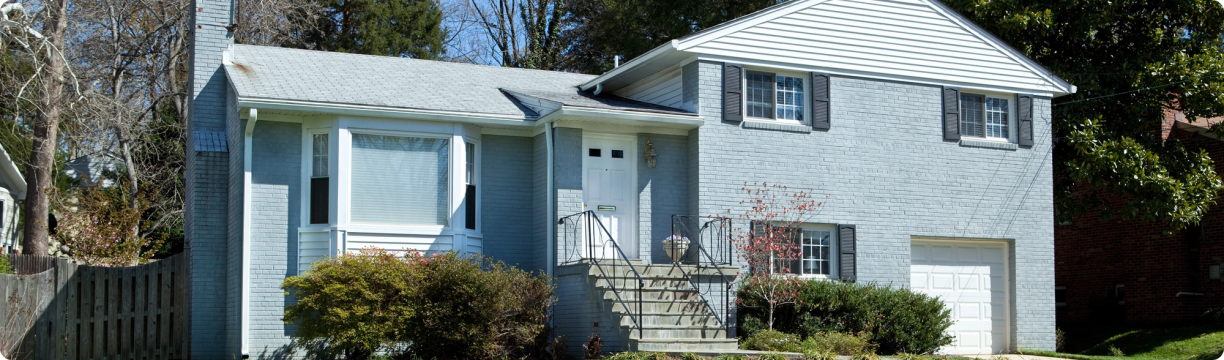
Split-Level Houses in 2026: What the Stairs, the Age, and the Discount Really Cost You


 FACT-CHECKEDFACT-CHECKED
A split-level house stacks its living space across three or more half-floors joined by short staircases, and the price discount these homes carry is no accident. It reflects their age, their layout, and the work most need. This guide treats the split-level as a financing decision, not just a style.
Key Takeaways
- A split-level separates living areas across three or more staggered half-levels, which is what distinguishes it from a two-level bi-level home.
- Most split-levels were built in the mid-twentieth century, so age and deferred maintenance are priced into both the listing and the appraisal.
- The lower asking price on these homes is a risk-adjusted discount, not free money, and the right loan structure decides who actually captures it.
- Renovation mortgages let you borrow against the home's after-repair value, which is the financing tool built for a house that needs work.
- The half-flight staircase that defines the layout is also the feature that affects resale, accessibility, and long-term livability.
- Comparing two loan offers on total cost, not just the headline rate, matters more on an older home where fees and reserves add up.

Why a Split-Level Is a Pricing Question Before It's a Style Question
When you walk through a split-level, the first thing you notice is the layout. A few steps up to the bedrooms, a few steps down to a den or garage, and a kitchen sitting on the level in between. The architecture is the easy part to describe. What most buyers miss is that every feature drawing their eye is also a line item an appraiser, an underwriter, and eventually a future buyer will price. The half-flight staircases, the era the home was built, the mixed foundation under your feet: these are not just design choices. They are the inputs that decide what the home is worth today, what it will cost to bring current, and which loan structure fits.
I've watched the same pattern repeat across three market cycles. A home type falls out of fashion, its price softens relative to comparable square footage, and buyers split into two groups. One group sees a tired house and walks. The other group sees a risk-priced discount and asks the only question that matters: does the price reflect the actual condition, and can I finance the gap between what this home is and what it could be? Fairness in a transaction is not just about the rate you're quoted. It is about understanding the full cost before you sign, and the split-level is one of the clearest places in the market to see that principle at work.
This guide covers what a split-level actually is, the main types you'll encounter, and how it differs from the bi-level it gets confused with, so the plain answer is here if that is all you came for. It then does what most explainers skip. It walks through why these homes are priced the way they are, the financing tools built for a property that needs work, and the long-term cost questions, from energy to accessibility, that should shape your offer. It is the read on a split-level that the AmeriSave team wishes more buyers had before they fell for the price.

What Is a Split-Level House?
A split-level house is a single-family home with living space divided across three or more levels, each separated from the next by a short half-flight of stairs rather than a full staircase. Instead of stacking floors directly on top of each other, the design staggers them, so you're always only a few steps from the level above or below. The middle level usually holds the shared living space, the kitchen and a living or dining room. A half-flight up sits the bedrooms. A half-flight down sits a den, a family room, a garage, or a basement.
The layout was built to solve real problems. Staggering the levels created natural separation between quiet space and active space without the cost of a full second story. It worked well on sloped lots, where the design could follow the grade of the land instead of fighting it. And it made a modest footprint feel larger, because you were never standing in a single open box. You were moving through distinct zones.
One common entry configuration is the split-foyer, where the front door opens onto a landing positioned between two levels. From that landing, one half-flight rises to the main living area and another descends to a lower level. That in-between entry is a signature of the style, though it is not the only way these homes are arranged.
The Main Types of Split-Level Layouts
The category covers several variations, and the differences usually come down to where the levels split. A side-split divides the home left to right: one side rises through two or more half-levels of bedrooms and a lower garage or basement, while the other side stays a single tall story holding the main living space. From the street, the staggered rooflines give it away.
A back-split keeps a flat face toward the road and steps down into multiple levels at the rear, which is why these are often built into hillsides. From the front, the home can look like a single story. From the back, the lower levels are fully exposed. A standard split places the entry on the main level, with stairs running down to a basement or garage and up to the bedrooms. A stacked split takes the idea further, layering four or more half-levels for maximum separation, at the cost of more stairs to climb. And a split-level ranch starts with a ground-level ranch and adds a partial upper level and a lower level off to one side, keeping most of the square footage in the open ranch portion.
The practical takeaway is that no two split-levels live the same way. Before you fall for a listing photo, walk the actual flights of stairs you would climb every day to reach your bedroom, your laundry, and your car.
Split-Level Versus Bi-Level: The Distinction That Trips Up Buyers
These two terms get used interchangeably, and they should not be. Both styles break the home into levels connected by short staircases, so the confusion is understandable. The dividing line is simple: a split-level has three or more levels, while a bi-level has exactly two.
A bi-level, sometimes called a raised ranch, typically has an entry foyer with one set of stairs going up to the main living level and another going down to a lower level that is often partly below grade. There is no true middle level. A split-level inserts that intermediate living zone, which is what produces the staggered, half-flight-at-a-time feel. The difference matters when you read a listing, because the two layouts carry different resale profiles, different renovation challenges, and sometimes different appraisal comparisons. A home marketed as one when it is built like the other can throw off your sense of what you're actually buying, which is why the AmeriSave team encourages buyers to verify the build, not just the listing label.
Why Split-Levels Cost Less, and What That Discount Is Actually Telling You
Here is where most guides stop short. They note that split-levels are often cheaper than comparable square footage and leave it there, as if the lower price were simply good luck for the buyer. It is not luck. It is the market pricing in risk and demand, and reading that price correctly is the difference between a smart purchase and an expensive surprise.


The discount comes from three forces working together. The first is demand. Buyer preference shifted decades ago toward open-concept floor plans, where a kitchen flows into a living and dining space on one continuous level. The compartmentalized, multi-level design of a split-level runs against that preference, and lower demand means a lower clearing price. The second is age. The vast majority of split-levels were built in a roughly two-decade window in the middle of the last century, which means most are now around fifty years old or older. That age tends to come with original systems, dated finishes, and deferred maintenance, all of which a buyer must either accept or pay to update. The third is the layout itself. The same stairs that create privacy also limit the buyer pool, because households with mobility concerns or very young children often screen these homes out.
When you put those forces together, the lower price reads as exactly what it is: a risk-adjusted discount. The market is offering you a lower entry point in exchange for taking on condition risk and a narrower future resale audience. That can be a genuinely good trade. A buyer who understands construction, plans the updates, and finances them correctly can capture real value that move-in-ready buyers leave on the table. The danger is treating the discount as pure savings and discovering the deferred cost after closing. At AmeriSave, the conversations that go well start the same way: with an honest read of what the home needs before anyone falls in love with the price.
Putting Real Numbers on the Renovation Question
The age of these homes makes renovation cost the central financial variable, so it helps to anchor it in current data rather than guesswork. National remodeling figures place the average whole-house remodel for a home of roughly 1,250 to 1,600 square feet at about $52,275, with smaller updates running a few thousand dollars and gut-level projects reaching $190,000 or more. Labor alone typically accounts for 50% to 60% of a project's total. Census Bureau spending data and industry benchmarks compiled by HomeAdvisor put light renovation work in the range of roughly $15 to $60 per square foot, with full structural remodels running well above that.
Split-levels carry their own cost wrinkles on top of those averages. The lower level often has reduced ceiling height, sometimes as low as seven feet, so raising it crosses into major structural work rather than cosmetic updating. The mixed foundation common to the style, a slab under one portion and a crawl space under another, complicates anything that touches the floor system. And the central staircase that anchors the layout limits how freely walls can move if you want a more open feel. None of these are dealbreakers. They are simply costs you want quantified before you write an offer, not discovered during demolition, and AmeriSave encourages buyers to price them with a contractor early.
The Financing Tool Built for a House That Needs Work
This is the part of the split-level story that almost never gets told, and it's the part that decides whether the discount works for you or against you. A standard purchase mortgage finances the home in its current condition. It does not give you a dollar for the kitchen you plan to redo or the lower level you intend to finish. That leaves a buyer paying cash for renovations on top of a down payment, or putting the work on higher-cost credit after closing. For an older home that needs updating, that gap is exactly where budgets break.
Renovation mortgages exist to close that gap, and they work on a principle worth understanding because it changes what you can afford. A renovation loan is underwritten not on what the home is worth today, but on its after-renovation value, the appraised value the property will have once the planned work is complete. The appraisal is done on a subject-to-completion basis, meaning the appraiser values the home as if the renovations are already finished. That single mechanic is what lets you fold the purchase price and the cost of the work into one loan, with one closing and one monthly payment, rather than stitching together separate financing.
Several programs use this structure. The Federal Housing Administration's 203(k) program comes in two forms. The Limited 203(k) is built for smaller, non-structural projects and now allows up to $75,000 in total rehabilitation costs, raised from the prior $35,000 ceiling, with a nine-month window to complete the work. The Standard 203(k) handles larger and structural projects, including the structural work an older split-level may need, with a twelve-month rehabilitation period. On the conventional side, Fannie Mae's HomeStyle Renovation loan finances purchase and renovation together based on as-completed value and, unlike the government-backed options, carries no upfront mortgage insurance premium when your loan-to-value ratio is below 80%. Freddie Mac's CHOICERenovation loan offers a comparable conventional path. For eligible buyers, the Department of Veterans Affairs and the Department of Agriculture both offer renovation options that can finance up to the full as-completed value.
One detail worth checking early is whether your purchase price plus the financed work stays inside the conventional conforming limit, which the Federal Housing Finance Agency sets at $832,750 for a one-unit home in most of the country and as high as $1,249,125 in designated high-cost areas. A split-level priced below comparable updated homes often leaves comfortable room under that ceiling even after you add the renovation, which keeps you in conventional territory rather than the pricier jumbo tier. That headroom is part of what makes these homes work as a financing play, and it's one of the first things the AmeriSave team checks when a buyer is weighing a renovation loan.
A Worked Example of After-Repair Financing
Walk through the math, because the principle is easier to trust once you see it move. Suppose a split-level lists at $280,000 in a market where comparable updated homes sell closer to $360,000. The home needs roughly $60,000 in work: a kitchen update, refinished lower level, and mechanical upgrades. With a standard purchase loan, you finance the $280,000 and then have to find $60,000 for the renovation on your own. With a renovation loan, the lender orders an appraisal on a subject-to-completion basis. If the appraiser confirms an after-renovation value of $360,000, the financing is sized against the completed project, folding the purchase and the $60,000 of work into a single loan, with funds released to contractors as the work passes inspection.
The figures here are illustrative, not a quote, and your actual numbers depend on the property, your credit, and current rates. But the structure is real, and it reframes the decision. The question stops being whether you can afford a house plus a renovation you pay for separately, and becomes whether the after-repair value supports financing the home you actually want. That is the lens that turns a dated split-level from a problem into an opportunity, and it's the structuring the team at AmeriSave walks borrowers through before they commit to a property.
Why You Compare Total Cost, Not Just the Rate
On an older home with renovation financing layered in, the headline interest rate tells you even less than usual. Renovation loans involve additional moving parts, inspection fees, contingency reserves, and sometimes a consultant on larger projects, and those costs vary between lenders. Two offers can show the same rate and carry very different total costs once every fee is counted. The Loan Estimate exists precisely so you can compare those costs side by side, in a standardized format, before you commit.
A quote is only fair when its price reflects the actual risk you bring. If you have strong credit, meaningful savings, and a stable income, your terms should reflect that, and if a quote does not, that is worth asking about. What you should never do is chase the lowest sticker rate without reading the full Loan Estimate, because a cheap rate often comes paired with higher fees or a lender that cannot close smoothly when a renovation timeline gets complicated. Put two estimates next to each other. Compare the total cost of credit, not the number in the largest font. On a transaction with this many parts, that discipline protects the biggest purchase most people ever make. AmeriSave builds its process around that transparency, because an informed borrower makes a better long-term customer than a converted one.
The Stairs Are a Feature and a Long-Term Cost
The defining trait of a split-level, its staircases, deserves an honest look beyond aesthetics, because it shapes both daily livability and long-term value. Half-flights distributed through the home create the privacy and the zoning that fans of the style love. They also mean you're climbing stairs to reach nearly every part of the house, and that has consequences worth weighing before you buy.
Consider the demographic math. A large share of the country's homeowners are aging in place in homes built decades ago, and the data on stairs is sober. Falls are the leading cause of injury-related death among adults 65 and older, with 1 in 4 older adults experiencing a fall each year. The Harvard Joint Center for Housing Studies has documented that much of the existing housing stock lacks basic accessibility features, such as a no-step entry and a full bathroom on the main level, and that retrofitting older homes will be a growing need as the population ages. A split-level, with its multiple half-flights and frequent lack of a true main-level bedroom and bath, sits at the center of that challenge.
This is not a reason to avoid these homes. It's a reason to think past your current stage of life. If you're buying a split-level, consider whether the layout supports a future where stairs become harder, whether a lower or main level could one day hold a bedroom and full bath, and what accessibility updates would cost if you needed them. Some buyers finance those adaptations into a renovation loan upfront, while the home is already a construction project. Thinking about the home you'll need in year fifteen, not just the one you want in year one, is the same risk-aware mindset that should guide the financing.
Should You Buy a Split-Level? A Framework, Not a Verdict
The honest answer is that it depends on your situation, but “it depends” is useless without the variables that drive the decision. Four questions do most of the work.
First, condition and budget. Get a thorough inspection, quantify the cost of the updates the home needs, and decide whether you have the financing structure to handle them. A renovation loan can fold that work into the purchase, but only if you have priced it honestly. Second, layout and life stage. Walk the stairs and picture climbing them daily, and through future stages of life. The privacy that appeals to one household is an obstacle to another. Third, the local market. In areas where these homes are plentiful, you may have negotiating room and a wider selection, while their lower demand can also mean a longer eventual resale. Fourth, the total cost of ownership. Factor in the age-related realities, older systems, potential energy inefficiency in a multi-level envelope, and the updates that keep the home current and competitive when you sell.
If those answers line up, a split-level can be a genuinely smart buy: more home for the money, real character, and a value-add opportunity for a buyer willing to do the work with the right financing behind it. If they do not, the discount is not worth the cost. The point is to decide with the full picture in front of you, which is the only sound way to decide on an asset this large.
The Bottom Line on Split-Level Houses
A split-level house separates living space across three or more half-levels joined by short staircases, and most were built in the middle of the last century, which is why age, condition, and layout shape both the price and the financing. The lower price these homes often carry is a risk-adjusted discount, not free money, and the buyers who do best are the ones who read it that way: they quantify the cost of the work, weigh the staircase against their long-term needs, and use a renovation loan structured on after-repair value to finance the home they actually want. Compare offers on total cost rather than the headline rate, plan for the home you'll need years from now, and the split-level can move from overlooked to opportunity. If you're weighing one, AmeriSave can help you structure financing that fits the home and the work it needs.
FHFA Announces Conforming Loan Limit Values for 2026.
Federal Housing Finance Agency · 2025 · fhfa.gov

FHA Updates 203(k) Rehabilitation Mortgage Insurance Program to Increase Accessibility (Mortgagee Letter 2024-13).
U.S. Department of Housing and Urban Development · 2024 · hud.gov
HomeStyle Renovation Mortgage.
Fannie Mae · 2025 · yourhome.fanniemae.com
How Much Does It Cost to Renovate a House?
Angi · 2026 · angi.com
Older Adult Falls Data.
Centers for Disease Control and Prevention · 2024 · cdc.gov
Aging Society and Inaccessible Housing Stock Suggest Growing Need for Remodeling.
Joint Center for Housing Studies of Harvard University · 2024 · jchs.harvard.edu
VA-Backed Home Loans.
U.S. Department of Veterans Affairs · 2025 · va.gov

Casey brings 28 years of comprehensive mortgage industry experience spanning operations, compliance, and capital markets to AmeriSave. She has led teams across disclosure, compliance, processing, underwriting, and post-closing while navigating three market crashes since 1998, and previously served as Managing Partner at Groundwork Consulting LLC. Based in Texas, specializes in risk mitigation, pricing integrity, and translating complex market dynamics into actionable borrower guidance.
Frequently Asked Questions
A split-level has three or more levels connected by short half-flights of stairs, with a middle living zone between an upper bedroom level and a lower level. A bi-level, sometimes called a raised ranch, has only two levels and no true middle floor. Both use short staircases, which is why they get confused, but the level count is the clear dividing line. The distinction matters when you read a listing, because the two layouts can carry different resale profiles and different appraisal comparisons, and a home marketed as one when it's built like the other changes what you're actually buying. Confirm which one you’re touring, and count the flights you would climb daily, before you anchor on a price.
The lower price reflects three forces working together: weaker buyer demand for compartmentalized layouts compared with open floor plans, the age of these homes since most are roughly fifty years old or older, and a narrower buyer pool because of the stairs. Put together, that is a risk-adjusted discount, the market trading a lower entry price for condition risk and a smaller future resale audience. It can be a real value for a buyer who plans and finances updates correctly, capturing value that move-in-ready buyers leave behind. The savings are genuine only when you have quantified the cost of the work the home needs, with a contractor estimate in hand, rather than treating the discount as money you simply pocket.
Yes, and renovation mortgages are built for exactly this situation. They are underwritten on the home's after-renovation value rather than its current condition, using a subject-to-completion appraisal that values the property as if the work is already done. That mechanic lets you fold the purchase price and the renovation into one loan with a single closing. The FHA's Limited 203(k) allows up to $75,000 in rehabilitation costs with a nine-month completion window, while the Standard 203(k) and conventional options such as Fannie Mae's HomeStyle handle larger and structural projects. For an aging split-level, this structure is often the difference between a dated home becoming a burden and becoming an opportunity you can actually afford.
They can be, for the same reasons they cost less to buy. Lower demand for the compartmentalized layout and the age of most split-levels mean they can sit on the market longer than updated open-concept homes do. Homes that have been well maintained and thoughtfully updated sell more readily and command stronger prices, while those left dated and original tend to draw bargain hunters and slower offers. If resale speed matters to you, factor the cost of keeping the home current into your ownership plan from the start, not as an afterthought when you finally list. The condition you maintain, far more than the style itself, is what drives how the home performs on the market when it's time to sell.
They present real challenges worth weighing honestly. The multiple half-flights mean stairs are unavoidable, and many split-levels lack a full bathroom and a bedroom on the main level, which is exactly what accessible living calls for. Falls are the leading cause of injury-related death among adults 65 and older, with 1 in 4 experiencing a fall each year, so the layout deserves real thought. That said, some buyers adapt these homes by financing accessibility updates, such as a main-level bedroom and bath or a stair lift, into a renovation loan upfront while the home is already a project. Whether a split-level fits depends on its specific layout and your willingness to invest in adaptations.
A renovation mortgage is the tool designed for it, because it finances both the purchase and the improvements based on the home's as-completed value rather than its current state. The FHA 203(k), available in Limited and Standard versions, and conventional options such as Fannie Mae's HomeStyle and Freddie Mac's CHOICERenovation are the common paths, and eligible buyers may also use Department of Veterans Affairs or Department of Agriculture renovation options that can finance up to the full as-completed value. The right fit depends on your credit, your down payment, and the scope of the work. Comparing the total cost of each option on the Loan Estimate, not just the headline rate, is how you choose the loan that actually serves you.