


Buying a House With a Septic System: 10 Things to Check Before You Make an Offer


 FACT-CHECKEDFACT-CHECKED
Buying a house with a septic system is common and entirely financeable; more than one in five U.S. homes rely on one, but it adds a few steps a city buyer skips: a dedicated septic inspection, loan-specific property requirements, and a long-term maintenance budget. Knowing how each one works before you make an offer keeps the right home from slipping away over a fixable issue.
Key Takeaways
- A home with a septic system is common and financeable; it adds steps to your purchase, not roadblocks.
- More than one in five homes in the United States run on a private septic or onsite wastewater system.
- Always add a dedicated septic-inspection contingency to your offer; a standard home inspection doesn't cover the system in depth.
- Government-backed loans (FHA, VA, and USDA) require the system to be functioning, sanitary, and a safe distance from any well, while conventional loans are the most flexible.
- Routine pumping runs about $250 to $500 every three to five years; repairing or replacing a failed system can cost $5,000 to $15,000 or more.
- The drainfield, not the tank, is usually the expensive part to fix, so protect the ground above it.
- Inspection findings are negotiating leverage, not an automatic reason to walk away from the right home.

What Buying a Home With a Septic System Actually Involves
A septic system scares off more buyers than it should. People hear the word, picture a problem buried in the backyard, and start looking for the exit. I'd ask you to slow down before you do that. A home that treats its own wastewater is not a defect. It's a normal feature of living outside the reach of a city sewer line, and it doesn't stand between you and a mortgage.
Here's the part that surprises first-time home buyers most: this setup is everywhere. More than one in five homes in the country rely on a private septic or onsite system, and tens of millions of people live with one every day. In a state like Kentucky, where roughly two in five homes run on septic, a buyer who refuses to consider one has quietly ruled out a large share of the market. These systems are common because, when they're cared for, they work.
So a septic system is not really the question. The question is whether you do three things before you sign. You get the system inspected on its own terms. You make sure the property clears the rules attached to your specific loan. And you budget for the upkeep the way you would for a roof or a furnace. Do those three things and a septic property is just a house. Skip them and you're guessing, which is the one thing I'd never want a buyer doing on the biggest purchase of their life.
The earlier you loop in your loan officer, the smoother this goes. An AmeriSave loan officer can tell you on day one how a private system affects the appraisal path for the loan you're using, and that one conversation often keeps a deal from stalling later. The rest of this comes down to ten checks. None of them is hard. Together they turn a property that felt risky into one you understand.

How a Septic System Works, in Plain Terms
You don't need to be a sanitarian to buy one of these homes, but a little vocabulary makes every later step easier, especially the inspection report, which is written in this language. A septic system has two main parts working together: a buried tank and a drainfield. Everything else is detail hanging off those two.
The tank
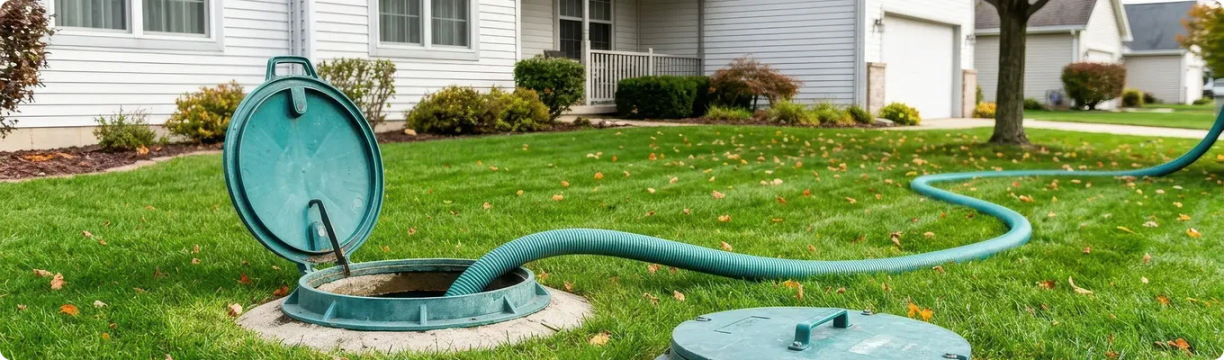
Wastewater from the home, the toilet, the shower, the kitchen sink, the washing machine, all flow into a buried tank, most often concrete. Inside, gravity does the first job. Solids sink to the bottom and form a layer called sludge. Grease and oils float to the top as scum. The clearer liquid in the middle, called effluent, exits toward the drainfield. Because solids keep building up, the tank has to be pumped out on a schedule, which is exactly why “when was it last pumped?” is one of the first questions worth asking a seller.
The drainfield, and why it matters most
The effluent leaves the tank and flows into the drainfield, sometimes called the leach field, a network of buried, perforated pipes spread across a patch of unsaturated soil. The soil does the final cleaning, filtering out bacteria before the water rejoins the groundwater. Pay attention to this part. The tank is repairable, and even replaceable, at a manageable cost. The drainfield is the slow, expensive piece, and most of the worst septic surprises trace back to a field that was overloaded, paved over, or simply worn out. When you walk the property, you're really walking the drainfield.
The words you'll see on an inspection report
A few more terms show up constantly, and recognizing them ahead of time helps the report read like information instead of a foreign language. The distribution box splits the effluent evenly among the drainfield lines. The effluent filter is a screen near the tank outlet that catches solids before they reach the field, and it needs occasional cleaning. Baffles guide flow inside the tank and keep scum from escaping with the effluent. A riser is the access lid that brings the tank opening up near the surface so it can be pumped without digging. That's the whole cast of characters.
Not every system is the same kind
One more distinction matters before you tour anything, because it changes both the upkeep and the price tag. Most homes use a conventional gravity system: a tank, a distribution box, and a drainfield that leans on gravity and good soil to do its work. When the soil drains poorly, the lot is small, or the water table sits high, a home may instead have an alternative or engineered system, a mound built up above the natural soil, an aerobic treatment unit that adds oxygen to break down waste faster, or a setup with a pump that pushes effluent uphill.
The difference reaches a buyer in two plain ways. Alternative systems have more moving parts, so they cost more to keep running and carry components that wear out on a shorter clock. They also often come with a service contract the county expects you to hold. None of that makes them a bad buy. It just means you want to know which kind sits in the ground, so the upkeep budget you build later reflects the real system rather than the simplest version of one.
10 Things to Check Before You Make an Offer
The short version is that buying a septic home is a sequence, not a leap of faith. Here is the sequence I'd walk a member of my own family through, roughly in the order it matters.
1. Confirm the home is really on septic, and find the paperwork
Start by confirming what you're dealing with, because plenty of buyers don't realize a home is on septic until closing is near. The tells include no municipal sewer bill in the seller's records, a small inspection riser or green cap poking out of the lawn, and a strip of grass that stays greener than the rest of the yard. Many of these homes also draw water from a private well, so assume from the start that you may be dealing with both a well and a septic system.
Then go get the records. The county or local health department keeps the original permit and the “as-built” drawing, which show the tank size, the install date, and exactly where the tank and drainfield sit. Ask the seller for the service and pumping history too. A homeowner who kept those receipts is telling you something good about how the system has been treated; a missing paper trail isn't a dealbreaker, but it does raise the value of a careful inspection. Share what you find with your AmeriSave loan officer early, since the system type shapes how the appraisal gets ordered and which inspections your loan will want.
2. Make your offer contingent on a dedicated septic inspection
This is the one I'd circle in red. A standard home inspection looks at the house; it doesn't open the tank, measure the sludge, or test the drainfield. Those are separate jobs done by a septic professional, and your purchase offer should say so in writing. Add a septic-inspection contingency, and, if there's a private well, a water-quality test, that gives you the right to review the results and to renegotiate or walk away if the system is failing. That clause is the difference between a confident purchase and a hopeful one.
A clean, specific offer actually strengthens your position rather than weakening it. When you pair a well-written inspection contingency with an AmeriSave Certified Approval, the seller sees a buyer whose financing is already backed and who simply wants to confirm the property is sound. That reads as serious, not difficult. Most sellers with a healthy system expect the request and have no reason to refuse it.
3. Know what a real septic inspection covers
A thorough inspection is hands-on. The professional locates and opens the tank, measures the sludge and scum layers, checks the baffles and the effluent filter, and looks at the distribution box. Many will run water or a dye test to confirm the drainfield accepts flow without surfacing, and some send a camera through the lines. There's even a rule of thumb for whether a tank is overdue: it generally needs pumping when the scum layer sits within about six inches of the outlet, the sludge is within about a foot of it, or solids fill more than a quarter of the tank.


Ask for the written report and read the recommendations, not just the pass-or-fail line at the top. A note about a filter that needs cleaning is routine housekeeping. A note about effluent surfacing in the yard is a different conversation. If a finding affects financing, your AmeriSave loan officer can tell you what it means for the specific loan you're using, so you're never reading the report alone.
It also helps to know there's more than one depth of inspection. A basic visual check confirms the system exists and shows no obvious failure; a full inspection pumps the tank, measures the layers, and tests the field, and that's the one I'd want on a home I was buying. The buyer usually arranges and pays for it, the same way you'd cover a home inspection, though in a time-of-sale county the seller may already be on the hook to produce a recent report. Sort out early who is ordering what, so two inspectors aren't booked for the same job and so the timing fits inside your contract's deadlines.
4. Match the system to your loan's property requirements
This is where a septic home stops being a home-inspection topic and becomes a financing topic, and it's the step buyers most often miss. Every major loan program wants the same basic thing: a system that functions, disposes of waste safely, and sits a safe distance from any drinking water. The appraiser is the first checkpoint, trained to flag visible failure or surface evidence of a problem even though the appraiser is not a septic engineer.
Where programs differ is how firm a line they draw. Government-backed loans set clear standards. FHA leans on the local health authority and uses baseline separation distances for existing homes, a well at least 50 feet from the tank, at least 100 feet from the drainfield (75 feet where the local authority allows it), and at least 10 feet from the property line, with stricter local rules taking over when they exist. VA loans require the system to be sanitary, functioning, and sized for the home, and call for a water test when there's both a well and a septic system. USDA loans, which are common on rural property, expect a functioning, adequate system and generally follow the same federal distance guidance on existing homes. Conventional loans are the most flexible of the group: they usually require a separate septic inspection only when the appraiser or someone in the deal flags a concern.
I won't pretend to map every program to every property in an article, because the right answer depends on your situation and your goals. That's the loan officer's job, not the article's. AmeriSave offers FHA, VA, USDA, and conventional financing, so the smart move is to put the property in front of a loan officer early and let them point you to the program that clears it with the least friction. A property that's a headache for one loan can be routine for another.
Two more points keep buyers out of trouble here. First, the appraiser and the septic inspector are not the same person doing the same job. The appraiser confirms the property meets the loan's standards and flags visible trouble; the septic inspector opens the system and tells you how it's actually holding up. You generally want both, because each one catches what the other isn't looking for. Second, some homes don't have a system of their own at all, they share a community or cluster system with adjoining properties, or sit on a lot where the drainfield is reached through a recorded easement. Loan programs accept these arrangements, but they want proof of legal access in writing. If the system you're buying lives partly on land you won't own, make sure that paperwork exists before you fall for the house.
5. Budget for the full cost, not just the purchase price
A septic system shifts a cost onto you that city homeowners pay through a utility bill instead, and the trade often comes out in your favor. There's no monthly sewer charge, but there is upkeep you own directly. Plan for routine pumping and inspections, and keep a reserve for the day a component finally wears out.
I've broken the real numbers down in the cost section below, along with a simple way to turn them into a monthly figure you can set aside. An AmeriSave loan officer can help you factor septic upkeep into the bigger affordability picture before you commit, so the number lands in your budget on purpose rather than as a surprise the first time the tank needs service.
6. Walk the drainfield and the land around it
Since the drainfield is the costly piece, give the ground above it real attention during showings. You're looking for soggy or unusually lush patches, standing water, and any sewage odor, all signs the field may be struggling to absorb what the tank sends it. A bright green stripe across an otherwise ordinary lawn can be the field telling on itself.
You also want to know how the field has been treated. A drainfield should never be paved, parked on, or planted with trees, because compaction and roots both wreck it. Roof gutters, downspouts, and sump pumps should send water away from the field, not toward it, since a flooded field can't treat anything. And keep age in mind: a field more than about 25 to 30 years old is into the back half of its life, so age plus any warning sign is worth a closer look from the inspector rather than a shrug.
If you can, get the as-built drawing in hand before you walk the lot, so you know where the field actually sits instead of guessing. Then look at how the land sheds water. A drainfield set at the low point of a yard, collecting everything that runs downhill in a storm, is working against gravity in a way a higher, drier field never has to. You can't move the field, but knowing its position tells you which warning signs to take seriously and where to point the inspector first.
7. Check local time-of-sale rules and county records
Septic rules are local, and they can reach right into your closing timeline and your wallet. Some counties and states run time-of-transfer programs that require an inspection, a pump-out, or even repairs before the title can change hands, and who pays for that is negotiable between you and the seller. Local code may also tie tank size to the number of bedrooms, which matters a great deal if you ever plan to finish a basement or add a room.
The county health department is the authority on all of this, and a quick call before you're deep into the contract beats discovering a requirement after you've committed. Knowing the local rule lets you write the right deadlines into your offer instead of scrambling against them while the clock runs.
8. Don't forget the well if there's no city water
Out where homes run on septic, the water often comes from a private well, and lenders evaluate the two as a pair. Government-backed loans require a water-quality test when a well is present, and FHA also looks for adequate flow, generally on the order of three to five gallons per minute. The well and the tank also have to keep their distance from each other, which loops straight back to those separation rules.
The practical move is to schedule the well-water test in the same window as the septic inspection, so you learn about both at once and protect your timeline instead of stacking one wait on top of another. Your AmeriSave loan officer can confirm exactly which tests your loan requires before you order anything, so you don't pay for a test you didn't need or skip one you did.
9. Build a maintenance habit before you move in
A septic system rewards a little routine and punishes neglect, so it helps to start the habit the day you get the keys rather than the day something backs up. Federal guidance boils care down to four ideas: inspect and pump on schedule, use water efficiently, dispose of waste properly, and protect the drainfield. On schedule means an inspection every one to three years and a pump-out roughly every three to five.
Using water efficiently matters more than people expect, because everything that goes down the drain lands in the same tank. A typical person sends as much as 70 gallons a day into the system, and a single running toilet can add 200 gallons a day on its own. Spread laundry across the week instead of marathon weekend loads, fix leaks quickly, and be honest about what goes down the drain. Grease, wipes, hygiene products, paint, and harsh chemicals all cause problems, and on a septic system, that problem is yours to fix, not the city's.
One myth is easy to retire while you're at it: the tank treatments sold as a way to skip pumping don't replace the real thing. The bacteria your system needs are already there from normal use, and no bottle changes the fact that solids still have to be physically removed on a schedule. Protect the field the same way; keep heavy vehicles, structures, and thirsty tree roots off it, and steer rain runoff away from it. A system that's pumped on time and a field that's left alone to breathe will quietly outlast most of the other equipment in the house.
10. Use the inspection to negotiate
If the inspection turns up trouble, take a breath before you panic. A finding is information, and information is leverage. Get written estimates from licensed contractors so you're negotiating with real numbers instead of a worst-case story in your head. With those in hand, you usually have more than one path forward.
You can ask for a price reduction, have the seller complete the repair before closing, set up a repair escrow that holds back funds until the work is finished, or take a credit at closing. Certain loan programs even allow some repairs to be financed into the purchase, which is one more reason to have your AmeriSave loan officer in the conversation early. A fixable septic issue is rarely a reason to lose a home you love. It's a number to solve for.
Warning Signs Worth Catching Early
Most septic disasters start as small signals that got ignored. Learning the signals protects you twice; once as a buyer touring a property, and again as the owner who wants to catch a problem while it's still cheap to fix. The earlier a system tells you something is wrong, the smaller the bill tends to be.
Inside the home, watch for drains that empty slowly across multiple fixtures at once, gurgling sounds from toilets or sinks, and any sewage smell indoors. Outside, the clues live over the tank and drainfield: standing water or spongy ground, a patch of grass that's greener and faster-growing than everything around it, or an odor in the yard after heavy use. A mechanical system with a pump may also have an alarm; if it's sounding, that's not a nuisance to silence, it's the system asking for help. One of these signs on a home you're touring is a reason to dig into the inspection, not necessarily to walk. The same sign once you own the place is a reason to call a professional that week rather than next season.
It helps to sort what you find into two buckets. A slow drain here, a faint odor there, a filter that needs cleaning; those are maintenance, the ordinary cost of owning the system. Sewage surfacing in the yard, backups into the house, or an alarm that won't reset belong in the other bucket, and they call for a professional now rather than a wait-and-see. The reason the line matters is money: a problem caught in the first bucket usually stays small, while the same problem ignored long enough to reach the second tends to take the drainfield down with it. When you're unsure, a single service call costs far less than the repair you're trying to avoid.
The Real Cost of Owning a Septic System
Numbers calm nerves, so let's put real ones on the table. Septic ownership has two cost tiers: the routine upkeep you can predict and plan around, and the repair or replacement you prepare for but hope to push far into the future.
Routine upkeep is modest
The recurring cost is smaller than most buyers fear. Routine maintenance, a professional pump-out and inspection, runs roughly $250 to $500 every three to five years, with the exact figure depending on tank size and where you live. Cleaning the effluent filter is a minor task in between. For a working system that's treated well, this is the whole story for years at a stretch, and it compares favorably with the monthly sewer bills city homeowners never get to escape.
Repairs and replacement are the real planning targets
The costs that matter are the ones that arrive when a system fails. Repairing or replacing a failed conventional system commonly runs $5,000 to $15,000, and advanced or alternative systems can run higher. The drainfield is usually the priciest single piece, which is exactly why the earlier checks put so much weight on protecting it. A concrete tank itself can last 50 years or more, while the pumps and controls on a mechanical system are typically replaced every 10 to 20 years. None of this is an emergency if you see it coming, and a solid inspection plus a maintenance habit is precisely how you see it coming.
Turning the numbers into a monthly reserve
Here's a simple way to make the cost concrete instead of frightening. Take the routine figure first. A $400 pump-out every four years works out to about $100 a year, or roughly $8 to $9 a month. Now plan for the big one. If you set aside money toward a possible $10,000 replacement spread across, say, 25 years of ownership, that's about $400 a year, or around $33 a month. Add the two together and a realistic septic reserve lands somewhere near $40 to $50 a month. Park that in a separate savings line, and the scary version of septic ownership, the surprise five-figure bill, becomes a planned expense you've already funded. That's the whole difference between owning the system and being owned by it.
What moves the number up or down
A few factors decide where you land inside those ranges, and most of them are knowable before you buy. Tank size and how many people live in the home set how often it needs pumping; a full house on a small tank simply fills it faster. The system type matters too: that conventional gravity setup is the cheapest to keep, while a mound or an aerobic unit costs more and asks for a service contract. Soil and the water table play a quiet role, since a field in poorly draining ground works harder and ages sooner. And local pricing varies, the same way every trade does from one region to the next. You can't control all of these, but you can ask about each one during the inspection, which turns a vague worry into a figure you can actually plan around.
The Bottom Line
A septic system is not a reason to walk away from the right home. It's a set of steps, and every one of them is inside your control. Get the system inspected on its own, not folded into the general home inspection. Match the property to the loan that clears it with the least friction. Budget for the upkeep before you own it, not after something breaks. I can't tell you what the housing market does next, and neither can anyone else. What I can tell you is that buyers who handle those three things rarely regret the septic property, and that the first home you buy is almost never the last one. If a home you love happens to treat its own wastewater, talk to an AmeriSave loan officer, get your Certified Approval in hand, and make the offer with your eyes open.
About Septic Systems.
U.S. Environmental Protection Agency · 2024 · epa.gov

How to Care for Your Septic System.
U.S. Environmental Protection Agency · 2024 · epa.gov
Why Maintain Your Septic System.
U.S. Environmental Protection Agency · 2024 · epa.gov
New Homebuyer's Guide to Septic Systems.
U.S. Environmental Protection Agency · 2017 · epa.gov
Single Family Housing Policy Handbook 4000.1.
U.S. Department of Housing and Urban Development · 2023 · hud.gov
VA Pamphlet 26-7, Lenders Handbook, Chapter 12: Minimum Property Requirements.
U.S. Department of Veterans Affairs · 2024 · benefits.va.gov
Single Family Housing Guaranteed Loan Program Technical Handbook (HB-1-3555).
U.S. Department of Agriculture, Rural Development · 2024 · rd.usda.gov
Selling Guide B4-1.3-04: Site Section of the Appraisal Report.
Fannie Mae · 2024 · selling-guide.fanniemae.com

Carl leads sales operations at AmeriSave, where he has served since August 2015. He holds a BBA in Business Administration & Management from the University of Kentucky and previously served as Director of Sales at Discover Financial Services. Based in Louisville, KY with his family, Carl brings a practical, solution-focused approach to mortgage sales that emphasizes transparency and reducing buyer anxiety.
Frequently Asked Questions
Yes. A private septic system doesn't block a mortgage. More than one in five U.S. homes run on one, and FHA, VA, USDA, and conventional loans all finance them, as long as the system is functioning and meets local health-authority standards. The system simply becomes part of what the appraiser and your lender review. The difference between programs is how closely they look. Conventional loans are the most flexible and usually require a separate septic inspection only if the appraiser or someone in the deal flags a problem. Government-backed loans; FHA, VA, and USDA, hold a firmer line: the system must be sanitary, sized for the home, and a safe distance from any private well. The practical step is to tell your AmeriSave loan officer the home is on septic early, so the right program and the right inspections get lined up before your timeline tightens.
Routine upkeep is modest. A professional pump-out and inspection runs roughly $250 to $500 every three to five years for a typical household system, with cleaning the effluent filter as a minor task in between.
The number you actually plan for is repair or replacement, which commonly runs $5,000 to $15,000 for a conventional system and more for advanced systems. A practical way to budget is to combine the two: a $400 pump-out every four years is about $100 a year, and setting aside money toward a possible $10,000 replacement over 25 years adds roughly $400 a year. Together that's near $40 to $50 a month, a planned expense rather than a shock.
Yes. A standard home inspection doesn't cover the septic system in depth. It won't open the tank, measure the sludge and scum, or test the drainfield. Those are separate jobs for a septic professional, and they're the only way to know what you're actually buying.
Build the protection into your offer with a septic-inspection contingency, and add a water-quality test if the property has a private well. A full inspection opens the tank, measures the layers, checks the filter and distribution box, and confirms the drainfield accepts flow without surfacing. Federal guidance recommends having a system inspected before purchase for exactly this reason. The written report is what lets you buy with confidence, or renegotiate with facts if something turns up.
Picture the worst realistic case: the inspector finds the drainfield is failing and effluent is surfacing in the yard. That's a real repair, not a minor note.
Even then, a failed inspection is a negotiation, not a dead end. Start with written estimates from licensed contractors so you're working with real numbers. From there you usually have several options: ask for a price reduction, have the seller complete the repair before closing, set up a repair escrow that holds funds until the work is done, or take a closing credit. Some loan programs even allow certain repairs to be financed into the purchase, which is worth raising with your AmeriSave loan officer. Replacing a failed system commonly runs $5,000 to $15,000, so the dollars are real, but so are the paths to solving it.
A well-maintained system can serve a home for decades. A concrete tank can last 50 years or more, while a drainfield typically begins to wear after about 25 to 30 years. Mechanical components such as pumps and controls are generally replaced every 10 to 20 years.
Lifespan depends far more on care than on age alone. The tank is the durable part; the drainfield is the piece that eventually wears out, especially if it's been overloaded, paved over, or planted on. When you're buying, the install date on the county's records tells you where a system sits in its life, and the inspection tells you how well it has aged. A 30-year-old system isn't automatically a problem; it's a reason to look closely.
For existing homes, FHA uses baseline separations: a private well at least 50 feet from the septic tank, at least 100 feet from the drainfield, and at least 10 feet from the property line. Stricter local rules take over wherever they exist.
FHA will accept a state or local standard down to 75 feet between the well and drainfield where the local authority allows it. VA and USDA loans defer to local health-department distance standards rather than setting their own, and both expect the system to be functioning and the water to test safe when a well is present. Conventional loans don't impose a federal distance matrix; the appraiser notes whether the setup appears sound. If your lot is tight, your AmeriSave loan officer can tell you early whether a waiver path exists for your situation.